
|
Community Health Systems, Inc. (CYH): Modelo de negócios Canvas [Jan-2025 Atualizado] |
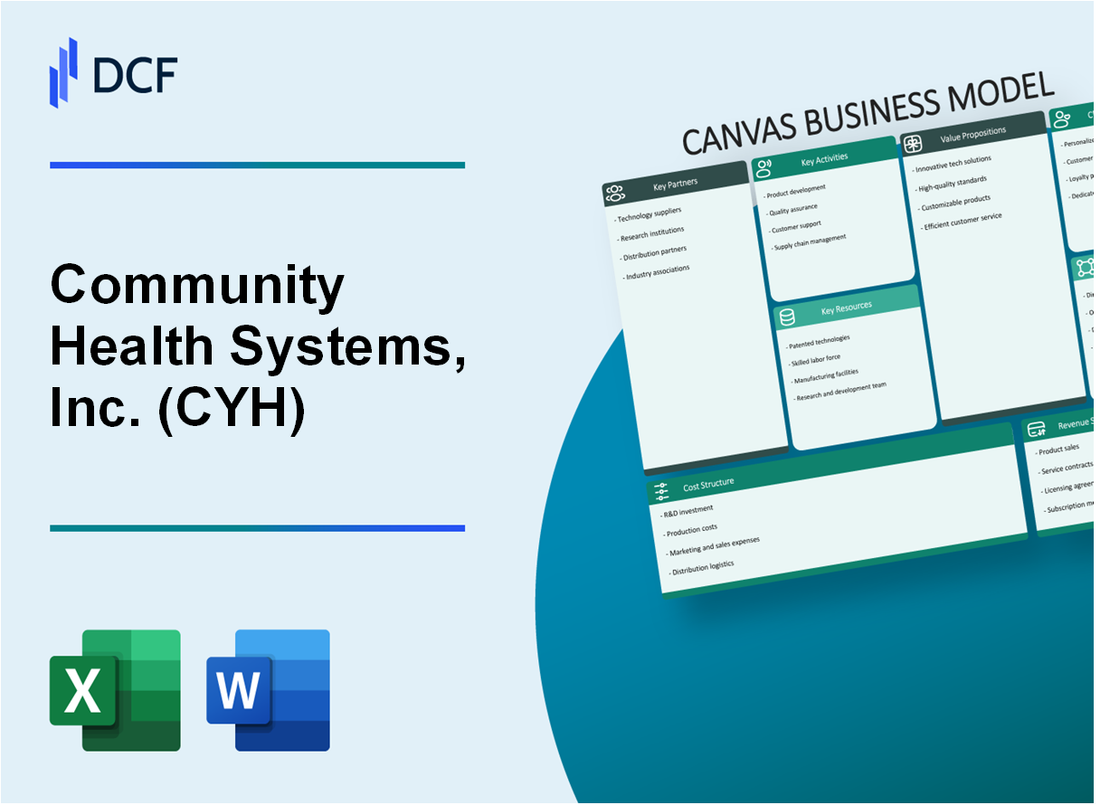
Totalmente Editável: Adapte-Se Às Suas Necessidades No Excel Ou Planilhas
Design Profissional: Modelos Confiáveis E Padrão Da Indústria
Pré-Construídos Para Uso Rápido E Eficiente
Compatível com MAC/PC, totalmente desbloqueado
Não É Necessária Experiência; Fácil De Seguir
Community Health Systems, Inc. (CYH) Bundle
No cenário complexo da prestação de serviços de saúde, a Community Health Systems, Inc. (CYH) surge como uma potência estratégica, transformando como os serviços médicos são conceituados, entregues e experimentados em diversas comunidades. Ao criar meticulosamente um modelo de negócios abrangente que preenche a inovação tecnológica, os cuidados centrados no paciente e as redes regionais expansivas, Cyh se posicionou como um participante fundamental na abordagem de desafios de saúde, particularmente em mercados carentes e rurais, onde o acesso a serviços médicos de qualidade permanece criticamente importante .
Community Health Systems, Inc. (CYH) - Modelo de negócios: Parcerias -chave
Redes hospitalares e prestadores de serviços de saúde
Os sistemas comunitários de saúde opera 84 hospitais afiliados em 16 estados a partir de 2023. Os principais detalhes da parceria incluem:
| Tipo de parceria | Número de instalações | Cobertura geográfica |
|---|---|---|
| Hospitais afiliados | 84 | 16 Estados dos EUA |
| Hospitais de cuidados agudos | 71 | Várias regiões |
Equipamentos médicos e fornecedores de tecnologia
As parcerias de tecnologia estratégica incluem:
- GE Healthcare - Equipamento de imagem médica
- Philips Healthcare - Tecnologia Clínica e de Diagnóstico
- Siemens Healthineers - Dispositivos médicos avançados
Companhias de seguros e organizações de assistência gerenciada
Principais parcerias de seguro a partir de 2023:
| Provedor de seguros | Valor do contrato | Tipo de cobertura |
|---|---|---|
| UnitedHealthcare | US $ 450 milhões | Rede Regional |
| Saúde Aetna/CVS | US $ 325 milhões | Cobertura de vários estados |
Fornecedores de sistemas de registro eletrônico de saúde (EHR)
As parcerias de tecnologia EHR incluem:
- Sistemas EPIC - Plataforma Primária de EHR
- Cerner Corporation - Soluções Suplementares de EHR
- Allscripts - documentação clínica especializada
Distribuidores de suprimentos farmacêuticos e médicos
Principais parcerias de distribuição farmacêutica:
| Distribuidor | Valor anual do contrato | Escopo de serviço |
|---|---|---|
| McKesson Corporation | US $ 775 milhões | Fornecimento médico nacional |
| Amerisourcebergen | US $ 650 milhões | Distribuição farmacêutica |
Community Health Systems, Inc. (CYH) - Modelo de negócios: Atividades -chave
Gerenciamento de instalações hospitalares e médicas
Os sistemas comunitários de saúde gerenciam 84 hospitais em 16 estados a partir de 2023. Capacidade total do leito hospitalar de 13.100 leitos. Admissões anuais de pacientes: 1,9 milhão. Receita operacional para gestão hospitalar: US $ 12,7 bilhões em 2022.
| Métrica | Valor |
|---|---|
| Hospitais totais | 84 |
| Estados operados | 16 |
| Camas de hospitais totais | 13,100 |
| Admissões anuais de pacientes | 1,9 milhão |
Atendimento ao paciente e serviços de tratamento
Volume anual de tratamento do paciente: 3,2 milhões de visitas ambulatoriais. Visitas à sala de emergência: 750.000 anualmente. Procedimentos cirúrgicos realizados: 215.000 por ano.
- Serviços ambulatoriais: 3,2 milhões de visitas
- Visitas à sala de emergência: 750.000
- Procedimentos cirúrgicos: 215.000
Implementação de tecnologia de saúde
Investimento em tecnologia: US $ 187 milhões em 2022 para infraestrutura de saúde digital. Cobertura do sistema eletrônico de registro de saúde (EHR): 100% dos hospitais gerenciados. Plataformas de telemedicina que atendem a 42 hospitais.
| Investimento em tecnologia | Quantia |
|---|---|
| Infraestrutura de saúde digital | US $ 187 milhões |
| Cobertura do sistema EHR | 100% |
| Hospitais de telemedicina | 42 |
Gerenciamento do ciclo de receita
Receita total para 2022: US $ 12,9 bilhões. Despesas operacionais: US $ 11,6 bilhões. Lucro líquido: US $ 348 milhões. Receita média do paciente por hospital: US $ 153,6 milhões.
Aquisições estratégicas e otimização de instalações
Gastos de aquisição em 2022: US $ 276 milhões. Número de instalações otimizadas: 22. Taxa de consolidação hospitalar: 7,3% ano a ano.
| Métrica de aquisição | Valor |
|---|---|
| Gastos com aquisição | US $ 276 milhões |
| Instalações otimizadas | 22 |
| Taxa de consolidação hospitalar | 7.3% |
Community Health Systems, Inc. (CYH) - Modelo de negócios: Recursos -chave
Extensa rede de hospitais e centros médicos
A partir do quarto trimestre de 2023, os sistemas comunitários de saúde opera 84 campus hospitalares em 16 estados. Total de camas licenciadas: 12.400. Distribuição geográfica:
| Região | Número de hospitais | Total de camas |
|---|---|---|
| Estados do sul | 52 | 7,600 |
| Estados do Centro -Oeste | 22 | 3,900 |
| Outras regiões | 10 | 900 |
Profissionais de saúde qualificados e equipe médica
Força de trabalho total a partir de 2023:
- Total de funcionários: 47.000
- Médicos: 6.200
- Enfermeiros registrados: 15.300
- Equipe administrativo: 12.500
- Pessoal de apoio: 13.000
Tecnologia Médica Avançada e Equipamento
Despesas de capital para tecnologia médica em 2023: US $ 287 milhões
| Categoria de tecnologia | Valor do investimento |
|---|---|
| Equipamento de diagnóstico | US $ 112 milhões |
| Tecnologias cirúrgicas | US $ 95 milhões |
| Sistemas de saúde digital | US $ 80 milhões |
Sistemas robustos de informação de saúde
Detalhes da infraestrutura de tecnologia:
- Cobertura do sistema eletrônico de registro de saúde (EHR): 100% dos hospitais
- Investimento anual de infraestrutura de TI: US $ 65 milhões
- Orçamento de segurança cibernética: US $ 22 milhões
Capital financeiro para expansão e modernização
Recursos Financeiros a partir de 2023:
| Métrica financeira | Quantia |
|---|---|
| Total de ativos | US $ 16,4 bilhões |
| Caixa e equivalentes de dinheiro | US $ 742 milhões |
| Dívida total | US $ 12,6 bilhões |
| Gastos anuais de capital | US $ 387 milhões |
Community Health Systems, Inc. (CYH) - Modelo de negócios: proposições de valor
Serviços abrangentes de saúde em várias regiões
Os sistemas comunitários de saúde opera 84 hospitais afiliados em 16 estados a partir de 2023. A contagem total do hospital representa 13.000 camas licenciadas com admissões anuais de pacientes de aproximadamente 1,6 milhão de pacientes.
| Cobertura geográfica | Contagem de hospitais | Camas licenciadas | Admissões anuais |
|---|---|---|---|
| 16 Estados dos EUA | 84 hospitais | 13,000 | 1,6 milhão |
Cuidados médicos acessíveis e acessíveis
2023 Dados financeiros indicam uma receita média de serviço do paciente de US $ 13,2 bilhões com receita líquida de pacientes de US $ 11,5 bilhões.
- Receita média do serviço do paciente: US $ 13,2 bilhões
- Receitas líquidas de pacientes: US $ 11,5 bilhões
- CARIDADE DE CARITORIA DUSTRA: US $ 482 milhões
Tratamento e resultados de paciente de alta qualidade
As métricas de qualidade demonstram o desempenho do atendimento ao paciente em vários indicadores clínicos.
| Métrica clínica | Taxa de desempenho |
|---|---|
| Pontuação de satisfação do paciente | 87.4% |
| Redução da condição adquirida em hospital | 15.6% |
Soluções integradas de tecnologia de saúde
O investimento em tecnologia em 2023 totalizou US $ 287 milhões, com foco em registros eletrônicos de saúde e plataformas de telemedicina.
- Investimento de tecnologia: US $ 287 milhões
- Interações de telemedicina: 2,3 milhões
- Cobertura eletrônica de registros de saúde: 100% dos hospitais afiliados
Serviços médicos especializados em áreas rurais e carentes
Os sistemas comunitários de saúde atendem a 35 municípios rurais com programas médicos especializados.
| Métricas de Serviço Rural | Números |
|---|---|
| Condados rurais serviram | 35 |
| Locais do hospital rural | 42 |
| Interações rurais do paciente | 512.000 anualmente |
Community Health Systems, Inc. (CYH) - Modelo de Negócios: Relacionamentos do Cliente
Abordagem de cuidados centrada no paciente
Os sistemas comunitários de saúde opera 84 hospitais em 16 estados a partir de 2023. As pontuações de satisfação do paciente tiveram uma média de 73,4% em sua rede de saúde.
| Métrica de interação do paciente | Desempenho anual |
|---|---|
| Tempo médio de envolvimento do paciente | 47 minutos por encontro do paciente |
| Taxa de retenção de pacientes | 68.2% |
Portais de pacientes digitais e plataformas de comunicação
Estatísticas de uso da plataforma digital para 2023:
- Usuários on -line de portal de pacientes: 2,3 milhões
- Downloads de aplicativos móveis: 1,7 milhão
- Consultas de telessaúde: 425.000 sessões anuais
Programas personalizados de gestão de saúde
Dados de inscrição para o programa de saúde personalizados:
| Tipo de programa | Números de inscrição |
|---|---|
| Gerenciamento de doenças crônicas | 186.000 pacientes |
| Programas de cuidados preventivos | 214.500 participantes |
Suporte ao cliente e serviços de defesa do paciente
Métricas de suporte ao paciente para 2023:
- 24/7 de suporte ao paciente center: 2,1 milhões de interações anuais
- Tempo médio de resposta: 12 minutos
- Tamanho da equipe de defesa do paciente: 285 profissionais dedicados
Monitoramento contínuo de saúde e atendimento de acompanhamento
Estatísticas de acompanhamento e monitoramento:
| Serviço de monitoramento | Desempenho anual |
|---|---|
| Pacientes de monitoramento remoto de pacientes | 97,000 |
| Taxa de acompanhamento pós-alta | 82.3% |
Community Health Systems, Inc. (CYH) - Modelo de Negócios: Canais
Hospital Físico e Instalações Médicas
A partir de 2024, os sistemas comunitários de saúde opera 130 hospitais afiliados em 19 estados. Capacidade total do leito hospitalar: 19.500 camas. Admissões anuais de pacientes: 1,2 milhão.
| Presença do estado | Número de hospitais | Capacidade total da cama |
|---|---|---|
| Tennessee | 22 | 3.400 camas |
| Alabama | 15 | 2.800 camas |
| Georgia | 18 | 3.100 camas |
Plataformas de telemedicina
Consultas de saúde digital: 450.000 visitas virtuais anuais. Crescimento do uso da plataforma: 37% ano a ano.
- Duração média da consulta de telemedicina: 18 minutos
- Especialidades cobertas: 24 disciplinas médicas
- Disponibilidade da plataforma: acesso 24/7
Portais de pacientes online
Usuários ativos do portal do paciente: 1,1 milhão. Taxa de acesso ao registro de saúde digital: 82%.
| Recurso do portal | Taxa de utilização |
|---|---|
| Agendamento de compromissos | 68% |
| Reabastecimento de prescrição | 55% |
| Pagamento da conta médica | 47% |
Aplicativos de saúde móvel
Downloads de aplicativos móveis: 750.000. Usuários ativos mensais: 320.000.
- Compatibilidade para iOS e Android
- Certificação de conformidade HIPAA
- Recursos de rastreamento de saúde em tempo real
Programas diretos de marketing e divulgação comunitária
Triações anuais de saúde comunitária: 85.000. Participantes do Programa de Bem -Estar: 210.000.
| Programa de divulgação | Alcance anual | Demografia alvo |
|---|---|---|
| Triagem de diabetes | 35,000 | Adultos 40-65 |
| Saúde Cardiovascular | 25,000 | Adultos 50-75 |
| Prevenção do câncer | 25,000 | Adultos 45-70 |
Community Health Systems, Inc. (CYH) - Modelo de negócios: segmentos de clientes
Comunidades rurais e suburbanas
A partir de 2022, a Community Health Systems opera 84 hospitais afiliados em 16 estados, atendendo principalmente mercados rurais e suburbanos. O portfólio hospitalar da empresa cobre aproximadamente 11,4 milhões de pessoas nessas comunidades.
| Segmento geográfico | Número de hospitais | População servida |
|---|---|---|
| Mercados rurais | 56 | 7,2 milhões |
| Mercados suburbanos | 28 | 4,2 milhões |
Populações sem seguro e com seguro insuficiente
Em 2022, Cyh relatou servir uma parcela significativa de pacientes sem seguro e com seguro insuficiente:
- Pacientes não segurados: 12,3% da população total de pacientes
- Pacientes com seguro insuficiente: 18,7% da população total de pacientes
- Total não seguro/sub -seguro: 31% da base de pacientes
Pacientes com doenças crônicas
Os sistemas comunitários de saúde têm como alvo o gerenciamento crônico de doenças em várias especialidades:
| Categoria de doenças crônicas | Volume do paciente |
|---|---|
| Gerenciamento de diabetes | 275.000 pacientes |
| Doenças cardiovasculares | 412.000 pacientes |
| Doenças respiratórias | 189.000 pacientes |
Populações idosas e envelhecidas
A demografia dos pacientes de Cyh para populações idosas em 2022:
- Pacientes do Medicare: 42,6% da base total de pacientes
- Pacientes com mais de 65 anos: 36,4% das admissões hospitalares
- Serviços de especialidade geriátrica: Disponível em 72 hospitais
Mercados de saúde locais e regionais
Penetração de mercado e cobertura de serviço para Cyh em 2022:
| Segmento de mercado | Quota de mercado | Número de condados servidos |
|---|---|---|
| Mercados locais | 23.5% | 214 municípios |
| Mercados regionais | 15.8% | 16 estados |
Community Health Systems, Inc. (CYH) - Modelo de negócios: estrutura de custos
Salários da equipe médica e compensação
A partir de 2023, o relatório anual, os sistemas comunitários de saúde relataram uma remuneração total dos funcionários de US $ 3,96 bilhões. O colapso inclui:
| Categoria de funcionários | Remuneração anual |
|---|---|
| Médicos | US $ 1,42 bilhão |
| Equipe de enfermagem | US $ 1,28 bilhão |
| Pessoal administrativo | US $ 680 milhões |
| Equipe de apoio | US $ 560 milhões |
Manutenção e operações da instalação hospitalar
As despesas relacionadas à instalação para 2023 totalizaram US $ 892 milhões, que incluíram:
- Utilitários: US $ 214 milhões
- Manutenção de edifícios: US $ 328 milhões
- Reparos da instalação: US $ 186 milhões
- Limpeza e saneamento: US $ 164 milhões
Equipamentos médicos e investimentos em tecnologia
Os gastos com tecnologia e equipamentos em 2023 foram de US $ 512 milhões, distribuídos da seguinte forma:
| Categoria de equipamento | Investimento |
|---|---|
| Equipamento de diagnóstico | US $ 218 milhões |
| Tecnologias cirúrgicas | US $ 164 milhões |
| Infraestrutura de TI | US $ 130 milhões |
Conformidade em saúde e despesas regulatórias
Os custos relacionados à conformidade para 2023 totalizaram US $ 276 milhões, incluindo:
- Relatórios regulatórios: US $ 98 milhões
- Conformidade legal: US $ 82 milhões
- Garantia de qualidade: US $ 96 milhões
Custos de marketing e aquisição de pacientes
As despesas de marketing para 2023 totalizaram US $ 187 milhões, com a seguinte alocação:
| Canal de marketing | Gastos |
|---|---|
| Marketing digital | US $ 76 milhões |
| Publicidade tradicional | US $ 58 milhões |
| Alcance da comunidade | US $ 53 milhões |
Community Health Systems, Inc. (CYH) - Modelo de negócios: fluxos de receita
Receita de serviço do paciente
Para o ano fiscal de 2023, os sistemas comunitários de saúde reportaram receitas líquidas totais de US $ 11,6 bilhões, com as receitas do serviço do paciente compreendendo a fonte de renda primária.
| Categoria de receita | Valor (2023) |
|---|---|
| Receita total de pacientes líquidos | US $ 11,6 bilhões |
| Serviços de internação | US $ 7,2 bilhões |
| Serviços ambulatoriais | US $ 4,4 bilhões |
Reembolsos de seguros
Os reembolsos de seguros representam um fluxo crítico de receita, representando aproximadamente 65% do total de receitas de serviço do paciente.
- Reembolsos de seguro comercial: US $ 5,1 bilhões
- Pagamentos privados de seguro de saúde: US $ 3,8 bilhões
- Pagamentos da organização de cuidados gerenciados: US $ 2,3 bilhões
Pagamentos do Medicare e Medicaid
Os reembolsos do Programa de Saúde do Governo constituem uma parcela significativa da estrutura de receita de Cyh.
| Programa | Valor da receita (2023) | Porcentagem da receita total |
|---|---|---|
| Pagamentos do Medicare | US $ 2,9 bilhões | 25% |
| Pagamentos do Medicaid | US $ 1,7 bilhão | 15% |
Taxas de serviço ambulatorial e hospitalar
O CYH gera receita através de diversas estruturas de taxas de serviço em vários modelos de prestação de serviços de saúde.
- Taxa média de serviço hospitalar: US $ 15.200 por admissão
- Taxa média de serviço ambulatorial: US $ 3.750 por visita
- Taxa de visita do departamento de emergência: US $ 1.850 por encontro
Serviços de saúde auxiliares e tratamentos especializados
Os serviços suplementares contribuem com fluxos de receita adicionais para sistemas comunitários de saúde.
| Serviço auxiliar | Receita anual |
|---|---|
| Diagnóstico imagens | US $ 620 milhões |
| Serviços de laboratório | US $ 450 milhões |
| Programas de tratamento especializados | US $ 380 milhões |
Community Health Systems, Inc. (CYH) - Canvas Business Model: Value Propositions
You're looking at Community Health Systems, Inc. (CYH) and trying to map out exactly what they promise their customers-the patients and communities-in return for their business. Honestly, the value proposition is built on scale and local presence, which is why they keep refining their portfolio through divestitures to focus on the best markets.
The core promise is delivering accessible, high-quality, comprehensive healthcare in local markets. This isn't about being the biggest nationally anymore; it's about being the essential provider where they choose to operate. For the nine months ended September 30, 2025, their consolidated net operating revenues were $9.379 billion, showing the sheer volume of care delivered across their footprint. Their full-year 2025 projection for net operating revenues sits between $12.4 billion and $12.6 billion.
This accessibility is supported by a physical footprint that, as of the latest reports following Q3 2025, includes:
- Operating 69 affiliated hospitals across 14 states.
- Maintaining over 10,000 beds across those hospitals.
- Operating more than 1,000 sites of care.
Here's a quick look at the scale of their acute care delivery system as of late 2025:
| Facility Type | Count (Late 2025 Estimate) | Metric Detail |
|---|---|---|
| Affiliated Hospitals | 69 | Owned or leased facilities |
| Hospital Beds | Over 10,000 | Total licensed beds across the system |
| Total Sites of Care | Over 1,000 | Includes all non-hospital locations |
| Same-Store Admissions Growth (YoY Q3 2025) | 1.3% | Indicates local market demand for core services |
The value proposition includes offering full-service acute care, emergency, and specialty surgical services. You see this reflected in their same-store operational performance. For the third quarter of 2025, same-store net operating revenue grew by 6.0% year-over-year, driven by a 5.6% increase in net revenue per adjusted admission. This pricing power and volume growth in their retained core assets is what management is betting on, even as they shed assets to improve leverage; their Net Debt-to-Adjusted EBITDA improved to 6.7x at Q3 2025.
Community Health Systems, Inc. (CYH) also promises an extensive outpatient network, which is key because healthcare shifts away from inpatient stays. This network includes the other sites of care mentioned, such as ambulatory surgery centers (ASCs), urgent care centers, and imaging centers. This diversification captures revenue from less acute, often higher-margin, procedures. The focus on clinical excellence is supported by their profitability metrics; for Q3 2025, Adjusted EBITDA reached $376 million, yielding an Adjusted EBITDA margin of 12.2%, a 100 basis point expansion year-over-year.
Finally, the entire model is framed around a patient-centric care model focused on clinical excellence. While quality scores aren't in the financial reports, the operational data suggests a focus on revenue quality. For instance, total consolidated uncompensated care as a percentage of adjusted net revenue improved to 25.2% in Q3 2025, down from 28.0% in Q3 2024, which suggests better management of the revenue cycle and patient financial responsibility. The company is projecting a full-year 2025 Adjusted EBITDA between $1.5 billion and $1.55 billion, which is the financial translation of delivering on these value promises efficiently.
Finance: draft the 2026 capital expenditure plan focusing on ASC expansion by Friday.
Community Health Systems, Inc. (CYH) - Canvas Business Model: Customer Relationships
Direct service delivery through employed and affiliated physicians.
Community Health Systems, Inc. affiliates operate across a broad footprint, supporting relationships with a large base of clinical providers. As of late 2025, the Company's subsidiaries own or lease 69 affiliated hospitals and operate more than 1,000 sites of care. These sites include physician practices, urgent care centers, and ambulatory surgery centers, which are key touchpoints for direct service delivery. The total volume of patient interaction is substantial; the 2025 Community Impact Report noted more than 14.7 million patient encounters across these locations. The clinical workforce supporting these relationships is significant, with more than 57,000 caregivers and colleagues working daily. Specifically regarding physician alignment, as of September 30, 2025, Community Health Systems, Inc. had approximately 160 more employee physicians and APPs (Advanced Practice Providers) in their clinics compared to the prior year.
Patient-centric care programs and satisfaction monitoring.
The relationship is actively managed through a focus on quality and experience metrics. One of the foundational strategic priorities for 2025 was emphasizing High-Quality Care and Patient Outcomes. The Company gathers direct feedback through a Patient Satisfaction Survey to ensure needs are met and services are improved. Leadership discussions in late 2025 confirmed an ongoing commitment to investments in quality, specifically mentioning the goal of improving both physician and patient experience.
Community engagement and local health system integration.
Community Health Systems, Inc. positions itself as a local healthcare leader, operating in 36 distinct markets across 14 states. This local integration is supported by significant financial commitment to the communities served. The 2025 Community Impact Report detailed substantial uncompensated care provided, totaling $1.2 billion in charity care, uninsured discounts, and other uncompensated care. Furthermore, the Company spent $360 million on capital investments to expand access, enhance services, and modernize facilities in 2025.
Here's a quick look at the scale of the 2025 community investment and operational footprint:
| Metric | Amount/Count |
| Total Patient Encounters (2025 Report) | More than 14.7 million |
| Charity Care & Uncompensated Care (2025 Report) | $1.2 billion |
| Capital Investments (2025 Report) | $360 million |
| Total Sites of Care | More than 1,000 |
| Affiliated Hospitals Owned/Leased | 69 |
Digital tools for patient monitoring and chronic condition management.
The relationship extends into the digital realm through ongoing innovation. Community Health Systems, Inc. continues to invest in technologies that advance patient care. These investments include emerging technologies like AI and the expansion of telehealth and virtual care capabilities, which are now part of everyday practice for earlier diagnoses and better treatment options.
- Focus on innovation including AI.
- Investment in telehealth and virtual care.
- Goal to relieve administrative burden for caregivers.
Community Health Systems, Inc. (CYH) - Canvas Business Model: Channels
You're looking at how Community Health Systems, Inc. gets its services to patients across its markets. This is all about the physical and virtual locations where care is delivered, and as of late 2025, the focus is clearly shifting toward outpatient access points, even while maintaining a core hospital base.
Community Health Systems, Inc. operates across 14 states in 36 distinct markets as of July 2025. The delivery system is a mix of large acute care anchors and a growing network of specialized, lower-cost sites of care.
The scale of the physical footprint is substantial, but the strategic direction shows a clear push into ambulatory settings. Here's a breakdown of the key channel components:
| Channel Component | Count/Metric | Data Source/Context |
| Affiliated Acute Care Hospitals (Owned or Leased) | 70 | As of July 23, 2025 |
| Hospital Beds | More than 10,000 | As of July 2025 |
| Total Sites of Care | More than 1,000 | As of July 2025 |
| Ambulatory Surgery Centers (ASCs) - Baseline | 47 | Total at the end of 2024 |
| ASCs Planned for 2025 Opening | Between 6 and 8 | Plan for 2025 |
| Freestanding Emergency Departments (EDs) - Annual Pace | Opening 3 to 4 per year | Annual pace of development |
The strategy involves balancing the necessary acute care services with these more flexible outpatient options. The company is actively investing capital into these access points because they are lower dollar investments that allow for greater expansion for the same capital outlay.
The distribution and growth of these outpatient channels are critical to the near-term strategy:
- Affiliated acute care hospitals.
- Over 40 Ambulatory Surgery Centers (ASCs).
- Freestanding emergency departments and urgent care centers.
- Physician practices and occupational medicine clinics.
Community Health Systems, Inc. is seeing growth in its ASC segment, with same-store ASC cases increasing 14% in the prior year. The company also completed the acquisition of 10 urgent care clinics in Tucson, Arizona, in late 2024 to bolster its primary and urgent care funnel.
The overall patient reach through these channels is significant, with the company reporting more than 14.7 million patient encounters across its sites of care in its 2025 Community Impact Report. This shows the sheer volume Community Health Systems, Inc. handles through its diverse network.
You can see the strategic shift in capital allocation; as CEO Kavin Hammons noted, more dollars in 2025 and moving into 2026 will focus on these access points like ASCs, urgent care, and freestanding EDs. Finance: draft the capital expenditure allocation breakdown for H2 2025 by next Tuesday.
Community Health Systems, Inc. (CYH) - Canvas Business Model: Customer Segments
You're looking at the core patient base for Community Health Systems, Inc. (CYH) as of late 2025. This company's model is built around serving specific geographic and demographic pockets across the United States. Honestly, the numbers tell you exactly where they focus their efforts.
Patients in rural and non-urban suburban communities.
Community Health Systems, Inc. maintains a significant presence in these areas, a focus dating back to its founding in 1985. As of mid-2025, the company's subsidiaries own or lease 70 affiliated hospitals with more than 10,000 beds across 14 states. The business model centers on acquiring and managing hospitals primarily in non-urban markets. The company operates more than 1,000 sites of care in total, which includes physician practices and urgent care centers supporting these communities.
Commercial insurance beneficiaries.
These patients represent a key source of revenue, with rate growth from commercial plans contributing to revenue per adjusted admission increases in early 2025. For the three months ended September 30, 2025, net operating revenues totaled $3.087 billion. The company was encouraged by some improvement in payer mix on both a sequential and year-over-year basis in Q3 2025.
Medicare and Medicaid patients (government programs).
Government programs make up a substantial portion of the patient base, but they bring specific financial pressures. For instance, in late 2023, Medicare (including FFS and Advantage) accounted for roughly 35.8% of net patient revenues, while Medicaid was about 14.8%. A noted trend is the shift from Medicare Fee-for-Service (FFS) into Medicare Advantage, which typically pressures revenue because less is collected on MA compared to traditional FFS. Furthermore, declining Medicaid rates were cited as a factor partially offsetting revenue gains in Q1 2025. The company did benefit from incremental state-directed payments from New Mexico and Tennessee when compared to the prior year in Q3 2025.
Uninsured and underinsured populations (charity care provided).
Community Health Systems, Inc. provides significant financial assistance to those unable to pay. In its 2025 Community Impact Report, the company highlighted that it provided $1.2 billion in charity care, uninsured discounts, and other uncompensated care. This demonstrates a commitment to serving the underinsured segment within its operating markets.
Here's a look at the most detailed payer mix breakdown available, which reflects net patient revenues for the third quarter ended September 30, 2023, to give you a concrete sense of the revenue mix:
| Payer Category | Net Patient Revenue (Q3 2023) | Percentage of Net Patient Revenue (Q3 2023) |
| Commercial | $1.5 billion | 47.9% |
| Medicare | $608 million | 19.7% |
| Medicare Advantage | $498 million | 16.1% |
| Medicaid | $456 million | 14.8% |
| Self-pay | $45 million | 1.5% |
You can see that commercial plans were the largest single segment, but government programs combined account for a very large piece of the pie. Finance: draft the 13-week cash flow view by Friday.
Community Health Systems, Inc. (CYH) - Canvas Business Model: Cost Structure
You're looking at the core expenses that drive Community Health Systems, Inc.'s operations as of late 2025. Honestly, for a hospital operator, the cost structure is dominated by people and the tools they use.
Labor is a massive component. For the second quarter of 2025, the average hourly wage rate saw an approximate 4% year-over-year increase, which was consistent with their expected growth range for the year. This increase, coupled with the growth in the number of employee positions, definitely puts pressure on margins. To be fair, contract labor expense was down year-over-year on a consolidated basis in Q2 2025.
Then there's the debt load. Community Health Systems, Inc. carries significant interest expense, which is a direct result of its leverage. As of September 2025, the reported long-term debt stood at approximately $10.6 billion. This figure reflects recent refinancing activities, such as the August 2025 offering of new notes to redeem older ones.
Medical specialist fees remain a persistent cost headwind. In the third quarter of 2025, these fees totaled $165 million, representing 5.4% of net revenue when excluding a specific legal settlement. Management expects continued upward pressure here, especially in radiology.
Here's a quick look at some of the key cost figures we have for the recent periods:
| Cost Category | Period/Context | Reported Amount/Metric |
| Labor Cost Increase (Avg Hourly Rate) | Q2 2025 Year-over-Year | 4% |
| Medical Specialist Fees | Q3 2025 | $165 million |
| Long-Term Debt | September 2025 | $10.6 billion |
| Supplies Expense as % of Net Revenue | Q3 2025 (Excluding settlement) | 15.0% (down 20 basis points year-over-year) |
| Total Operating Expenses | Q1 2025 | $2.8 billion |
You also have to factor in the ongoing need for capital investment. Community Health Systems, Inc. allocates funds for capital expenditures specifically targeted at facility modernization and technology upgrades. While a precise quarterly number for this category isn't always broken out in the same way as labor or fees, it's a necessary, non-negotiable outlay for maintaining competitive infrastructure.
Finally, supplies and pharmaceutical costs are a constant drain. For the nine months ended September 30, 2025, the company was focused on controlling these expenses, noting that supplies expense was down year-over-year in Q3 2025.
The key cost drivers you need to watch are:
- Labor Costs: Driven by wage inflation and staffing levels.
- Interest Expense: Tied directly to the $10.6 billion in outstanding debt.
- Medical Specialist Fees: A line item that hit $165 million in Q3 2025.
- Supplies & Pharma: Managed to keep the percentage of revenue low, at 15.0% in Q3 2025.
- Capital Expenditures: Necessary spending for facility and tech modernization.
Finance: draft 13-week cash view by Friday.
Community Health Systems, Inc. (CYH) - Canvas Business Model: Revenue Streams
The revenue streams for Community Health Systems, Inc. (CYH) are fundamentally tied to the delivery of acute care hospital services and related outpatient services across its network. Management has provided clear financial targets for the full fiscal year 2025, reflecting a strategy focused on operational efficiency and balance sheet improvement alongside top-line performance.
The company projects its consolidated Net Operating Revenues for the full 2025 fiscal year to be in the range of $12.4 billion and $12.6 billion. This projection was tightened following the third-quarter 2025 results. Furthermore, the guidance for Adjusted EBITDA for the full year 2025 has been tightened to a range of $1.50 billion to $1.55 billion. This focus on profitability is central to the current strategy. For context on the recent performance driving this guidance, here are the key financial targets:
| Metric | Full-Year 2025 Guidance/Figure |
| Projected Net Operating Revenues | $12.4 billion to $12.6 billion |
| Tightened Adjusted EBITDA Guidance | $1.50 billion to $1.55 billion |
| Q3 2025 Adjusted EBITDA | $376 million |
| Q3 2025 Adjusted EBITDA Margin | 12.2% |
The core of the revenue generation comes from patient service revenue. This is derived from treating patients across the spectrum of care, which is segmented by the source of payment. You see revenue flowing from both commercial payers and government programs, which include Medicare and Medicaid. For the first quarter of 2025, the payer mix breakdown of net revenue showed:
- Medicare and Medicare Managed Care: 46.5% of net revenue in Q1 2025.
- Medicaid: 19.1% of net revenue in Q1 2025.
- Self-pay: 0.6% of net revenue in Q1 2025.
The company also benefits significantly from non-patient revenue sources, including supplemental reimbursement programs. Specifically, revenue recognition under new state-directed payment (SDP) programs in New Mexico and Tennessee has been a driver of same-store net revenue growth. The potential EBITDA contribution from these new SDPs was previously estimated to be between $100 million and $125 million if approved. Also contributing to non-patient revenue are one-time items, such as a legal settlement recognized in Q3 2025 amounting to $28 million.
A third, non-operational, but important, cash-generating stream is the proceeds from strategic hospital and asset divestitures. Community Health Systems, Inc. has been actively selling assets to reduce debt. The company generated over $1 billion in divestiture proceeds so far in 2025 from sales including ShorePoint Health System, Lake Norman Regional Medical Center, and Merit Health Biloxi, with Cedar Park closing soon. Further bolstering liquidity, the company signed a deal in July 2025 to sell selected assets of its ambulatory outreach lab services to Labcorp for proceeds of approximately $195 million, expected to close later in the quarter.
Finance: draft 13-week cash view by Friday.
Disclaimer
All information, articles, and product details provided on this website are for general informational and educational purposes only. We do not claim any ownership over, nor do we intend to infringe upon, any trademarks, copyrights, logos, brand names, or other intellectual property mentioned or depicted on this site. Such intellectual property remains the property of its respective owners, and any references here are made solely for identification or informational purposes, without implying any affiliation, endorsement, or partnership.
We make no representations or warranties, express or implied, regarding the accuracy, completeness, or suitability of any content or products presented. Nothing on this website should be construed as legal, tax, investment, financial, medical, or other professional advice. In addition, no part of this site—including articles or product references—constitutes a solicitation, recommendation, endorsement, advertisement, or offer to buy or sell any securities, franchises, or other financial instruments, particularly in jurisdictions where such activity would be unlawful.
All content is of a general nature and may not address the specific circumstances of any individual or entity. It is not a substitute for professional advice or services. Any actions you take based on the information provided here are strictly at your own risk. You accept full responsibility for any decisions or outcomes arising from your use of this website and agree to release us from any liability in connection with your use of, or reliance upon, the content or products found herein.