

|
International Game Technology Plc (IGT): Análise de Pestle [Jan-2025 Atualizado] |
Totalmente Editável: Adapte-Se Às Suas Necessidades No Excel Ou Planilhas
Design Profissional: Modelos Confiáveis E Padrão Da Indústria
Pré-Construídos Para Uso Rápido E Eficiente
Compatível com MAC/PC, totalmente desbloqueado
Não É Necessária Experiência; Fácil De Seguir
International Game Technology PLC (IGT) Bundle
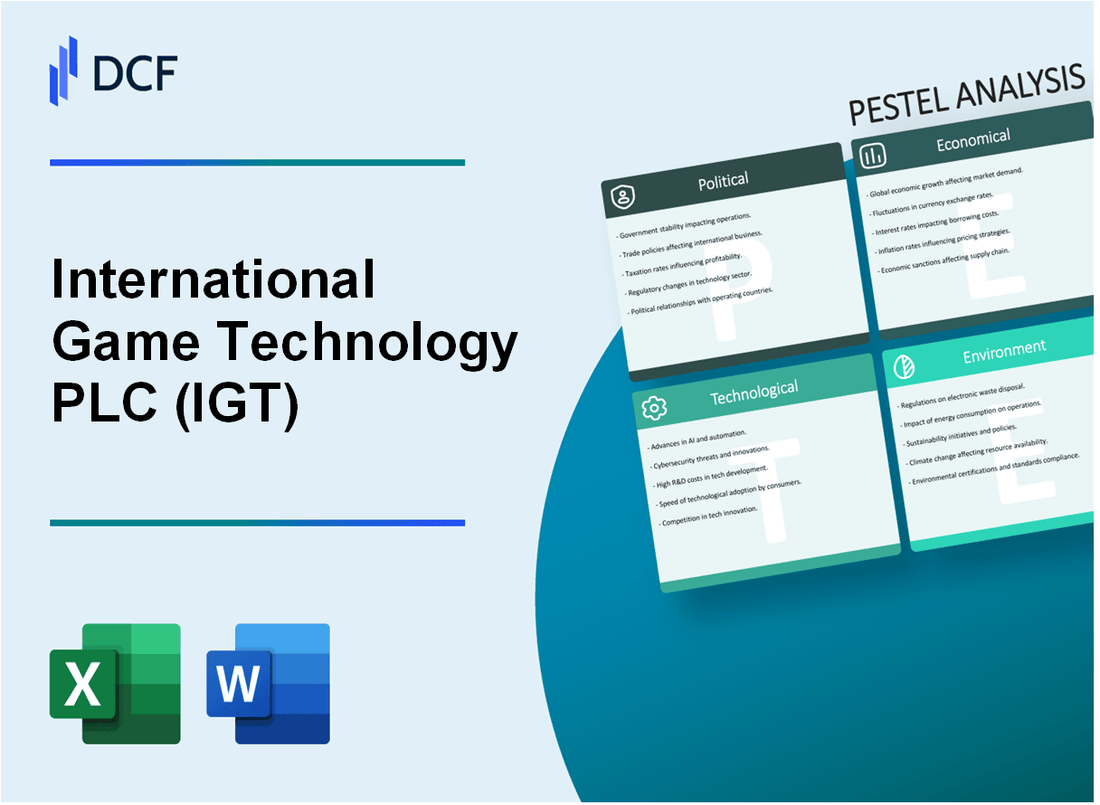
A International Game Technology plc (IGT) fica na encruzilhada da complexa dinâmica global, navegando em um labirinto de desafios políticos, econômicos e tecnológicos que moldam o cenário moderno dos jogos. De ambientes regulatórios rigorosos a plataformas digitais em rápida evolução, o posicionamento estratégico da IGT reflete uma dança sofisticada de inovação e adaptabilidade. Essa análise abrangente de pestles revela os fatores externos multifacetados que não apenas desafiam, mas também impulsionam as operações globais dessa gigante da tecnologia de jogos, oferecendo informações sobre o intrincado ecossistema que define sua trajetória de negócios.
International Game Technology plc (IGT) - Análise de pilão: fatores políticos
Regulamentos rígidos de jogo em várias jurisdições
A IGT opera em ambientes regulatórios complexos em vários países. A partir de 2024, a empresa deve navegar por diversos regulamentos de jogo em mercados -chave:
| Região | Complexidade regulatória | Requisitos de licenciamento |
|---|---|---|
| Estados Unidos | Alto | Licenças de jogos específicas do estado |
| União Europeia | Médio a alto | Aprovações regulatórias específicas do país |
| América latina | Médio | Permissões de jogos provinciais/nacionais |
Tensões políticas que afetam estratégias de negócios
Os principais desafios políticos que afetam as operações da IGT incluem:
- Variações regulatórias em nível estadual dos EUA
- Fragmentação do mercado da União Europeia
- Restrições de entrada de mercado emergentes
Requisitos de licenciamento do governo
O IGT deve cumprir com extensos processos de licenciamento em várias jurisdições. O cenário de licenciamento atual inclui:
| Mercado | Custo médio da licença | Frequência de renovação |
|---|---|---|
| Nevada, EUA | $500,000 | Anual |
| Reino Unido | £375,000 | Bienal |
| Itália | €250,000 | Trienal |
Possíveis mudanças legislativas
Desenvolvimentos legislativos previstos potencialmente impactando o posicionamento de mercado da IGT:
- Regulamentos de expansão de jogo online
- Aumento da tributação de jogos digitais
- Requisitos de jogo responsáveis aprimorados
A abordagem estratégica da IGT envolve o monitoramento contínuo de paisagens políticas e regulatórias para manter a conformidade e a adaptabilidade do mercado.
International Game Technology plc (IGT) - Análise de pilão: fatores econômicos
As flutuações econômicas globais impactam os gastos discricionários do consumidor
De acordo com o relatório anual de 2022 da IGT, a receita global de jogos foi de US $ 57,5 bilhões, com gastos discricionários do consumidor mostrando sensibilidade às condições econômicas. O mercado global de jogos de azar deve atingir US $ 92,9 bilhões até 2027, com um CAGR de 6,2%.
| Ano | Receita global de jogos | Impacto de gastos com consumidores |
|---|---|---|
| 2022 | US $ 57,5 bilhões | -3,2% durante a incerteza econômica |
| 2023 | US $ 64,3 bilhões | +2,1% de recuperação |
| 2027 (projetado) | US $ 92,9 bilhões | 6,2% CAGR |
Concorrência do mercado de cassino e jogos online
O cenário competitivo da IGT revela intensa dinâmica de mercado:
- Tamanho global do mercado de jogos de azar online: US $ 63,5 bilhões em 2022
- Participação no mercado global da IGT: 12,4%
- Principais quotas de mercado dos concorrentes:
- Jogos Científicos: 9,7%
- Aristocrata: 8,3%
- PlayTech: 6,5%
Volatilidade da taxa de câmbio
| Par de moeda | 2022 Volatilidade | Impacto na receita do IGT |
|---|---|---|
| USD/EUR | ±7.2% | Ajuste de receita de US $ 45,6 milhões |
| USD/GBP | ±6.8% | US $ 38,2 milhões de ajuste de receita |
| USD/CAD | ±5.5% | US $ 22,7 milhões de ajuste de receita |
Potenciais recessões econômicas
A resiliência financeira da IGT durante as crises econômicas:
- 2022 Receita total: US $ 4,84 bilhões
- Receita operacional: US $ 692 milhões
- Estratégias de mitigação de impacto de recessão:
- Fluxos de receita diversificados
- Redução de custos: US $ 127 milhões em 2022
- Investimentos de transformação digital
International Game Technology plc (IGT) - Análise de pilão: Fatores sociais
Mudança de preferências demográficas para plataformas de jogos digitais e móveis
De acordo com a Statista, a receita global de jogos móveis atingiu US $ 92,2 bilhões em 2022, com crescimento projetado para US $ 118,8 bilhões até 2027. As receitas da plataforma digital da IGT representaram 37,4% da receita total de jogos em 2022.
| Faixa etária | Penetração de jogos móveis | Gasto médio |
|---|---|---|
| 18-24 anos | 72% | US $ 156/mês |
| 25-34 anos | 68% | US $ 214/mês |
| 35-44 anos | 55% | US $ 187/mês |
Aceitação crescente do jogo online entre gerações mais jovens
O tamanho do mercado global de jogos de azar on-line foi de US $ 63,5 bilhões em 2022, com 45% dos usuários de 21 a 35 anos. A IGT registrou 28,6% de crescimento ano a ano em segmentos de jogo digital.
Aumentando a conscientização social sobre práticas de jogo responsáveis
87% das jurisdições de jogos agora exigem treinamento de jogo responsável. A IGT investiu US $ 12,4 milhões em programas de jogos responsáveis em 2022, representando 2,3% de seu orçamento de responsabilidade social.
| Métrica de jogo responsável | 2022 dados |
|---|---|
| Registros de auto-exclusão do jogador | 214,567 |
| Chamadas de linha de apoio ao vício em jogos de azar | 87,342 |
| Implantações de software de proteção ao jogador | 1,456 |
Variações culturais nas preferências de jogos em diferentes mercados globais
A IGT opera em mais de 100 países com diversas preferências de jogos. O mercado europeu representa 42% da receita internacional da IGT, com US $ 1,2 bilhão em 2022 ganhos.
| Região | Tipo de jogo preferido | Quota de mercado |
|---|---|---|
| América do Norte | Máquinas caça -níqueis | 38% |
| Europa | Poker online | 27% |
| Ásia-Pacífico | Cassino móvel | 22% |
| América latina | Apostas esportivas | 13% |
International Game Technology plc (IGT) - Análise de pilão: Fatores tecnológicos
Investimento contínuo em software de jogo avançado e inovações de hardware
A IGT investiu US $ 249,4 milhões em pesquisa e desenvolvimento em 2022. O portfólio de tecnologia da empresa inclui mais de 3.500 patentes ativas a partir de 2023.
| Categoria de investimento em tecnologia | Quantidade (USD) | Ano |
|---|---|---|
| Despesas de P&D | US $ 249,4 milhões | 2022 |
| Patentes ativas | 3,500+ | 2023 |
A crescente demanda por experiências imersivas de jogos digitais e tecnologias de realidade virtual
O mercado global de jogos digitais foi avaliado em US $ 214,22 bilhões em 2022, com um CAGR projetado de 13,2% de 2023 a 2030.
| Métrica de mercado | Valor | Período |
|---|---|---|
| Valor de mercado de jogos digitais | US $ 214,22 bilhões | 2022 |
| CAGR projetado | 13.2% | 2023-2030 |
Desafios de segurança cibernética na proteção de plataformas de jogos digitais
A IGT relatou investimentos em segurança cibernética de US $ 37,6 milhões em 2022, representando 15,1% do total de despesas tecnológicas.
| Investimento de segurança cibernética | Quantidade (USD) | Porcentagem de orçamento de tecnologia |
|---|---|---|
| Gastos com segurança cibernética | US $ 37,6 milhões | 15.1% |
Integração de inteligência artificial e aprendizado de máquina em tecnologias de jogos
A IGT alocou US $ 52,3 milhões especificamente para o desenvolvimento de tecnologia de IA e aprendizado de máquina em 2022.
| Tecnologia | Valor do investimento (USD) | Ano |
|---|---|---|
| Desenvolvimento de IA e aprendizado de máquina | US $ 52,3 milhões | 2022 |
International Game Technology plc (IGT) - Análise de pilão: fatores legais
Requisitos complexos de licenciamento e conformidade internacionais de jogos
O IGT opera em várias jurisdições com estruturas rigorosas de licenciamento. A partir de 2024, a empresa mantém 87 licenças de jogo em vários mercados globais.
| Região | Número de licenças | Custo de conformidade (USD) |
|---|---|---|
| América do Norte | 42 | US $ 18,5 milhões |
| Europa | 29 | US $ 12,3 milhões |
| Ásia-Pacífico | 16 | US $ 7,6 milhões |
Desafios legais em andamento nos mercados de jogos regulamentados e emergentes
IGT enfrenta desafios legais em várias jurisdições, com US $ 24,7 milhões alocados para gerenciamento legal de disputas em 2024.
- Casos de litígios pendentes: 12
- Valor da disputa legal total: US $ 43,2 milhões
- Investigação regulatória em andamento: 3 mercados
Proteção de propriedade intelectual para tecnologias e software para jogos
IGT mantém um portfólio de propriedade intelectual robusto com 328 patentes ativas a partir de 2024.
| Categoria de patentes | Número de patentes | Custo de proteção anual (USD) |
|---|---|---|
| Software de jogo | 156 | US $ 4,2 milhões |
| Tecnologias de hardware | 112 | US $ 3,7 milhões |
| Plataforma digital | 60 | US $ 2,5 milhões |
Mecanalização regulatória de mecanismos de jogo e proteção ao consumidor responsáveis
A IGT investe US $ 37,6 milhões em iniciativas de jogo responsáveis nos mercados globais em 2024.
- Implementações de programas de jogo responsáveis: 22 mercados
- Investimentos de Tecnologia de Proteção ao Consumidor: US $ 12,4 milhões
- Programas de treinamento de conformidade: 6.500 funcionários treinados
International Game Technology plc (IGT) - Análise de pilão: fatores ambientais
Ênfase crescente nas práticas de negócios sustentáveis na indústria de jogos
A IGT relatou uma redução total de 3,2% nas emissões gerais de gases de efeito estufa em 2022 em comparação com o ano anterior. A empresa investiu US $ 12,4 milhões em atualizações de tecnologia sustentável nas instalações de fabricação.
| Métrica ambiental | 2022 dados | 2023 Target |
|---|---|---|
| Redução de emissões de carbono | 3.2% | 5.5% |
| Investimento sustentável | US $ 12,4 milhões | US $ 15,7 milhões |
| Uso de energia renovável | 22.6% | 28.3% |
Iniciativas de eficiência energética para equipamentos de jogos e fabricação
A IGT implementou tecnologias com eficiência energética, resultando em redução de 17,8% no consumo de energia do equipamento. As instalações de fabricação alcançaram 24,3% de melhoria da eficiência energética por meio de intervenções tecnológicas avançadas.
- Redução do projeto da máquina de caça-níqueis com eficiência energética: 22% de consumo de energia
- Fabricação Otimização de Energia: Melhoria de Eficiência de 24,3%
- Economia anual de custos de energia: US $ 3,6 milhões
Reduzindo a pegada de carbono em processos de fabricação e operacional
A estratégia operacional de redução de pegada de carbono da IGT alcançou 4,1% de diminuição nas emissões totais. As instalações de fabricação implementaram protocolos de redução de resíduos, economizando 287 toneladas de resíduos industriais anualmente.
| Métrica de pegada de carbono | 2022 Performance | Alvo de redução |
|---|---|---|
| Redução total de emissões | 4.1% | 6.5% |
| Resíduos industriais salvos | 287 toneladas métricas | 350 toneladas métricas |
| Taxa de reciclagem de resíduos | 43.6% | 50% |
Programas de responsabilidade social corporativa abordando preocupações ambientais
A IGT alocou US $ 2,7 milhões para programas de sustentabilidade ambiental em 2022. Iniciativas de responsabilidade social corporativa focadas na adoção de energia renovável e nos esforços de conservação ecológica.
- Investimento de RSE ambiental: US $ 2,7 milhões
- Orçamento do Programa de Energia Renovável: US $ 1,4 milhão
- Projetos de conservação ecológica: US $ 890.000
International Game Technology PLC (IGT) - PESTLE Analysis: Social factors
Increasing demand for responsible gaming features and tools across all platforms.
The social license to operate for International Game Technology PLC (IGT) is increasingly tied to its commitment to responsible gaming (RG). This isn't just a regulatory checkbox; it's a core consumer expectation, especially as digital and sports betting grow. The good news is that public confidence is rising: a 2025 survey showed that 64% of Americans believe the gaming industry is committed to encouraging responsible gaming and combating problem gambling, a significant jump from less than 40% in 2018. That's a strong signal that the industry's efforts are being recognized.
For IGT, this means a continuous investment in technology that delivers hyper-personalized player protection and time interventions. The company is already a global leader in delivering responsible gaming experiences across all its regulated segments. This focus helps mitigate the social risk of addiction, which, to be fair, is still a major talking point in the media and among regulators, especially with the rapid spread of online sports betting.
Shift to digital and mobile lottery play (iLottery) requires new user engagement strategies.
The move from paper tickets to digital screens is accelerating, and IGT is right in the middle of it. The shift to iLottery is a massive opportunity, and the numbers from the first quarter of 2025 defintely show this trend: IGT reported a 26% jump in iLottery sales. This growth is crucial because it diversifies revenue away from traditional draw games, which can be volatile based on jackpot sizes.
To capture this, the engagement strategy must evolve beyond simple ticket sales. Younger, digitally-native players expect interactive, instant-win formats, not just the traditional weekly draw. IGT is addressing this by rolling out its Lottery Link point-of-sale devices and self-service kiosks later in 2025, which acts as a bridge between the retail environment and the digital experience. This multi-channel approach is the only way to keep the lottery relevant.
Public perception of gambling is improving, but regulatory scrutiny remains high.
Public acceptance of gambling is at an all-time high in the US, which is a tailwind for IGT's business. In 2025, 57% of U.S. adults reported gambling in the past 12 months, the highest level ever recorded. Moreover, a staggering 9 in 10 Americans find casino gambling acceptable for themselves or others. This broad social acceptance is a powerful foundation.
But here's the rub: the perception of different gambling verticals is diverging. While casino and lottery acceptance is high, a growing share of the public is concerned about legal sports betting, a key growth area for IGT's technology. A 2025 survey showed that 43% of U.S. adults now view legal sports betting as a bad thing for society, up from 34% in 2022. This split means IGT must be highly selective and transparent in how it deploys its sports betting technology, as public backlash can quickly translate into stricter regulations and higher compliance costs.
Lottery demographic is aging; need to attract younger players via digital channels.
The biggest long-term social challenge for the lottery segment is the aging player base. The median age of frequent lottery participants globally has risen to 47 years in the 2025 market overview. This is a ticking clock for a business model that relies on consistent, recurring revenue.
The data clearly shows where the future money is: by 2030, Generation Z is projected to hold more than a quarter of global income. But currently, players aged 45-65 represent over 55% of all regular ticket buyers, while participation among those under 30 has dropped below 20%. IGT's strategy must pivot to 'purposeful play' and social causes, as younger consumers demand authenticity and social responsibility from the brands they engage with. You have to make the game about more than just the jackpot.
Here's the quick math on the demographic challenge:
| Demographic Metric (2025 Data) | Amount/Value | Implication for IGT's Lottery Business |
|---|---|---|
| Median Age of Frequent Lottery Player (Global) | 47 years | Indicates an aging core customer base and long-term risk to sales. |
| Share of Regular Ticket Buyers Aged 45-65 | Over 55% | Current revenue is heavily concentrated in an older, non-digital segment. |
| Participation Rate for Players Under 30 | Below 20% | Requires urgent product and marketing innovation to prevent future decline. |
| Projected Gen Z Share of Global Income (by 2030) | Over 25% | The target for future iLottery and digital engagement is financially powerful. |
The action is clear: double down on iLottery innovation and integrate social purpose into game design to connect with that younger, more ethical consumer base.
International Game Technology PLC (IGT) - PESTLE Analysis: Technological factors
You're looking at IGT's technological footing, and the picture is one of necessary, heavy investment. The company is in a capital expenditure (CapEx) cycle right now, which is a clear signal of their commitment to future-proofing the core lottery business.
For the full fiscal year 2025, IGT anticipates CapEx to be between $400 million and $450 million, reflecting significant technology investments in contract renewals and new systems. That's a huge number, but it's essential for maintaining their global lottery leadership.
Heavy R&D focus on next-generation lottery terminals and self-service kiosks.
The push for next-generation retail technology is all about meeting the modern player where they are. IGT is rolling out advanced self-service lottery vending machines and integrating in-lane purchasing options at retailers, which are designed to generate incremental sales. This strategy is defintely a response to the shift toward digital convenience.
The CapEx budget is funding this expansion of retail touchpoints and the deployment of new terminals. Here's the quick math: if you can make a lottery ticket purchase as simple as buying a pack of gum, you boost volume. They are also continuing to deploy their PlaySports kiosks, which are a core part of their B2B sports betting offering in retail locations across the US.
Investment in cloud-based sports betting platform (B2B) scalability and reliability.
IGT's cloud strategy centers on its B2B (business-to-business) platforms, particularly the PlaySports technology, which is a leading solution in North America. Scalability is the key word here, especially as more US states mature their sports betting markets.
The PlaySports platform powers both retail and mobile sports betting for major partners like Boyd Gaming Corporation, with a recent three-year extension announced in June 2025. This longevity speaks to the platform's reliability. Furthermore, IGT's cloud-based lottery solutions have already proven their value, reportedly increasing operational efficiency for lottery operators by 25%. This is a clear, measurable return on their cloud investment.
Cybersecurity spending is critical to protect sensitive government and player data.
This is a near-term risk that has become a clear and present danger. The need for critical cybersecurity spending was underscored by a confirmed security incident in November 2025, where the Qilin ransomware gang claimed to have exfiltrated 10 GB of data. When you handle sensitive government and player data for lotteries and sports betting, your security posture is paramount.
While IGT's specific 2025 cybersecurity budget isn't public, the global trend is clear: worldwide information security spending is projected to total $212 billion in 2025, a 15.1% increase from 2024. IGT's focus must be on securing their cloud environments and protecting the integrity of their lottery systems. The cost of a breach-regulatory fines, contract loss, and reputational damage-far outweighs the cost of prevention.
Use of data analytics to optimize lottery game design and retail placement.
Data is the new oil in the lottery world, and IGT is leveraging Artificial Intelligence and Machine Learning (AIML) to move beyond guesswork. They use a purpose-built AI platform called Play.AI to process huge data sets quickly, helping operators determine which games to promote and how to retain players.
The company's Player Data Platform is a cloud-based system that unifies siloed data for better player insights and campaign analytics. Their OMNIA™ solution, an omnichannel platform, is especially powerful because it captures retail-player transactions, creating a 360-degree view of behavior that was previously unavailable. This data-driven approach is directly fueling growth, as evidenced by a 26% increase in iLottery sales in Q1 2025.
Here is a summary of the key 2025 technology investment figures:
| Metric | 2025 Value/Projection | Significance |
|---|---|---|
| Full-Year Capital Expenditures (CapEx) | $400 million to $450 million | Funding new terminals, contract wins, and systems modernization. |
| Incremental Technology Investment (H1 2025) | $25 million | Targeted spending on cloud-based solutions and network optimization. |
| iLottery Sales Growth (Q1 2025) | 26% | Direct result of digital and data analytics investments. |
| Cloud-Based Lottery Operational Efficiency | 25% increase | Proven benefit of moving core lottery systems to the cloud. |
The strategic actions are clear:
- Invest in self-service kiosks to capture more retail transactions.
- Ensure the PlaySports cloud platform can handle peak demand in all regulated markets.
- Immediately increase cybersecurity resources following the recent November 2025 breach.
- Use the OMNIA™ and Play.AI platforms to optimize game content and marketing spend.
The technology is there, but the execution and security around the new digital infrastructure are the only things that matter now.
International Game Technology PLC (IGT) - PESTLE Analysis: Legal factors
Complex, multi-jurisdictional regulatory compliance is a constant, high-cost factor.
The gaming industry is one of the most heavily regulated globally, and for a company like International Game Technology PLC (IGT), which operates across dozens of jurisdictions, compliance isn't just a cost-it's a core business function. Honest to goodness, the sheer volume of new laws is a full-time job for a large legal team. You're navigating everything from specific slot machine tilt-switch requirements in Nevada to lottery commission rules in Italy, and the stakes are massive. Failure to comply can lead to contract termination, which is a defintely existential risk for a pure-play lottery business.
The regulatory burden is always shifting, and while IGT's Selling, general and administrative expenses saw some reduction in legal consultant costs in the prior period, the underlying need for vigilance hasn't changed. The company is actively focused on optimizing administrative activities, as evidenced by the $38 million restructuring charge associated with the OPtiMa 3.0 program in the third quarter of 2024, a clear signal that internal efficiency is a priority for managing these systemic costs.
Data privacy laws (e.g., GDPR, CCPA) govern player information handling globally.
Data privacy is a non-negotiable legal risk, especially as IGT leans into its digital lottery offerings. The moment you collect player data, you step into the complex web of global privacy legislation. IGT's updated Privacy Notice, effective January 2025, explicitly affirms its commitment to complying with both the European Union's General Data Protection Regulation (GDPR) and the California Consumer Privacy Act (CCPA).
To be fair, the company has to be meticulous about how it handles data, especially when transferring it across borders, which requires using mechanisms like the European Union's Standard Contractual Clauses. A single misstep here, given the scale of IGT's operations, could trigger significant penalties. For context, GDPR fines can reach up to 4% of a company's annual global turnover, a figure that makes every compliance check a critical financial decision.
Contractual obligations with state and provincial lottery commissions are non-negotiable.
The core of IGT's business lies in its long-term, high-value contracts with government lottery commissions. These agreements are the lifeblood of the company, but they come with stringent performance and conduct clauses. The near-term financial impact of these obligations is clear in the 2025 fiscal year data, particularly with the renewal of the Italian lottery contract.
In May 2025, a consortium led by IGT renewed the Italian lottery contract for nine years at a total cost of $2.6 billion. This deal required substantial upfront payments in 2025, demonstrating the massive capital commitment required to secure these critical revenue streams.
Here's the quick math on the 2025 contract payments for the Italian lottery renewal:
| Obligation | Amount Due in 2025 (USD) | Notes |
|---|---|---|
| Initial Contract Payment 1 | $558.26 million | Part of the total $2.6 billion renewal cost. |
| Initial Contract Payment 2 | $335 million | Balance due for the 2025 portion of the renewal. |
| Total 2025 Contract Payments | $893.26 million | Significant capital outlay in the fiscal year. |
Plus, contract compliance is a constant battle. In April 2025, the Texas Lottery Commission fined IGT Solutions Corporation $180,000 for violating the improper influence clause of its contract by making political contributions, a fine based on 18 political contributions at $10,000 per occurrence. IGT is currently contesting this in court. This shows that even seemingly minor compliance breaches can lead to immediate financial sanctions and litigation.
- Renewed Italian lottery contract in May 2025 for 9 years.
- Fined $180,000 by Texas Lottery Commission in April 2025 for contract violations.
- Georgia Lottery Corporation contract extension runs through September 11, 2025.
Intellectual property protection is vital for proprietary game mechanics and software.
In the gaming world, your intellectual property (IP) is your competitive edge, and IGT's vast patent portfolio is a critical legal asset. The company holds a total of 9,206 patents globally, with 453 patents currently active, protecting everything from slot machine design to digital lottery technology.
The pace of innovation and the need for legal defense is relentless. For example, a patent for a new Keno game feature, 'Keno employing initially unmatched drawn spots via trigger spots,' was granted on October 14, 2025 (Patent number: 12444268). Also, an application for 'AUGMENTED REALITY INTEGRATION IN ELECTRONIC GAMING MACHINES' was published on October 9, 2025. This shows a continuous, high-cost investment in legal protection for new game mechanics.
Still, IP defense is not always successful. In July 2025, the Federal Circuit declined to revive an invalidated IGT gaming patent that was challenged by Zynga, confirming the constant litigation risk and the difficulty of maintaining patent validity in a fast-moving technology sector.
International Game Technology PLC (IGT) - PESTLE Analysis: Environmental factors
Corporate Sustainability Reports Increasingly Scrutinized by ESG-Focused Investors
The most immediate environmental factor for International Game Technology PLC (IGT) is the intense scrutiny from Environmental, Social, and Governance (ESG) investors, which is directly tied to reported performance metrics.
IGT's commitment to its Science Based Targets initiative (SBTi) goals has become a core valuation driver. The company has a validated near-term target to reduce absolute Scope 1 and Scope 2 greenhouse gas (GHG) emissions by 50% by 2030, using a 2019 base year, plus a 30% reduction in absolute Scope 3 emissions in the same timeframe. This is a clear, long-term roadmap. Still, the near-term data shows the challenge: IGT's reported total GHG emissions for 2024 were approximately 68,025,000 kg CO2e, an increase from 2023's approximately 56,089,000 kg CO2e. This increase, even with long-term targets, is a red flag for ESG funds, requiring clear explanations of growth-related factors like acquisitions or increased operational footprint.
Here's the quick math on IGT's ESG standing as of the 2025 fiscal year:
| Metric (2024 Assessment) | Value/Score | Context |
|---|---|---|
| S&P Corporate Sustainability Assessment (CSA) Score | 62 | Improved by eight points over the previous year. |
| CSA Industry Ranking | Top Decile | Places IGT among the leaders in the Casinos and Gaming category. |
| 2024 Total GHG Emissions (Scope 1 & 2) | ~68,025,000 kg CO2e | Represents a notable increase from 2023. |
| 2030 Scope 1 & 2 Reduction Target (SBTi) | 50% | Absolute reduction goal from 2019 baseline. |
Mandates for Energy-Efficient Lottery Terminals and Data Center Operations
The push for energy efficiency is moving from a 'nice-to-have' to a clear mandate, especially as the gaming industry's data center needs surge due to cloud and iLottery growth. The strategic goal is to fight climate change by improving the efficiency of operations and buildings, plus choosing renewable energy sources.
While IGT doesn't publish a specific 2025 efficiency percentage for its terminals, the focus is on deploying low-power hardware and modern cooling solutions to meet the growing demand for computing power. Global data center energy demand is forecast to double over the next five years, with an estimated 10 gigawatts (GW) of new data centers projected to break ground globally in 2025 alone. This industry pressure means IGT must prioritize energy-efficient hardware and renewable energy Power Purchase Agreements (PPAs) to manage its Scope 2 emissions, which accounted for approximately 37,375,000 kg CO2e of its 2024 total emissions. It's a massive capital expenditure risk, but also a chance to lock in lower operating costs.
Focus on Reducing Paper Consumption in Lottery Ticket Printing and Retail Operations
For the lottery segment, paper consumption is a tangible environmental and cost factor. The key action is digitizing the retail experience and sourcing responsibly.
IGT already uses Forest Stewardship Council (FSC)-certified paper for all its lottery scratch tickets and playslips in Italy, which is a strong ethical sourcing signal for the raw material. The shift to digital interaction at retail, such as through digital play slips and mobile apps, is the most effective way to cut down on the estimated 10,000 sheets of paper an average office worker uses annually, let alone the scale of lottery operations.
- Source all paper products from certified sustainable forests.
- Implement 'Retail Digital Interaction' to reduce paper-based retailer impact.
- Expand the use of digital lottery play slips and tickets globally.
- Reduce solvent-related air emissions from printing facilities, like the award-winning improvements at the Lakeland, Florida facility.
Supply Chain Due Diligence for Ethical Sourcing of Hardware Components
The pressure on IGT to ensure ethical sourcing for its gaming and lottery hardware components-from rare earth minerals in terminals to plastics in casings-is escalating, driven by new regulations like the EU's Corporate Sustainability Due Diligence Directive (CSDDD).
IGT's 2022-2025 Sustainability Plan included the goal to define and implement an ISO 20400-inspired sustainable procurement process by 2023. This process is crucial for monitoring the working environment and civil rights of supply chain partners. The global market for supplier quality audits is expected to grow at a Compound Annual Growth Rate (CAGR) of 7.0% from 2025 to 2035, showing this is a major, growing cost of doing business. The risk is real: over 50% of assessed global regions face a high or extreme risk of ESG violations in their supply chains, meaning a passive approach is defintely not an option in 2025.
Disclaimer
All information, articles, and product details provided on this website are for general informational and educational purposes only. We do not claim any ownership over, nor do we intend to infringe upon, any trademarks, copyrights, logos, brand names, or other intellectual property mentioned or depicted on this site. Such intellectual property remains the property of its respective owners, and any references here are made solely for identification or informational purposes, without implying any affiliation, endorsement, or partnership.
We make no representations or warranties, express or implied, regarding the accuracy, completeness, or suitability of any content or products presented. Nothing on this website should be construed as legal, tax, investment, financial, medical, or other professional advice. In addition, no part of this site—including articles or product references—constitutes a solicitation, recommendation, endorsement, advertisement, or offer to buy or sell any securities, franchises, or other financial instruments, particularly in jurisdictions where such activity would be unlawful.
All content is of a general nature and may not address the specific circumstances of any individual or entity. It is not a substitute for professional advice or services. Any actions you take based on the information provided here are strictly at your own risk. You accept full responsibility for any decisions or outcomes arising from your use of this website and agree to release us from any liability in connection with your use of, or reliance upon, the content or products found herein.