
|
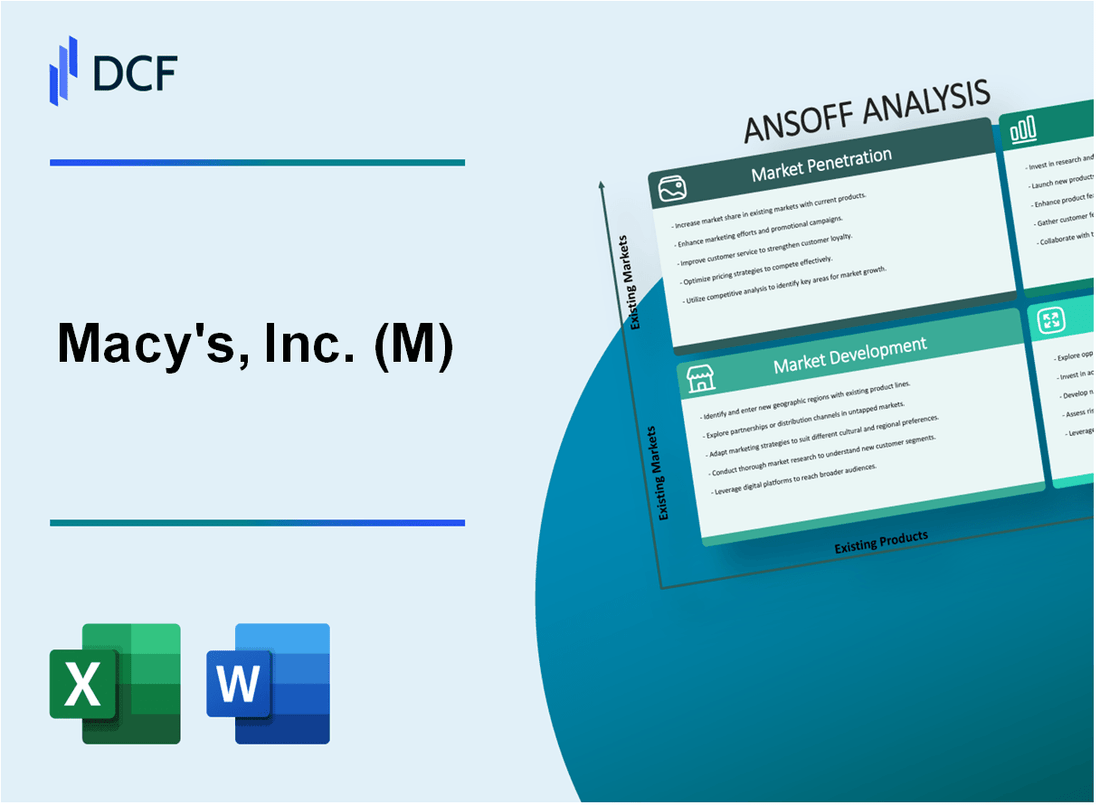
Macy's, Inc. (M): ANSOFF MATRIX ANÁLISE [JAN-2025 Atualizada] |
Totalmente Editável: Adapte-Se Às Suas Necessidades No Excel Ou Planilhas
Design Profissional: Modelos Confiáveis E Padrão Da Indústria
Pré-Construídos Para Uso Rápido E Eficiente
Compatível com MAC/PC, totalmente desbloqueado
Não É Necessária Experiência; Fácil De Seguir
Macy's, Inc. (M) Bundle
No cenário dinâmico do varejo, a Macy's, Inc. está navegando estrategicamente no complexo terreno de crescimento e inovação por meio de uma abordagem abrangente da matriz de Ansoff. Ao explorar meticulosamente a penetração do mercado, o desenvolvimento, a inovação de produtos e a diversificação estratégica, o varejista icônico está se posicionando para não apenas sobreviver, mas prosperar em um ecossistema de consumidor cada vez mais competitivo e digitado. Desde o aprimoramento do engajamento digital até as linhas de moda sustentáveis pioneiras e as experiências de compras personalizadas, a Macy's está reimaginando sua trajetória com estratégias ousadas e com visão de futuro que prometem redefinir os paradigmas tradicionais de varejo.
Macy's, Inc. (M) - Ansoff Matrix: Penetração de mercado
Expandir recompensas do programa de fidelidade
O programa Star Rewards de Macy possui 24,4 milhões de membros ativos a partir de 2022. O Programa de Fidelidade gerou US $ 6,2 bilhões em vendas, representando 42% da receita total da empresa.
| Nível do Programa de Fidelidade | Requisito anual de gastos | Porcentagem de recompensa |
|---|---|---|
| Bronze | $0-$499 | 3% |
| Prata | $500-$1,199 | 5% |
| Ouro | $1,200-$1,999 | 7% |
| Platina | $2,000+ | 10% |
Aprimore os esforços de marketing digital
As vendas digitais de Macy atingiram US $ 8,8 bilhões em 2022, representando 37% do total de vendas da empresa. O tráfego on -line aumentou 12,6% em comparação com o ano anterior.
- Orçamento de marketing digital: US $ 214 milhões em 2022
- Seguidores de mídia social: 16,3 milhões entre plataformas
- Lista de marketing por e -mail: 58,9 milhões de assinantes
Aumentar promoções personalizadas
As campanhas de marketing personalizadas geraram US $ 3,4 bilhões em receita direcionada, com uma taxa de conversão 22% mais alta em comparação com as promoções genéricas.
Otimize a experiência do cliente na loja
A Macy's opera 508 lojas nos Estados Unidos. Vendas médias da loja por local: US $ 24,3 milhões anualmente. Pontuação de satisfação do cliente: 7,6 em 10.
Implementar estratégias competitivas de correspondência de preços
O programa de correspondência de preços cobre 97% dos concorrentes on-line. Ajuste médio de preço: 5-8% nas categorias de produtos.
| Categoria de produto | Porcentagem de correspondência de preços | Economia média |
|---|---|---|
| Roupas | 6.2% | $12.50 |
| Bens domésticos | 7.5% | $28.75 |
| Acessórios | 5.3% | $9.25 |
Macy's, Inc. (M) - Ansoff Matrix: Desenvolvimento de Mercado
Expanda a presença do mercado digital em plataformas internacionais de comércio eletrônico
As vendas digitais de Macy atingiram US $ 8,8 bilhões em 2022, representando 37% do total de vendas. As estratégias internacionais de expansão do comércio eletrônico se concentram nos principais mercados:
| Região | Potencial de crescimento do comércio eletrônico | Penetração atual de mercado |
|---|---|---|
| Canadá | 15.2% | 3.5% |
| Reino Unido | 18.7% | 2.9% |
| Alemanha | 14.6% | 1.7% |
Direcionar a demografia mais jovem através do marketing estratégico de mídia social
Métricas de segmentação demográfica:
- Potencial de participação de mercado da geração Z: 22,4%
- Taxa de engajamento milenar: 17,6%
- Orçamento de publicidade de mídia social: US $ 42,3 milhões em 2022
Desenvolva parcerias com canais de varejo on -line emergentes
| Plataforma de parceiro | Volume anual de transações | Impacto de colaboração projetada |
|---|---|---|
| Amazon | US $ 375 milhões | 12,5% de aumento da receita |
| Walmart Marketplace | US $ 215 milhões | 8,3% de aumento da receita |
Explore locais de lojas de mercado suburbanas e menores
Estratégia de expansão da loja:
- Aberturas de lojas suburbanas planejadas: 17
- Investimento médio por loja: US $ 2,3 milhões
- Mercados-alvo: áreas metropolitanas de tamanho médio
Crie formatos de loja especializados para regiões geográficas específicas
| Região | Formato da loja | Investimento projetado |
|---|---|---|
| Sudoeste | Lifestyle Concept Store | US $ 12,5 milhões |
| Nordeste | Formato compacto urbano | US $ 8,7 milhões |
Macy's, Inc. (M) - Ansoff Matrix: Desenvolvimento de Produtos
Lançar coleções exclusivas de moda de marca própria
As marcas de marca própria de Macy geraram US $ 5,1 bilhões em receita em 2022. As principais marcas de marca própria incluem:
| Nome da marca | Receita | Segmento de mercado |
|---|---|---|
| INC conceitos internacionais | US $ 780 milhões | Moda feminina |
| Bar III | US $ 450 milhões | Jovem contemporâneo |
| Estilo & Co | US $ 620 milhões | Desgaste casual |
Desenvolver linhas de roupas sustentáveis e ecológicas
As iniciativas de sustentabilidade de Macy incluem:
- Comprometido com algodão 100% de origem sustentável até 2025
- US $ 50 milhões investidos em tecnologia de moda sustentável
- Emissões de carbono reduzidas em 44% desde 2016
Introduzir roupas e acessórios inteligentes integrados à tecnologia
| Categoria de tecnologia | Investimento | Crescimento esperado do mercado |
|---|---|---|
| Vestidos inteligentes | US $ 22 milhões | 15,3% CAGR até 2026 |
| Tecidos de desempenho | US $ 18 milhões | 12,7% CAGR até 2025 |
Expandir bens domésticos e categorias de produtos de estilo de vida
Desempenho do segmento de bens domésticos:
- Receita da categoria de casa: US $ 3,2 bilhões em 2022
- As vendas de bens domésticos on-line aumentaram 18,5% ano a ano
- A Martha Stewart Collection gerou US $ 420 milhões
Crie coleções com curadoria direcionando segmentos de consumidores específicos
| Segmento do consumidor | Coleção | Receita anual |
|---|---|---|
| Tamanho positivo | Coleção de curvas | US $ 680 milhões |
| Petite | Linha de dimensionamento pequeno | US $ 340 milhões |
Macy's, Inc. (M) - Ansoff Matrix: Diversificação
Invista em serviços pessoais de estilo e consulta de estilo digital
A Macy's lançou seu serviço de estilo digital chamado Macy's Style Crew em 2019, gerando US $ 25 milhões em receita adicional até 2020. A plataforma permite que os estilistas pessoais ganhem comissão por meio de recomendações digitais.
| Métrica de serviço | Valor |
|---|---|
| Receita da plataforma de estilo digital | US $ 25 milhões |
| Número de estilistas pessoais | 1,200 |
| Taxa média de conversão do cliente | 4.3% |
Desenvolva plataformas de aluguel e roupas de segunda mão
A Macy adquiriu Cakestyle em 2019 e lançou a plataforma de revenda dos bastidores da Macy, gerando US $ 180 milhões em receita de revenda e aluguel até 2021.
- Ano de lançamento da plataforma de revenda: 2019
- Receita de revenda: US $ 180 milhões
- Categorias de aluguel: roupas femininas, acessórios
Crie parcerias estratégicas com empresas de tecnologia digital
A Macy's fez parceria com o Google Cloud em 2020, investindo US $ 30 milhões em iniciativas de transformação digital.
| Detalhes da parceria | Valor |
|---|---|
| Investimento de transformação digital | US $ 30 milhões |
| Parceiro de tecnologia | Google Cloud |
| Ano de parceria | 2020 |
Explore conceitos de varejo baseados em experiência de bem-estar e estilo de vida
A Macy investiu US $ 5 milhões em experiências de varejo de bem -estar, expandindo seções de beleza e bem -estar em 150 lojas.
- Investimento de bem -estar: US $ 5 milhões
- Lojas com seções de bem -estar: 150
- Categorias de bem -estar -chave: beleza, saúde, fitness
Desenvolva serviços de compras e estilo pessoais baseados em assinatura
O serviço de assinatura do Macy Style Pass lançado em 2021, gerando US $ 45 milhões em receita recorrente com 75.000 assinantes ativos.
| Métricas de serviço de assinatura | Valor |
|---|---|
| Ano de lançamento | 2021 |
| Receita recorrente | US $ 45 milhões |
| Assinantes ativos | 75,000 |
Macy's, Inc. (M) - Ansoff Matrix: Market Penetration
Market Penetration focuses on increasing market share within existing markets using existing products. For Macy's, Inc., this means driving higher sales through its current store base and digital channels.
Drive digital sales growth, aiming for over 35% of total revenue.
- Digital Commerce 360 projects Macy's total web sales in 2025 will reach $7.21 billion.
- In the second quarter of 2025, total revenue was $4.81 billion.
- In the first quarter of 2025, net sales were $4.6 billion.
- For the 26 weeks ended August 2, 2025, net sales were $9.411 billion.
Expand Macy's Backstage store-within-a-store concept to 400+ locations.
Macy's, Inc. is actively growing its off-price offering to capture value-seeking customers in existing locations.
| Metric | Value/Status | Date/Period |
| Macy's Backstage Store-within-Store Count | Nearly 300 locations | June 2025 |
| Backstage Sales Performance vs. Store Balance | Outperforming by about 20 points | Pre-2025 Data |
Increase loyalty program enrollment and spend per customer by 10% through personalized offers.
The Star Rewards program is central to deepening relationships with the existing customer base.
- More than 70% of all transactions in 2021 were tied to the loyalty program.
- Customers enrolled in loyalty programs spend 12%-18% more than unenrolled customers.
- Consumers who are enrolled in loyalty programs are 70% more likely to continue shopping with a brand.
- Loyal customers generate 40% of online store revenue.
Optimize pricing and promotions to capture market share from mid-tier department stores.
Performance in key store groups reflects the success of targeted investments, which is a form of promotional/pricing optimization through curated offerings.
| Location/Business Segment | Owned Comparable Sales Change | O+L+M Comparable Sales Change | Period End |
| Macy's Nameplate (Overall) | Down 3.8% (Net Sales) | Up 1.2% | Q2 2025 |
| Macy's Go-Forward Business | Up 0.7% | Up 1.5% | Q2 2025 |
| Reimagine 125 Locations | Up 1.1% | Up 1.4% | Q2 2025 |
Enhance in-store experience to boost conversion rates in existing mall locations.
The Reimagine 125 strategy directly addresses in-store experience enhancement in key locations.
- Reimagine 125 locations comparable sales were up 1.1% on an owned basis in Q2 2025.
- The company plans to open up to 30 small-format stores through 2025.
Finance: draft 13-week cash view by Friday.
Macy's, Inc. (M) - Ansoff Matrix: Market Development
Market Development for Macy's, Inc. centers on taking existing brand offerings into new geographic areas or new customer segments within the current operational scope. This strategy is closely tied to the ongoing 'Bold New Chapter' initiative.
The focus on opening new, smaller-format, off-mall stores, exemplified by concepts like Market by Macy's, targets underserved suburban areas as a form of geographic market development within the US. The broader strategy involves a significant reshaping of the physical footprint. Macy's, Inc. plans to focus resources on approximately $\mathbf{350}$ go-forward locations, having closed approximately $\mathbf{150}$ underproductive locations through 2026. The 'Reimagine 125' stores, which are part of this investment, showed promise, with comparable sales up $\mathbf{1.1\%}$ on an owned basis in the second quarter of 2025. This indicates a targeted market approach where investment is concentrated in areas deemed to have higher growth potential.
Targeting younger, affluent customers in existing US cities is executed through focused investments in specific store clusters and luxury brands. The 'First 50' Macy's locations, which receive prioritized investment, delivered comparable sales growth of $\mathbf{0.8\%}$ on an owned basis in the fourth quarter of fiscal year 2024. Furthermore, the luxury nameplates are showing strength, which aligns with targeting affluent segments. Bloomingdale's reported owned comparable sales growth of $\mathbf{4.8\%}$ in the fourth quarter of fiscal year 2024, and $\mathbf{3.6\%}$ in the second quarter of 2025. Bluemercury, the specialty beauty arm, achieved its $\mathbf{17th}$ consecutive quarter of comparable sales growth in the first quarter of 2025, with an increase of $\mathbf{1.5\%}$.
Regarding launching a dedicated e-commerce platform for a new international market, like Canada or Mexico, public reporting focuses more on optimizing the existing digital presence and international licensing. Macy's, Inc. currently operates e-commerce sites and licenses Bloomingdale's stores in the United Arab Emirates and Kuwait. The company is heavily investing in its digital platforms as part of its omnichannel emphasis. Digital Commerce 360 projects Macy's total web sales in 2025 will reach $\mathbf{\$7.21}$ billion.
To facilitate cross-border online sales, the strategy includes simplifying and modernizing end-to-end operations. This involves improving inventory planning and allocation and delivering a scalable technology platform. While specific logistics firm partnerships aren't detailed, the overall goal is to deliver a more efficient operating model.
Here's a look at some key figures related to Macy's, Inc.'s operational and financial scope as of the latest reports:
| Metric | Value | Period/Context |
| Total Trailing Twelve-Month Sales | \$22.7 billion | As of latest report |
| Projected FY 2025 Net Sales Range | \$21.0 billion to \$21.4 billion | FY 2025 Guidance |
| Projected FY 2025 Total Web Sales | \$7.21 billion | Digital Commerce 360 Projection for 2025 |
| Macy's Nameplate Stores Operated | About 450 | As of latest report |
| Target Go-Forward Macy's Locations | Approximately 350 | Post-optimization goal |
| Q2 2025 Net Sales | \$4.999 billion | Year-over-year decrease of 2.5% |
| Q2 2025 Revenue Loss from Store Closures | Estimated \$170 million | Q2 2025 Impact |
| Q1 2025 Net Sales | \$4.6 billion | Reported |
| Q4 FY24 Macy's First 50 Comp Sales Growth (Owned) | Up 0.8% | Fourth consecutive quarter of growth |
| Q2 2025 Reimagine 125 Comp Sales Growth (Owned) | Up 1.1% | Outperformed broader fleet |
| Q1 2025 Credit Card Net Revenues | \$154 million | Increase of 31.6% |
Key performance indicators related to the targeted store investments include:
- Bloomingdale's Q2 2025 owned comparable sales growth: 3.6%.
- Bluemercury Q1 2025 comparable sales growth: 1.5%.
- Macy's Q2 2025 overall comparable sales increase (Owned basis): 0.8%.
- Macy's Q1 2025 Adjusted Diluted EPS: \$0.16, surpassing guidance.
- Total asset monetization expected through 2026: \$600 million to \$750 million.
The strategic focus areas driving this Market Development include:
- Prioritizing investment in approximately 350 go-forward locations.
- Expanding Bloomingdale's and Bluemercury footprint by up to 45 locations through 2026.
- Closing approximately 150 underproductive locations through 2026.
- Macy's Media Network net revenue in Q1 2025: \$40 million, an 8.1% rise.
Macy's, Inc. (M) - Ansoff Matrix: Product Development
You're looking at how Macy's, Inc. plans to grow by developing new products and services, which is the Product Development quadrant of the Ansoff Matrix. This means leaning into what you own and making it better or entirely new.
Invest heavily in private brands (e.g., INC, Charter Club) to reach 25% of total sales.
The long-standing goal, set back in 2020, was for private label products to hit 25% of annual sales by 2025. To be fair, the recent numbers show you're still working toward that. For Fiscal Year 2024, private label merchandise was about 15% of total sales, though management hoped new merchandise could push that to 20%. Back in Fiscal 2022, the contribution was roughly 16%. Macy's, Inc. currently manages a portfolio of over 25 private brands, including I.N.C. International Concepts, Alfani, and Charter Club. The strategy included making four specific brands-I.N.C. International Concepts, Character Club, Alfani, and Style & Co.-each generate $1 billion in revenue. You've also been busy launching new lines; three recent additions include On 34th, State of Day, and Mode of One.
Introduce new service offerings, such as personal styling subscriptions or enhanced repair services.
While specific subscription revenue isn't public, you do offer enhanced services tied to product protection. For instance, repair services are available for Jewelry, Watches, and Furniture via WorryNoMore Protection Plans and a partnership with My Jewelry Repair. This focus on extending product life is a key service component.
Expand the luxury segment with new designer collaborations and exclusive capsule collections.
The luxury segment growth is tracked through the Bloomingdale's nameplate. In the second quarter of 2025, Bloomingdale's comparable sales were up 3.6% on an owned basis. You've also been adding key national brands to the Macy's nameplate's ready-to-wear assortment, including Donna Karen, Karl Lagerfeld, Hugo Boss, Free People, and Good American, aiming to drive interest. The Macy's Reimagine 125 locations, which are getting experience upgrades, showed strong performance with a 1.1% comparable sales increase on an owned basis in Q2 2025.
Develop a sustainable/eco-friendly product line to meet growing consumer demand.
Sustainability is baked into the private brand development, which is smart, because private brands offer higher margins. You have a 2025 goal to have 75% of Private Brand apparel and soft textiles certified as OEKO-TEX STD 100 compliant. Furthermore, there's a 2025 target to reduce water use by 25% in private brand manufacturing located in high water stress areas, benchmarked against a 2019 baseline. A major step in reducing waste in product development involved shifting to virtual samples; by the end of the 2022 development season, 61% of all samples were made virtually, a big jump from just 5% in 2019.
Pilot a rental or resale program for high-end apparel and accessories.
The focus here is on circularity to extend product life, which is a form of product development for the service side. Macy's, Inc. is part of the Ellen MacArthur Foundation to accelerate the transition to a circular economy. You also have a partnership with Give Back Box, allowing customers to donate pre-loved items for resale and recycling. Separately, the beauty products team launched a pilot program to recycle outdated collateral instead of disposing of it in-store as part of the broader 2025 goal to increase in-store recycling rates to 80%.
Here's a quick look at some of the relevant figures for these product-focused initiatives:
| Metric | Value/Target | Context/Year |
| Private Brand Sales Target (2025) | 25% of total sales | Goal set in 2020 |
| Private Brand Sales Actual | Approx. 15% | Fiscal Year 2024 |
| Private Brand Portfolio Size | Over 25 brands | Current |
| Virtual Samples Adoption | 61% | End of 2022 development season |
| In-Store Recycling Rate Goal (2025) | 80% | Sustainability Goal |
| Private Brand Apparel Certification Goal (2025) | 75% OEKO-TEX certified | Sustainability Goal |
| Bloomingdale's Owned Comp Sales | Up 3.6% | Q2 2025 |
You're definitely putting work into differentiating your offerings, which is key when national brands are pulling back. The focus on private brand DNA and consumer data suggests a more rigorous approach than just slapping a label on a product.
- Four private brands targeted to hit $1 billion in revenue each.
- New private brands launched in the last two years include On 34th, State of Day, and Mode of One.
- Repair services available for Jewelry, Watches, and Furniture.
- Goal to reduce water use in private brand manufacturing by 25% by 2025 (vs. 2019 baseline).
Finance: draft 13-week cash view by Friday.
Macy's, Inc. (M) - Ansoff Matrix: Diversification
For Macy's, Inc., diversification moves into new markets or new product/service categories represent aggressive growth vectors beyond core department store sales. The current financial structure provides a baseline for the scale of existing non-merchandise revenue streams.
Acquire a minority stake in a high-growth, non-retail technology company focused on retail AI.
Macy's, Inc. is already embracing AI through partnerships like the one with Rokt, which leverages AI and machine learning within the Macy's Media Network. This existing network, which connects advertising partners with customers, saw its net revenue rise by 8.1% in the first quarter of fiscal 2025, reaching $40 million. The company's CEO and Chair, Tony Spring, has explicitly stated a focus on embracing the power of AI and generative AI to lower costs and unlock efficiencies as part of the three-year turnaround plan. Any minority stake investment would be measured against the existing digital advertising revenue base, which for the full fiscal year 2024 was $176 million.
Launch a standalone financial services product, like a high-yield savings account for cardholders.
The existing credit card operation is a significant, though volatile, revenue source. In the second quarter of fiscal 2025, Credit card net revenues were $153 million, and in the first quarter of 2025, they were $154 million. This revenue stream is integral to the loyalty program, which talks to 40 million customers across Macy's and Bloomingdale's. A new, standalone product would aim to stabilize and grow this base, which saw a year-over-year decrease in net revenue of $84 million to $150 million in the second quarter of fiscal 2023, partly due to delinquencies. The company maintains consistent quarterly cash dividends of approximately $50 million.
Develop and license proprietary retail technology (e.g., inventory management software) to third parties.
Macy's, Inc. is investing heavily in proprietary operational technology, evidenced by the new automated fulfillment center in China Grove, North Carolina, a 2.5 million square foot facility. This facility uses state-of-the-art automation and an advanced warehouse management system, designed to process more orders and replenish stores with greater speed and efficiency. The success of the in-house Macy's Media Network, which generates tens of millions in net revenue quarterly, serves as a proof point for the potential value of licensing other internal systems, such as the technology that doubled productivity in other operations.
Enter the home goods installation and assembly service market, leveraging existing customer base.
This service expansion would align with the focus on the home category, which saw the launch of the new private brand, Arch Studio, offering curated pieces across bath, bedding, kitchenware, and dinnerware. The overall annual revenue guidance for fiscal year 2025 is projected to be between $21.15 billion and $21.45 billion. The company is actively refining its physical footprint to support better service and product delivery for categories like home.
Invest in small, specialized e-commerce brands outside the core apparel and beauty categories.
The company is accelerating growth in luxury and beauty through Bloomingdale's and Bluemercury, with Bluemercury achieving its 17th consecutive quarter of comparable sales growth in Q1 2025. The strategy also involves investing in new brands within the core Macy's nameplate, such as Jenni Kayne and Skims, which contributed to positive comparable sales growth in Q3 2024. The company ended fiscal year 2024 with cash and cash equivalents of $1.3 billion, providing capital for such investments.
The scale of existing non-merchandise revenue streams provides context for potential diversification revenue targets:
| Revenue Stream Component | Latest Reported Amount (2025) | Period |
| Credit Card Net Revenues | $154 million | Q1 2025 |
| Credit Card Net Revenues | $153 million | Q2 2025 |
| Macy's Media Network Net Revenue | $40 million | Q1 2025 |
| Macy's Media Network Net Revenue | $34 million | Q2 2025 |
| Total Other Revenue | $194 million | Q1 2025 |
| Total Other Revenue | $187 million | Q2 2025 |
The physical footprint strategy is central to supporting any new service or product offering:
- Plan to close approximately 150 underproductive stores over a three-year period through fiscal 2026.
- 66 non-go-forward Macy's store locations were targeted for closure in 2025.
- The focus is on investing in 350 go-forward Macy's locations.
- The 'First 50' pilot stores saw three consecutive quarters of strong growth.
- The company is expanding the 'First 50' blueprint to 125 stores in Fiscal 2025.
- The new China Grove fulfillment center is 2.5 million square feet.
Disclaimer
All information, articles, and product details provided on this website are for general informational and educational purposes only. We do not claim any ownership over, nor do we intend to infringe upon, any trademarks, copyrights, logos, brand names, or other intellectual property mentioned or depicted on this site. Such intellectual property remains the property of its respective owners, and any references here are made solely for identification or informational purposes, without implying any affiliation, endorsement, or partnership.
We make no representations or warranties, express or implied, regarding the accuracy, completeness, or suitability of any content or products presented. Nothing on this website should be construed as legal, tax, investment, financial, medical, or other professional advice. In addition, no part of this site—including articles or product references—constitutes a solicitation, recommendation, endorsement, advertisement, or offer to buy or sell any securities, franchises, or other financial instruments, particularly in jurisdictions where such activity would be unlawful.
All content is of a general nature and may not address the specific circumstances of any individual or entity. It is not a substitute for professional advice or services. Any actions you take based on the information provided here are strictly at your own risk. You accept full responsibility for any decisions or outcomes arising from your use of this website and agree to release us from any liability in connection with your use of, or reliance upon, the content or products found herein.