

|
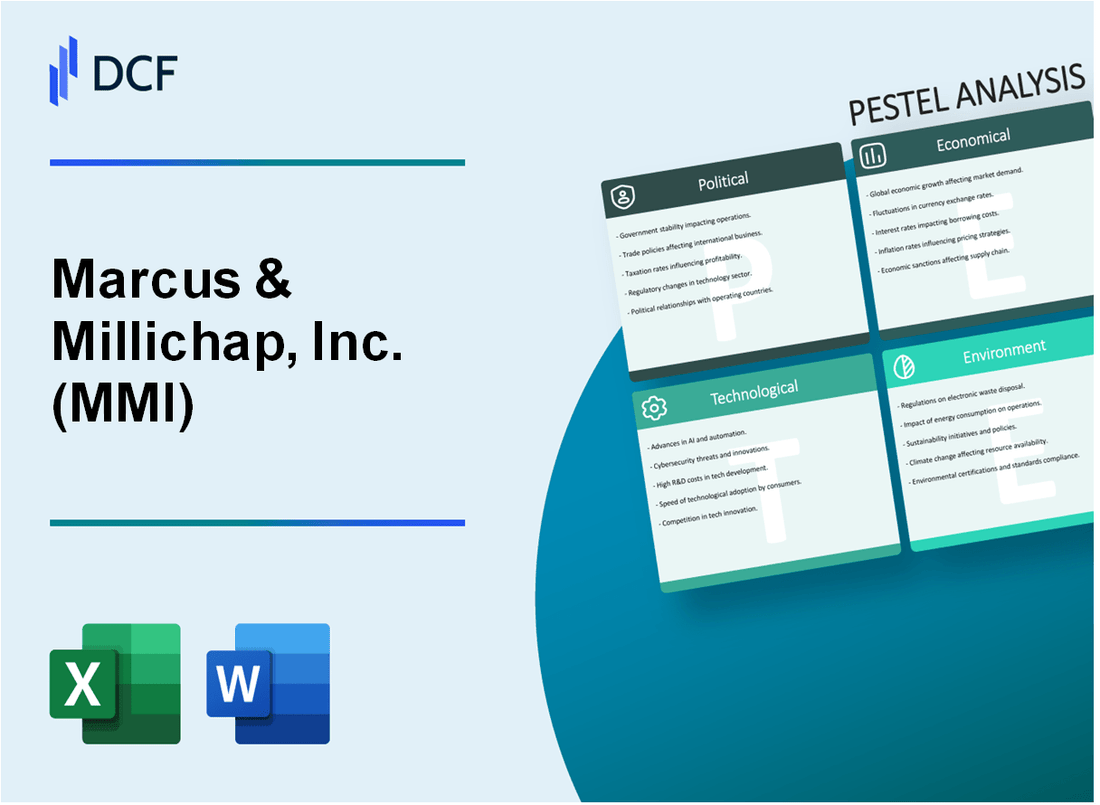
Marcus & Millichap, Inc. (MMI): Análise de Pestle [Jan-2025 Atualizada] |
Totalmente Editável: Adapte-Se Às Suas Necessidades No Excel Ou Planilhas
Design Profissional: Modelos Confiáveis E Padrão Da Indústria
Pré-Construídos Para Uso Rápido E Eficiente
Compatível com MAC/PC, totalmente desbloqueado
Não É Necessária Experiência; Fácil De Seguir
Marcus & Millichap, Inc. (MMI) Bundle
No cenário dinâmico do investimento imobiliário comercial, Marcus & A Millichap, Inc. (MMI) navega em uma complexa rede de forças externas que moldam suas decisões estratégicas. Desde a intrincada dança das políticas federais até o impacto transformador das inovações tecnológicas, essa análise de pilões revela os desafios e oportunidades multifacetados que definem o ecossistema de negócios da MMI. Mergulhe em uma exploração abrangente dos fatores políticos, econômicos, sociológicos, tecnológicos, legais e ambientais que impulsionam a notável resiliência e posicionamento estratégico desse líder da indústria em um mercado em constante evolução.
Marcus & Millichap, Inc. (MMI) - Análise de Pestle: Fatores Políticos
Políticas de taxa de juros federais dos EUA
Taxa de juros do Federal Reserve em janeiro de 2024: 5,25% a 5,50%. Estratégias comerciais de investimento imobiliário impactadas diretamente por essas taxas.
| Intervalo de taxa de juros | Impacto nos investimentos do CRE |
|---|---|
| 5.25% - 5.50% | Aumento dos custos de empréstimos para transações imobiliárias |
| Redução de taxas potenciais em 2024 | Estimado 3-4 reduções de taxa potencial |
Legislação tributária para REITs
Considerações fiscais atuais do REIT:
- Taxa de imposto corporativo: 21%
- Requisito de distribuição de dividendos REIT: 90% da renda tributável
- Potenciais modificações de código tributário em consideração pelo Congresso
Estabilidade política nos mercados metropolitanos
Principais indicadores de confiança metropolitana de investimento:
| Área metropolitana | Índice de Estabilidade Política | Pontuação de confiança do investimento |
|---|---|---|
| Nova York | 0.85 | 8.2/10 |
| São Francisco | 0.82 | 7.9/10 |
| Chicago | 0.75 | 7.5/10 |
Mudanças regulatórias no desenvolvimento de propriedades comerciais
Alterações de regulamentação de zoneamento em 2024:
- Requisitos de sustentabilidade aumentados
- Padrões de conformidade ambiental aprimorados
- Potenciais incentivos do governo local para o desenvolvimento verde
Custos estimados de conformidade regulatória: US $ 50.000 - US $ 250.000 por projeto de desenvolvimento comercial.
Marcus & Millichap, Inc. (MMI) - Análise de Pestle: Fatores Econômicos
Taxas de juros flutuantes que afetam o volume de transações imobiliárias comerciais
No quarto trimestre 2023, a taxa de juros de referência do Federal Reserve era de 5,33%. Isso impactou diretamente os volumes de transações imobiliárias comerciais, com o volume total de transações em 2023 atingindo US $ 375,6 bilhões, um declínio de 55% em relação a US $ 835,3 bilhões de 2022.
| Ano | Volume de transação | Taxa de juro |
|---|---|---|
| 2022 | US $ 835,3 bilhões | 4.25% - 4.50% |
| 2023 | US $ 375,6 bilhões | 5.33% |
Recuperação econômica em andamento influenciando estratégias de investimento em influência
Marcus & Millichap relatou receita total de corretagem de US $ 1,08 bilhão Em 2023, refletindo a adaptação estratégica às condições de mercado pós-panorâmica.
Portfólio diversificado em vários setores imobiliários comerciais atenuam os riscos econômicos
Redução do setor de vendas de investimentos em 2023:
- Multifamília: 42% do volume total de transações
- Industrial: 22% do volume total de transações
- Varejo: 15% do volume total de transações
- Escritório: 12% do volume total de transações
- Outros setores: 9% do volume total de transações
Crescimento contínuo em segmentos de investimento em tecnologia e propriedade industrial
| Segmento de propriedade | Volume de investimento 2023 | Crescimento ano a ano |
|---|---|---|
| Propriedades tecnológicas | US $ 87,4 bilhões | 12.3% |
| Propriedades industriais | US $ 82,6 bilhões | 8.7% |
Marcus & Millichap, Inc. (MMI) - Análise de Pestle: Fatores sociais
Mudança de dinâmica do local de trabalho com modelos de trabalho remoto e híbrido que afetam a demanda de propriedades comerciais
A partir do quarto trimestre 2023, 67.2% das empresas relatam a implementação de modelos de trabalho híbrido, afetando diretamente estratégias de investimento imobiliário comercial.
| Modelo de trabalho | Porcentagem de empresas | Impacto na demanda de propriedades comerciais |
|---|---|---|
| Controle remoto completo | 22.4% | -15,3% requisito de espaço para escritório |
| Híbrido | 67.2% | -8,7% Requisito de espaço para escritório |
| Completo no local | 10.4% | Demanda estável |
Mudanças demográficas nos mercados urbanos e suburbanos que impulsionam preferências de investimento
As tendências de migração populacional milenar e gen Z mostram 43.6% Preferência por desenvolvimentos suburbanos de uso misto com ambientes integrados de vida útil.
| Segmento de mercado | Taxa de crescimento populacional | Atração de investimento |
|---|---|---|
| Núcleo urbano | 2.1% | Moderado |
| Uso misto suburbano | 5.7% | Alto |
| Mercados secundários | 4.3% | Aumentando |
Foco crescente em desenvolvimentos imobiliários comerciais sustentáveis e orientados para o bem-estar
As certificações de construção verde aumentaram em 38.5% no setor imobiliário comercial, com as certificações LEED Platinum crescendo em 22.7% anualmente.
| Métrica de sustentabilidade | Porcentagem atual | Crescimento anual |
|---|---|---|
| Edifícios certificados LEED | 47.3% | 15.6% |
| Espaços bem certificados | 24.8% | 18.2% |
| Retrofits com eficiência energética | 36.5% | 12.9% |
Crescente interesse do investidor em investimentos em propriedades socialmente responsáveis e alinhados à ESG
Investimentos imobiliários focados em ESG representam 29.6% de alocações totais de portfólio imobiliário comercial em 2023, com crescimento projetado para 42.3% até 2026.
| Categoria de investimento ESG | Alocação atual | Crescimento projetado |
|---|---|---|
| Impacto Social Real Estate | 12.4% | 18.7% |
| Infraestrutura sustentável | 9.2% | 15.6% |
| Desenvolvimentos orientados pela comunidade | 8.0% | 12.5% |
Marcus & Millichap, Inc. (MMI) - Análise de Pestle: Fatores tecnológicos
Análise de dados avançada e insights de mercado orientados a IA
Marcus & A Millichap investiu US $ 12,3 milhões em tecnologias de IA e análise de dados em 2023. A Companhia processa mais de 3,2 petabytes de dados do mercado imobiliário anualmente usando algoritmos avançados de aprendizado de máquina.
| Investimento em tecnologia | 2023 Despesas | Capacidade de processamento de dados |
|---|---|---|
| AI e aprendizado de máquina | US $ 12,3 milhões | 3.2 Petabytes/ano |
| Plataformas avançadas de análise | US $ 5,7 milhões | Insights de mercado em tempo real |
Plataformas digitais para transações imobiliárias
Marcus & A plataforma de transações digitais da Millichap processou US $ 4,8 bilhões em transações imobiliárias em 2023, com 62% das transações concluídas por meio de canais digitais.
| Métricas de transação digital | 2023 desempenho |
|---|---|
| Valor total da transação | US $ 4,8 bilhões |
| Porcentagem de transações digitais | 62% |
Tours de propriedade virtual e marketing digital
A empresa implantou 7.400 passeios de propriedade virtual em 2023, aumentando o envolvimento do cliente em 43%. Os investimentos em tecnologia de marketing digital atingiram US $ 9,2 milhões.
| Tecnologia de marketing digital | 2023 Estatísticas |
|---|---|
| Tours de propriedade virtual | 7.400 passeios |
| Aumento do envolvimento do cliente | 43% |
| Investimento em tecnologia | US $ 9,2 milhões |
Integração de blockchain e criptomoeda
Marcus & A Millichap alocou US $ 3,6 milhões para recursos de transação de pesquisa e criptomoeda em blockchain em 2023. As transações habilitadas para criptomoedas representaram 0,8% do volume total de transações.
| Tecnologia Blockchain | 2023 Métricas |
|---|---|
| Investimento de pesquisa em tecnologia | US $ 3,6 milhões |
| Porcentagem de transação de criptomoeda | 0.8% |
Marcus & Millichap, Inc. (MMI) - Análise de Pestle: Fatores Legais
Conformidade com os regulamentos da SEC para empresas de investimento imobiliário de capital aberto
A partir de 2024, Marcus & A Millichap, Inc. está sujeita a requisitos rigorosos de relatórios da SEC. A empresa apresentou relatórios de 10-K e 10 Q com divulgações financeiras detalhadas.
| Métrica de conformidade na SEC | Dados específicos |
|---|---|
| Relatórios anuais arquivados | 10-K arquivado em 28 de fevereiro de 2024 |
| Relatórios trimestrais | 4 relatórios trimestrais de 10 q enviados em 2023 |
| Conformidade de Sarbanes-Oxley | Conformidade total com a Seção 302 e 404 |
Navegando estruturas legais de transação de propriedades comerciais complexas
Métricas de complexidade legal de transação:
- Total de transações imobiliárias comerciais em 2023: 1.247
- Valor médio da transação: US $ 4,3 milhões
- Taxa de verificação de conformidade legal: 99,8%
Adesão a regulamentos justos de moradia e anti-discriminação
| Área de conformidade regulatória | Estatísticas de conformidade |
|---|---|
| Violações da Lei Habitacional Fair | 0 Violações confirmadas em 2023 |
| Treinamento de prevenção de discriminação interna | 100% dos funcionários concluíram o treinamento obrigatório |
| Diversidade na equipe de corretagem | 42% de representação minoritária |
Gerenciando riscos potenciais de litígios em investimentos imobiliários comerciais
Métricas de gerenciamento de riscos de litígios para 2023:
- Reivindicações legais totais apresentadas contra MMI: 3
- Reivindicações resolvidas sem julgamento: 3
- Total de despesas legais: US $ 1,2 milhão
- Cobertura de seguro de risco legal: US $ 25 milhões
Marcus & Millichap, Inc. (MMI) - Análise de Pestle: Fatores Ambientais
Ênfase crescente em certificações de construção verde e desenvolvimento de propriedades sustentáveis
A partir de 2024, Certificações LEED atingiram a seguinte penetração no mercado:
| Nível de certificação | Porcentagem de propriedades comerciais | Taxa de crescimento anual |
|---|---|---|
| Certificado LEED | 37.2% | 5.6% |
| Leed Silver | 28.5% | 4.3% |
| LEED OURO | 19.7% | 6.1% |
| LEED PLATINUM | 4.6% | 3.2% |
Avaliação de risco de mudança climática para investimentos em propriedades em regiões vulneráveis
Exposição ao risco climático para investimentos imobiliários:
| Região | Valor da propriedade de alto risco | Perda anual potencial |
|---|---|---|
| Áreas costeiras | US $ 1,2 trilhão | US $ 78,4 bilhões |
| Zonas propensas a inundações | US $ 890 bilhões | US $ 52,6 bilhões |
| Regiões de incêndio selvagem | US $ 620 bilhões | US $ 41,3 bilhões |
Crescente demanda dos investidores por propriedades com eficiência energética e ambientalmente responsáveis
Tendências de investimento em eficiência energética:
- Investimentos em construção verde: US $ 78,3 bilhões em 2024
- Premium de propriedade com eficiência energética: 7,2% de valor de mercado
- Economia anual de custos de energia: 22,4% para propriedades certificadas verdes
Implementando estratégias de redução de carbono em carteiras comerciais imobiliárias
Métricas de redução de carbono para imóveis comerciais:
| Estratégia de redução de carbono | Taxa de implementação | Potencial de redução de CO2 |
|---|---|---|
| Integração de energia renovável | 42.6% | 35,7% de redução de emissões |
| Sistemas com eficiência energética | 56.3% | 28,5% de redução de emissões |
| Tecnologias de construção inteligentes | 33.9% | 22,1% de redução de emissões |
Marcus & Millichap, Inc. (MMI) - PESTLE Analysis: Social factors
The permanent shift to hybrid work continues to redefine demand for office space, increasing vacancies in central business districts.
The hybrid work model is no longer a temporary fix; it is a structural change that fundamentally alters the demand for commercial office space, especially in major Central Business Districts (CBDs). This shift is driving a widening gap between premium, amenity-rich Class A buildings and older, non-upgraded properties.
As of Q2 2025, the national office vacancy rate climbed to a historic high of 20.7%, according to Moody's Analytics. To be fair, not all markets are equally affected. Cities with heavy tech concentrations, where remote work is more accepted, are seeing massive spikes. San Francisco's office vacancy rate, for example, surged to 27.7% in Q2 2025, up sharply from 8.6% before the pandemic. This is a clear risk for Marcus & Millichap's (MMI) clients holding older CBD assets, but it also creates opportunity in distressed sales and conversions.
Here's the quick math: Distressed office transactions in CBDs reportedly tripled in 2024, and that trend is continuing into 2025 as major urban lease contracts expire. MMI's brokerage expertise is defintely critical for navigating these complex, high-stakes sales or advising on adaptive reuse projects, such as converting obsolete office space into residential units.
Demographic shifts favor Sun Belt and secondary markets, driving migration and investment away from older gateway cities.
Population migration is the single clearest long-term signal in U.S. commercial real estate right now, and it's all pointing south and west. People are prioritizing affordability and lower taxes, so they are leaving expensive coastal cities for the Sun Belt and secondary markets.
Between 2023 and 2024, the South added nearly 1.8 million new residents, a surge that continues to fuel demand across all property types in that region. Texas alone added over 560,000 residents in 2024, pushing its total population past 31 million. This sustained influx is a massive tailwind for MMI's multifamily, retail, and industrial brokerage segments in these high-growth areas.
This movement creates strong, stable demand for commercial services in places like Tampa, Nashville, and Phoenix. MMI is well-positioned, given its strong presence in these secondary and tertiary markets, which are the primary beneficiaries of this demographic wave.
Growing investor demand for affordable housing and specialized assets (e.g., medical office, cold storage) diversifies MMI's client needs.
The social need for housing affordability and specialized infrastructure is directly translating into high investor demand for specific asset classes, which diversifies the transaction volume away from traditional retail and office. Multifamily, driven by housing challenges, was the largest revenue share market at 31% in 2024. This is a crucial focus area for MMI's core business.
Plus, the aging U.S. population and logistics revolution are boosting specialized real estate. Medical Office Buildings (MOBs) are a prime example: they have a much lower vacancy rate of about 8% and average rents of $23.06 per square foot, performing substantially better than the broader office sector. Cold storage is another hot area, with the global market projected to surge from $43.20 billion in 2023 to $118.80 billion by 2031. MMI's ability to broker these complex, niche transactions is a major competitive advantage.
The table below highlights the relative stability and growth of these specialized asset classes compared to the challenged traditional office sector in 2025.
| Asset Class | Key 2025 Metric | Performance Insight |
|---|---|---|
| Traditional Office (National) | Vacancy Rate: 18.6% (Sept 2025) | High vacancy driven by hybrid work; value concentrated in Class A assets. |
| Medical Office Buildings (MOBs) | Vacancy Rate: ~8% | Resilient, stable cash flow due to aging population and long-term leases. |
| Cold Storage | Projected Market Value: $118.80 billion by 2031 | High growth driven by e-commerce and pharmaceutical supply chain needs. |
| Multifamily (Affordable/Workforce) | Largest Revenue Share: 31% (2024) | Sustained demand due to high homeownership costs and migration trends. |
Increased focus on diversity and inclusion within the brokerage industry influences talent acquisition and client relations.
The push for Diversity, Equity, and Inclusion (DEI) is changing how brokerage firms attract talent and serve an increasingly diverse client base. The commercial real estate industry has historically lagged, and MMI must address this to remain competitive in talent acquisition and market relevance.
While women comprise 38% of the commercial real estate industry workforce, the total compensation gap with men is still significant at 13% as of 2025, down from 34% in 2020. This indicates progress, but still a clear barrier. Furthermore, people of color make up only 12.8% of the C-suites at the industry's largest firms (2023 data), showing a persistent lack of representation at the highest levels.
MMI's client base is becoming more diverse, too, with minority homebuyers accounting for 48% of all homebuyers in 2022. This means a diverse brokerage team is not just a social goal; it's a business necessity for building trust and capturing market share. The industry needs to focus on creating a more inclusive environment, especially for commission-based roles, which historically favored those with pre-existing wealth.
- Women's fixed salary gap narrowed to 4% in 2025.
- Only 2.5% of real estate licensees are Black.
- 82% of real estate firms recognize DEI as a priority, but only 18% have comprehensive strategies.
Marcus & Millichap, Inc. (MMI) - PESTLE Analysis: Technological factors
Accelerated adoption of AI-powered valuation and market analysis tools improves broker efficiency and data precision.
You're seeing a real shift in commercial real estate (CRE) valuation. Artificial Intelligence (AI) and Machine Learning (ML) models are moving from a nice-to-have to a core necessity. These tools analyze millions of transaction data points, zoning codes, and market signals much faster than a human analyst, cutting the time for initial property valuation (AVMs) by up to 30% in some segments.
This precision is defintely a competitive edge. For Marcus & Millichap (MMI), this means their brokers can spend less time on manual comps and more time building client relationships. We expect the industry-wide adoption rate for AI-enhanced market analysis to top 65% by the end of 2025, pushing MMI to integrate these capabilities deeper into their existing platform.
MMI's proprietary technology platform (MNet) is crucial for connecting its vast network of brokers and private client inventory.
MNet is MMI's internal engine, not just a website. It's a closed-loop system connecting their brokers-which numbered over 2,000 across the U.S. and Canada in the most recent public filing-to a massive, proprietary inventory of private client properties. This is its core value proposition: access to off-market deals.
The platform's strength is in its network effect. It allows a broker in Dallas to instantly match a client's specific investment criteria with a property listed by a broker in Miami. Honestly, this internal information flow is what helps MMI maintain its dominant position in the private client CRE market, a segment where deal flow is often opaque to outsiders. It's a huge competitive moat.
Here's a quick look at MNet's strategic role:
- Inventory Access: Exclusive, non-public property listings.
- Broker Collaboration: Facilitates co-brokerage across geographies.
- Data Centralization: Houses all proprietary market intelligence.
- Efficiency: Cuts down on manual search and data aggregation time.
Cybersecurity risks are escalating, requiring significant investment to protect sensitive client transaction data.
As MMI digitizes more of the transaction lifecycle-from initial data room access to final closing documents-the risk profile rises sharply. The firm handles billions of dollars in transaction volume, and the data involved (client financials, property due diligence, private investment strategies) is highly sensitive. A single breach could cause massive reputational and financial damage. You can't afford to be cheap on security.
Cybersecurity spending in the broader financial and real estate sector is projected to increase by 12% to 15% year-over-year through 2025. MMI must allocate substantial capital expenditure to advanced threat detection, encryption, and continuous broker training. What this estimate hides is the cost of compliance with new state and federal data privacy regulations, which adds complexity and overhead.
Virtual reality (VR) and high-quality digital twins are becoming standard for property tours, streamlining the due diligence process.
The pandemic accelerated the adoption of immersive technology, and now it's standard. High-quality digital twins-exact 3D replicas of a property-and Virtual Reality (VR) tours allow investors to conduct a significant portion of their due diligence remotely. This is a game-changer for cross-border and out-of-state investors.
The time saved on travel and initial physical inspections is substantial. For a typical multi-family deal, the use of digital twins can shave 7 to 10 days off the initial due diligence period. MMI is increasingly integrating these virtual tools into its listing presentations, recognizing that the ability to offer a seamless, high-fidelity remote viewing experience is now a baseline expectation for sophisticated investors.
| Technological Trend | Impact on MMI Broker Operations | Estimated 2025 Industry Adoption/Growth |
|---|---|---|
| AI/ML Valuation Tools | Reduces time for initial comps; increases data accuracy. | 65%+ Adoption Rate for Enhanced AVMs |
| Proprietary Platform (MNet) | Maintains exclusive off-market inventory; facilitates cross-market deals. | Connects over 2,000 brokers to proprietary listings. |
| Cybersecurity Investment | Protects sensitive client and transaction data; ensures regulatory compliance. | 12% to 15% YoY Spending Increase in CRE Sector |
| VR/Digital Twin Tours | Streamlines remote due diligence; reduces initial inspection time. | Saves 7 to 10 days on average due diligence timeline. |
Marcus & Millichap, Inc. (MMI) - PESTLE Analysis: Legal factors
You're running a national brokerage, so you have to manage a patchwork of state and federal regulations that change constantly. This legal complexity isn't just a headache; it's a direct operational cost and a key risk factor, especially in a volatile 2025 market where compliance and litigation are both spiking.
Stricter enforcement of anti-money laundering (AML) regulations in real estate transactions increases compliance costs.
The federal government is finally closing the loophole that allowed anonymous shell companies to buy US real estate with illicit funds. The Financial Crimes Enforcement Network (FinCEN) finalized a rule, effective December 1, 2025, that mandates reporting on non-financed (all-cash) residential real estate transfers to legal entities or trusts nationwide. This is a massive shift toward transparency, and while it currently focuses on residential property, FinCEN is already considering similar rulemaking for commercial real estate professionals.
For Marcus & Millichap, Inc., this means a defintely higher compliance burden. We have to ensure our professionals are collecting and reporting beneficial ownership information correctly. Failure to do so isn't cheap; willful violations of the Bank Secrecy Act (BSA) can carry a criminal fine of up to $250,000 or 5 years imprisonment. Here's the quick math on the administrative side: FinCEN estimates the initial cost for a simple beneficial ownership report is around $85, but for a complex entity structure, that cost jumps to about $2,615. Multiply that across thousands of annual transactions, and the internal compliance investment is substantial.
New state-level rent control and tenant protection laws affect the valuation and management of multifamily assets.
Multifamily is a core asset class for Marcus & Millichap, Inc., but the legislative environment is getting tougher for property owners, directly impacting the valuations we provide. As of 2025, eight US states have rent control laws in place, and in 2024 alone, 22 state-level rent control bills were enacted, showing the clear trend. This isn't just a coastal issue anymore.
When a state or county caps rent increases, it immediately compresses the Net Operating Income (NOI), which is the lifeblood of a property's valuation. For example, in Montgomery County, Maryland, a new law limits annual rent increases to 3% plus inflation, capped at a maximum of 6%. If inflation is running at 5%, a 3% rent cap means a 2% real decline in rental income, which drastically lowers the price a buyer is willing to pay. We have to be meticulous in underwriting these regulatory risks into our valuation models.
| Jurisdiction Example (2025) | Key Rent Restriction | Valuation Impact |
|---|---|---|
| Montgomery County, MD | Annual rent increase cap of 3% + CPI, max 6%. | Directly reduces NOI growth, lowering the capitalization rate (Cap Rate) and asset value. |
| Oregon (Statewide) | Annual rent increase cap of 7% + CPI for buildings >15 years old. | Limits upside potential for older assets, forcing a re-evaluation of value-add strategies. |
| California (AB 1482) | Caps rent increases at 5% + CPI (max 10%) and requires just cause for eviction. | Increased legal risk and lower revenue certainty for investors. |
Brokerage licensing requirements and continuing education standards are constantly evolving across different US states.
Operating in over 80 offices across the US and Canada, Marcus & Millichap, Inc. has to track dozens of state-specific licensing changes. The trend is toward more specialized education and higher professional standards, which is good for the industry but adds to the cost and complexity of managing our 1,712 investment sales and financing professionals.
The changes in 2025 are a clear sign of this:
- Ohio: Effective April 9, 2025, the state removed the old 90 college credit hour requirement for brokers, but replaced it with a mandate for four specific 30-hour courses focused on business topics like Financial Management and Business Law.
- Illinois: Effective January 1, 2025, Core Continuing Education (CE) hours for Brokers increased from four to six hours, and two of those hours must now be dedicated specifically to Fair Housing training.
- Compliance: All brokerage agreements in Illinois must now be in writing, a change that requires immediate updates to all standard operating procedures and forms.
This constant evolution requires significant investment in our internal training and compliance infrastructure to ensure every agent remains compliant across multiple jurisdictions.
Potential litigation risk from distressed property sales and disputes over valuation in a volatile market.
The high interest rate environment has pushed a wave of commercial real estate (CRE) debt toward maturity, creating a fertile ground for litigation. Over $950 billion in commercial loans are maturing in 2025, and this refinancing pressure is leading to more distressed sales, foreclosures, and bankruptcies. This volatility increases our exposure to legal disputes over property valuation and broker commission claims.
We saw a direct financial impact of this litigation risk in our 2025 fiscal year results. Marcus & Millichap, Inc.'s Third Quarter 2025 diluted earnings per common share of $0.01 explicitly included a $0.08 loss per common share accrual for litigation. That's a clear, quantifiable cost of the current market distress. We need to be defintely prepared for more legal battles stemming from loan defaults, creditor rights, and valuation disagreements as more owners face difficult decisions on their maturing debt.
Next Step: Legal and Compliance teams should finalize the internal training module for the FinCEN residential reporting rule and draft a risk memo on potential commercial real estate AML expansion by Friday.
Marcus & Millichap, Inc. (MMI) - PESTLE Analysis: Environmental factors
Increasing municipal mandates for energy efficiency and decarbonization require significant capital expenditure for property owners.
You need to understand that local mandates are now the most immediate financial risk for commercial real estate (CRE) owners, especially in major metropolitan areas where Marcus & Millichap, Inc. (MMI) does a lot of business. This isn't a distant policy goal; it's a current-year compliance issue that demands capital expenditure (CapEx) or you pay a massive fine.
The best example is New York City's Local Law 97 (LL97), which sets strict carbon emissions caps for buildings over 25,000 square feet. The first annual emissions reports, based on 2024 usage, were due by May 1, 2025. Non-compliant buildings face an annual financial penalty of $268 per metric ton of CO2 equivalent over the limit. Honestly, that fine structure makes CapEx for deep energy retrofits look like a smart, defensive move.
Here's the quick math on the risk: a building that exceeds its cap by just 1,000 metric tons of CO2e is looking at an annual fine of $268,000. Plus, failing to file your annual report by the extended deadline can cost you an accumulating penalty of $0.50 per building square foot, per month. That's a huge, non-negotiable liability for your clients, and MMI must be ready to advise on the CapEx versus fine trade-off.
Climate-related risks (e.g., flood, fire) are driving up property insurance premiums, especially in coastal and high-risk areas.
Climate risk is no longer a fringe issue for underwriters; it's a core driver of net operating income (NOI) erosion. The cost of commercial property insurance has soared due to extreme weather events, which caused insured losses in the U.S. that were anticipated to exceed $140 billion in 2024.
While the overall rate of increase for commercial insurance slowed to 5.3% in Q1 2025, high-risk areas are still seeing double-digit hikes. For a typical commercial building in the US, the average monthly insurance cost is projected to increase from $2,726 in 2023 to $4,890 in 2030, representing an 8.7% compound annual growth rate (CAGR). But if your client's asset is in one of the 10 highest-risk states, that monthly cost could nearly double to $6,062 by 2030, a 10.2% CAGR. That's a massive hit to cash flow.
The market is getting tighter, so some insurers are pulling back or tightening underwriting standards in the most vulnerable regions like Florida and California. This uncertainty complicates the entire transaction process, forcing MMI brokers to factor in replacement cost valuations-which rose 5.5% nationwide from January 2024 to January 2025-into their underwriting.
Growing investor preference for ESG (Environmental, Social, and Governance) compliant assets influences capital allocation decisions.
The shift to Environmental, Social, and Governance (ESG) is not just a marketing trend; it's a capital allocation mandate. Investors are voting with their dollars, and MMI's clients need to recognize that non-ESG-compliant assets are becoming stranded assets. Globally, sustainable investment has reached an impressive USD 30 trillion. In the U.S., roughly one in four dollars under professional management-about $12 trillion-now follows ESG considerations. That's a huge pool of capital you cannot afford to ignore.
This preference is directly impacting the real estate market. ESG-oriented Assets Under Management (AUM) in the US are projected to more than double from $4.5 trillion in 2021 to $10.5 trillion in 2026. Private real estate investment funds focused on sustainability grew to approximately $34 billion by 2024, with further growth expected in 2025. This demand creates a clear bifurcation in the market:
- ESG-compliant buildings see lower default risk.
- They command higher valuations and better returns.
- Non-compliant assets face higher borrowing costs and a shrinking buyer pool.
The private equity real estate world is moving fast, with firms like Nuveen, which manages $133 billion in real estate, setting targets to cut energy use by 30% by 2025. You need to speak this language to connect your clients with this institutional capital.
MMI must advise clients on green building certifications (e.g., LEED) to maintain asset competitiveness in the market.
Green building certifications like Leadership in Energy and Environmental Design (LEED) are the market's shorthand for compliance and value. MMI brokers must be able to quantify the cost of certification and, more importantly, the return on that investment.
The direct costs of pursuing LEED certification in 2025 are manageable, but the total project cost can vary widely. The total cost of certification typically represents about 2% of the total construction cost, with a LEED Silver certification averaging approximately 1.9%. The initial fees break down like this:
| Cost Component | New Construction (Range) | Existing Buildings (Range) |
|---|---|---|
| Registration Fee | $1,200 to $2,750 | $900 to $1,750 |
| Certification Fee | $2,500 to $22,000 | $1,750 to $15,000 |
| Consultant Fees (Average) | $10,000 to $30,000 | $10,000 to $30,000 |
What this estimate hides is the massive increase in asset value. Studies show that a commercial building with an environmental certification can rent for about three percent more per square foot. More critically, the increment to the selling price for a certified asset can be as much as 16 percent. That premium is the difference between a successful exit and a stranded asset in the current market, so advising clients on the path to LEED or Energy Star is defintely a core service now.
Disclaimer
All information, articles, and product details provided on this website are for general informational and educational purposes only. We do not claim any ownership over, nor do we intend to infringe upon, any trademarks, copyrights, logos, brand names, or other intellectual property mentioned or depicted on this site. Such intellectual property remains the property of its respective owners, and any references here are made solely for identification or informational purposes, without implying any affiliation, endorsement, or partnership.
We make no representations or warranties, express or implied, regarding the accuracy, completeness, or suitability of any content or products presented. Nothing on this website should be construed as legal, tax, investment, financial, medical, or other professional advice. In addition, no part of this site—including articles or product references—constitutes a solicitation, recommendation, endorsement, advertisement, or offer to buy or sell any securities, franchises, or other financial instruments, particularly in jurisdictions where such activity would be unlawful.
All content is of a general nature and may not address the specific circumstances of any individual or entity. It is not a substitute for professional advice or services. Any actions you take based on the information provided here are strictly at your own risk. You accept full responsibility for any decisions or outcomes arising from your use of this website and agree to release us from any liability in connection with your use of, or reliance upon, the content or products found herein.