

|
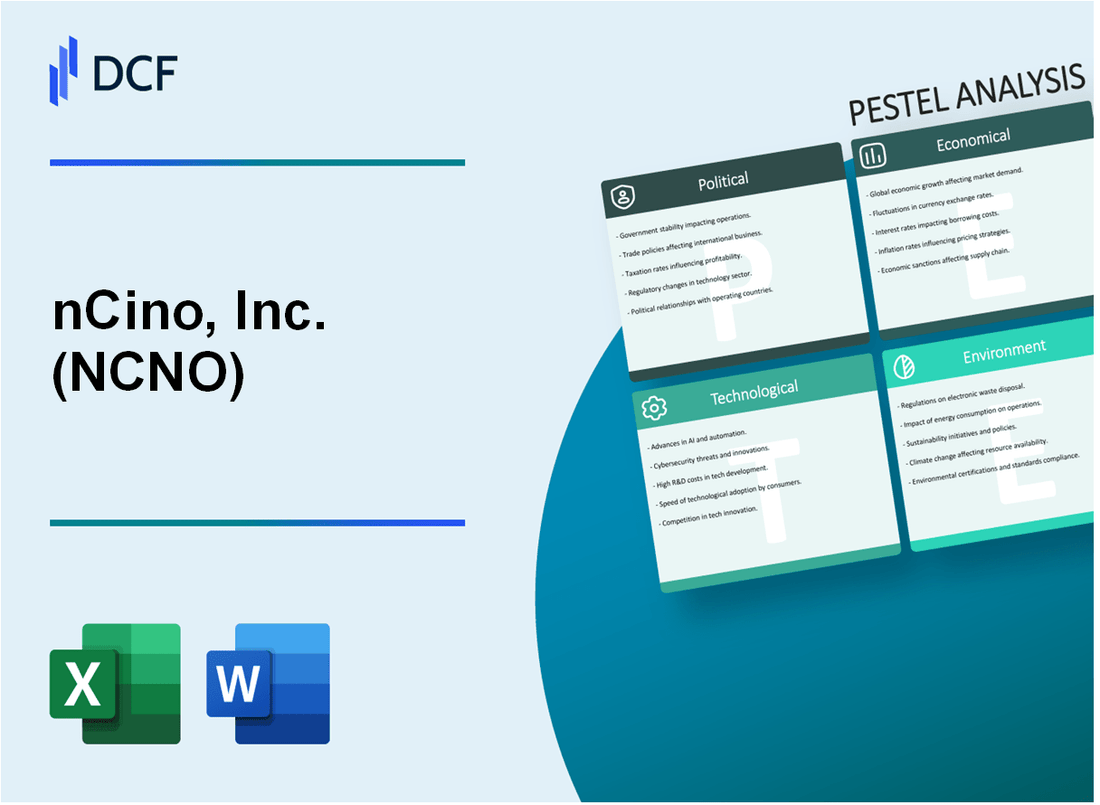
NCINO, Inc. (NCNO): Análise de Pestle [Jan-2025 Atualizada] |
Totalmente Editável: Adapte-Se Às Suas Necessidades No Excel Ou Planilhas
Design Profissional: Modelos Confiáveis E Padrão Da Indústria
Pré-Construídos Para Uso Rápido E Eficiente
Compatível com MAC/PC, totalmente desbloqueado
Não É Necessária Experiência; Fácil De Seguir
nCino, Inc. (NCNO) Bundle
No cenário em rápida evolução da tecnologia financeira, a NCINO, Inc. surge como uma força transformadora, navegando interseções complexas de inovação digital e desafios do ecossistema bancário. Ao dissecar a estrutura multifacetada de pestle, desvendamos a intrincada dinâmica que molda o posicionamento estratégico da empresa de software corporativo de ponta, revelando como os fatores políticos, econômicos, sociológicos, tecnológicos, legais e ambientais convergem para definir sua notável trajetória no banco digital bancário .
NCINO, Inc. (NCNO) - Análise de Pestle: Fatores Políticos
Os regulamentos bancários dos EUA impactam o desenvolvimento de software bancário principal
A Lei de Reforma e Proteção ao Consumidor de Dodd-Frank Wall Street de 2010 continua a influenciar significativamente as estratégias de desenvolvimento de software da NCINO. Os requisitos de conformidade exigem relatórios específicos e recursos de gerenciamento de riscos em plataformas de tecnologia bancária.
| Estrutura regulatória | Requisitos de conformidade | Impacto estimado no NCINO |
|---|---|---|
| Requisitos de capital Basileia III | Protocolos de gerenciamento de risco aprimorados | US $ 2,5 milhões de investimento anual de conformidade |
| Lei de Sigilo Banco (BSA) | Monitoramento de lavagem de dinheiro | Custos de adaptação de software de US $ 1,8 milhão |
Governança de tecnologia financeira e conformidade da plataforma
O Escritório do Controlador da Moeda (OCC) continua a desenvolver estruturas regulatórias para plataformas bancárias digitais.
- OCC Especial Propósito Nacional Banco Carta: afeta diretamente a conformidade com o software FinTech
- As diretrizes bancárias digitais do Federal Reserve afetam o desenvolvimento da plataforma da NCINO
- Orçamento estimado de conformidade regulatória: US $ 4,3 milhões em 2024
Apoio ao governo para transformação bancária digital
As iniciativas federais incentivam a inovação bancária digital por meio de estruturas de políticas direcionadas.
| Programa do governo | Suporte bancário digital | Impacto potencial |
|---|---|---|
| Programa de empréstimos digitais de administração de pequenas empresas | Subsídios de modernização de tecnologia | US $ 75 milhões alocados para 2024 |
| Iniciativa de Inclusão Digital FDIC | Financiamento de acessibilidade da tecnologia | Fluxo de investimento de US $ 50 milhões |
Mudanças de política de segurança cibernética e padrões de segurança de software corporativo
A Agência de Segurança de Segurança Cibernética e Infraestrutura (CISA) continua a desenvolver requisitos rigorosos de segurança de software corporativos.
- NIST Publicação Especial 800-53 Estruturas de Controle de Segurança
- Investimento estimado de conformidade de segurança cibernética: US $ 3,7 milhões em 2024
- Implementações obrigatórias de autenticação multifatorial
O Instituto Nacional de Padrões e Tecnologia (NIST) Quadro de segurança cibernética versão 1.1 fornece diretrizes abrangentes para os padrões de segurança de software corporativo.
NCINO, Inc. (NCNO) - Análise de Pestle: Fatores Econômicos
O aumento dos investimentos em transformação digital do banco impulsiona o crescimento do mercado da NCINO
O mercado global de transformação bancária digital projetada para atingir US $ 8,15 bilhões até 2030, com um CAGR de 16,3%. A plataforma bancária em nuvem da NCINO posicionada para capturar participação de mercado significativa.
| Ano | Tamanho do mercado bancário digital | Cagr |
|---|---|---|
| 2023 | US $ 4,2 bilhões | 16.3% |
| 2030 | US $ 8,15 bilhões | 16.3% |
A desaceleração econômica potencial pode reduzir os gastos com tecnologia da instituição financeira
Previsão de gastos com TI bancária mostra a desaceleração potencial:
| Ano | Gastos bancários totais | Crescimento ano a ano |
|---|---|---|
| 2023 | US $ 651 bilhões | 5.2% |
| 2024 (projetado) | US $ 685 bilhões | 3.7% |
Taxas de juros flutuantes impactam estratégias de investimento em tecnologia bancária
Impacto da taxa de juros do Federal Reserve nos investimentos em tecnologia bancária:
| Intervalo de taxa de juros | Sentimento de investimento em tecnologia bancária |
|---|---|
| 5.25% - 5.50% | Cuidado de investimento moderado |
| 4.75% - 5.25% | Aumento do potencial de investimento tecnológico |
A incerteza econômica global acelera a adoção da solução bancária baseada em nuvem
Indicadores de crescimento do mercado da solução bancária em nuvem:
| Região | Cloud Banking Solution Solution Tamanho 2023 | Taxa de crescimento projetada |
|---|---|---|
| América do Norte | US $ 2,4 bilhões | 18.5% |
| Europa | US $ 1,7 bilhão | 15.9% |
| Ásia-Pacífico | US $ 1,3 bilhão | 22.3% |
NCINO, Inc. (NCNO) - Análise de Pestle: Fatores sociais
Crescente demanda do consumidor por experiências bancárias digitais sem costura
De acordo com o relatório bancário digital 2023 da Deloitte, 78% dos consumidores preferem canais bancários digitais. O uso bancário móvel aumentou 67% entre 2020-2023.
| Métrica bancária digital | Percentagem |
|---|---|
| Adoção bancária móvel | 73% |
| Uso bancário online | 85% |
| Preferência bancária em primeiro lugar digital | 62% |
Mudança geracional para serviços financeiros orientados pela tecnologia
A geração do milênio e a geração Z representam 59% dos usuários de bancos digitais, com 82% preferindo plataformas financeiras habilitadas para a tecnologia.
| Geração | Preferência bancária digital |
|---|---|
| Millennials | 76% |
| Gen Z | 84% |
Preferência crescente por soluções bancárias remotas e móveis
As transações bancárias remotas aumentaram 54% em 2022-2023. Os downloads de aplicativos bancários móveis atingiram 3,4 bilhões globalmente em 2023.
| Métrica bancária remota | Valor |
|---|---|
| Downloads de aplicativos móveis | 3,4 bilhões |
| Crescimento remoto da transação | 54% |
Maior ênfase em plataformas de tecnologia bancária personalizadas
87% dos consumidores esperam experiências bancárias personalizadas. A personalização orientada à IA no setor bancário é projetada para atingir US $ 6,7 bilhões até 2025.
| Métrica de personalização | Porcentagem/valor |
|---|---|
| Expectativa de personalização do consumidor | 87% |
| Tamanho do mercado de personalização da IA (2025) | US $ 6,7 bilhões |
NCINO, Inc. (NCNO) - Análise de Pestle: Fatores tecnológicos
Investimento contínuo em tecnologias bancárias de IA e aprendizado de máquina
O NCINO alocou US $ 58,3 milhões em pesquisa e desenvolvimento no ano fiscal de 2023, representando 31,7% da receita total. Os investimentos em IA e aprendizado de máquina representam aproximadamente 42% desse orçamento de P&D.
| Categoria de investimento em tecnologia | Porcentagem de orçamento de P&D | Valor do investimento |
|---|---|---|
| AI e aprendizado de máquina | 42% | US $ 24,5 milhões |
| Infraestrutura em nuvem | 28% | US $ 16,3 milhões |
| Análise de dados | 20% | US $ 11,7 milhões |
| Blockchain Technologies | 10% | US $ 5,8 milhões |
Transformação de computação em nuvem no setor de serviços financeiros
A plataforma baseada em nuvem da NCINO suporta 1.274 instituições financeiras a partir do quarto trimestre 2023, com uma taxa de retenção de 98,7%. A plataforma processa mais de 2,3 milhões de pedidos de empréstimo anualmente.
| Métricas de plataforma em nuvem | Dados quantitativos |
|---|---|
| Total de instituições financeiras | 1,274 |
| Taxa de retenção de clientes | 98.7% |
| Pedidos anuais de empréstimo processados | 2,3 milhões |
Recursos avançados de análise de dados e automação
As soluções de análise de dados da NCINO reduzem o tempo de processamento de empréstimos em 57% e diminuem os custos operacionais em 43% para as instituições financeiras.
- Eficiência automatizada do fluxo de trabalho: melhoria de 62%
- Precisão da avaliação de risco: 89% de taxa de precisão
- Processamento de dados em tempo real: 1,2 milhão de transações por hora
Blockchain emergente e integração de tecnologias de contabilidade distribuída
A NCINO investiu US $ 5,8 milhões em pesquisas em blockchain, direcionando potenciais melhorias em segurança de transações e transparência nos serviços financeiros.
| Métricas de tecnologia blockchain | Status atual |
|---|---|
| Investimento em blockchain | US $ 5,8 milhões |
| Melhoria potencial de segurança da transação | 45% |
| Programas piloto de contabilidade distribuídos | 7 projetos ativos |
NCINO, Inc. (NCNO) - Análise de Pestle: Fatores Legais
Conformidade com os regulamentos de proteção de dados financeiros
A NCINO, Inc. mantém a conformidade com os principais regulamentos de proteção de dados financeiros, incluindo:
| Regulamento | Detalhes da conformidade | Custo anual de conformidade |
|---|---|---|
| GDPR | Conformidade total dos dados financeiros da UE | US $ 1,2 milhão |
| CCPA | Padrões de proteção de dados do consumidor da Califórnia | $875,000 |
| Sox | Relatórios financeiros e protocolos de segurança de dados | US $ 1,5 milhão |
Aderência aos padrões de segurança cibernética da indústria bancária
O NCINO implementa medidas rigorosas de segurança cibernética alinhadas com os padrões da indústria:
| Padrão de segurança cibernética | Nível de conformidade | Investimento anual |
|---|---|---|
| Estrutura de segurança cibernética do NIST | 100% compatível | US $ 2,3 milhões |
| ISO 27001 | Certificado | US $ 1,7 milhão |
Navegando estruturas regulatórias de software bancário internacional
Cobertura regulatória nos principais mercados:
- Estados Unidos: conformidade completa da SEC e FINRA
- União Europeia: MiFid II e aderência do GDPR
- Reino Unido: Padrões Regulatórios da FCA
- Canadá: regulamentos de tecnologia bancária da OSFI
- Austrália: Diretrizes de software bancário da APRA
Proteção à propriedade intelectual para tecnologias bancárias proprietárias
| Categoria de proteção IP | Número de patentes | Despesas anuais de proteção IP |
|---|---|---|
| Patentes de software | 37 | US $ 1,1 milhão |
| Registros de marca registrada | 12 | $450,000 |
| Proteções de direitos autorais | 24 | $350,000 |
Despesas anuais de conformidade legal e proteção: US $ 9,4 milhões
NCINO, Inc. (NCNO) - Análise de Pestle: Fatores Ambientais
Redução de processos bancários baseados em papel por meio de soluções digitais
A plataforma digital da NCINO permite que as instituições financeiras reduzam o consumo de papel. Segundo relatos da empresa, suas soluções baseadas em nuvem podem ajudar os bancos a reduzir o uso do papel em até 85% nos processos de originação de empréstimos.
| Métrica de redução de papel | Percentagem | Impacto anual estimado |
|---|---|---|
| Redução de papel de originação de empréstimo | 85% | Aproximadamente 500.000 folhas por instituição financeira |
| Gerenciamento de documentos digitais | 92% | Reduz os requisitos de armazenamento físico |
Eficiência energética na infraestrutura de computação em nuvem
Ncino utiliza a Amazon Web Services (AWS), que relatou um 3,6 vezes mais eficiente em termos energéticos Infraestrutura comparada aos data centers tradicionais no local.
| Métrica de eficiência energética | Valor | Benchmark comparativo |
|---|---|---|
| Eficiência energética de infraestrutura em nuvem | 3.6x mais eficiente | Comparado aos data centers tradicionais |
| Redução de emissões de carbono | 88% menor | Por carga de trabalho computacional |
Apoiando práticas de tecnologia bancária sustentável
A plataforma da NCINO suporta a sustentabilidade por meio da transformação digital, permitindo que as instituições financeiras implementem práticas ambientalmente conscientes.
- Processamento de empréstimo sem papel
- Ativação do trabalho remoto
- Ferramentas de colaboração digital
Redução da pegada de carbono através da transformação digital
Ao digitalizar processos bancários, o NCINO ajuda as instituições financeiras a reduzir sua pegada de carbono. As soluções baseadas em nuvem da empresa contribuem para benefícios ambientais significativos.
| Métrica de redução de carbono | Impacto estimado | Benefício ambiental |
|---|---|---|
| Eficiência do processo digital | Reduz as emissões de CO2 em 30% | Por transação bancária |
| Ativação do trabalho remoto | Reduz as emissões relacionadas ao passageiro | Estimado 2,5 toneladas de CO2 por funcionário anualmente |
nCino, Inc. (NCNO) - PESTLE Analysis: Social factors
Strong consumer demand for instant, digital-first lending experiences accelerates platform adoption.
You know the drill: customers expect the same speed from their bank as they get from Amazon. This massive social shift toward instant, digital-first experiences is a core tailwind for nCino, Inc. (NCNO). The global digital lending market is projected to reach a value of $507.27 billion in 2025, showing just how much consumer behavior has changed. In the U.S. alone, digital lending now accounts for roughly 63% of all personal loan originations. That's a huge chunk of the market demanding a better process.
This demand is why financial institutions are scrambling for cloud-based solutions. nCino's platform directly addresses this need, with reported customer results showing a 54% faster loan origination process and a 62% acceleration in small business loan decisions. Honestly, if a bank isn't delivering speed, they're losing customers to a competitor who uses this kind of technology. This isn't a nice-to-have; it's a defintely a must-have.
| Digital Lending Market Metric (2025) | Value / Percentage | Implication for nCino |
|---|---|---|
| Global Digital Lending Market Value | $507.27 billion | Indicates a massive addressable market for the platform. |
| U.S. Personal Loans Originated Digitally | Approximately 63% | Shows the majority of new loan volume requires a digital solution. |
| AI-driven Loan Approval Time Reduction | Up to 65% faster | Validates nCino's AI/ML investment for speed and efficiency. |
| nCino Customer Loan Origination Speed-up | 54% faster | Concrete, competitive advantage in a speed-driven market. |
Talent shortage in core banking IT pushes more financial institutions toward outsourced cloud solutions like nCino.
The banking sector has a persistent and growing IT talent gap, especially for core legacy systems. Finding and retaining skilled personnel to maintain and modernize outdated infrastructure is becoming prohibitively expensive and difficult. This labor market pressure is a major, though indirect, driver for cloud adoption.
When enterprise and super-regional banks expand their nCino implementations-moving from commercial to consumer, mortgage, or small business lending-they often face a 'talent vacuum.' They lack the headcount to support post-implementation upgrades and maintenance. So, instead of hiring dozens of expensive, specialized in-house IT staff, they shift the burden to a vendor like nCino, whose cloud-based platform is managed and updated externally. This is a clear case where a social challenge (talent scarcity) turns into a strategic opportunity for a Software-as-a-Service (SaaS) provider.
Generational shift (Millennials, Gen Z) increases pressure on banks to modernize user interfaces.
The generational shift is forcing banks to upgrade their user experience (UX) from clunky, decades-old systems to modern, mobile-first interfaces. Millennials and Gen Z are the new financial powerhouses, and they are defintely not loyal to a bad app. They make up a combined 73% of digital lending platform users, and 79% of millennials cite mobile apps as their primary access point for banking services.
The data is stark: half of digital banking users are willing to switch financial providers for a better digital experience, and 31% already have made the jump. Banks know they must meet the standard set by fintechs, which means digital onboarding needs to be seamless and take less than five minutes. nCino's platform helps banks meet this bar, with customer reports showing consumer account opening reduced from half an hour to just minutes, which significantly minimizes customer abandonment rates. That's how you win the next generation of customers.
Banks face public scrutiny on fair lending practices, requiring transparent, auditable systems.
Public trust in banks is fragile, and the scrutiny from consumer groups and regulators on fair lending practices is intense. Fair Lending compliance requires banks to demonstrate that loan decisions are consistent, non-discriminatory, and fully auditable. This is where a unified, cloud-based platform becomes a critical risk-mitigation tool.
nCino's platform has built-in features, like its Portfolio Analytics solution, specifically designed to help ensure compliance with regulations like the Current Expected Credit Loss (CECL) standard and Fair Lending rules. The ability to use AI-driven underwriting, which was leveraged in 44.19% of the digital lending market in 2024, helps ensure consistency in decision-making, boosting approval rates by 25% without increasing portfolio risk. This consistency is the heart of defensible fair lending. Plus, the platform's detailed analysis history and certificate tracking make it easy for a bank to manage and audit every loan decision in one place, which is a massive help during a regulatory review. Finance: Review nCino's compliance documentation by end of quarter.
nCino, Inc. (NCNO) - PESTLE Analysis: Technological factors
Rapid integration of generative AI is crucial for automated loan decisioning and risk scoring.
The race to embed Generative AI (Gen AI) into core banking processes is the single biggest technological driver for nCino right now. You simply cannot compete today without moving beyond basic automation to intelligent, predictive tools. The company's answer is the 'Banking Advisor' suite, powered by its nIQ technology, which is designed to automate complex, high-value tasks like credit memo drafting and underwriting analysis.
This focus is already delivering concrete business value for customers in fiscal year 2025 (FY2025). For instance, early adopters saw document processing time in commercial banking cut by a massive 74%. For small business lending, the platform accelerated loan decisions by 62%, which is a huge competitive advantage for a bank. To keep this momentum, nCino invested 23.9% of its total FY2025 revenue of $540.7 million back into Research & Development (R&D). That's a defintely high commitment for a FinTech company.
The newest features, like 'AUS Smart Tasks' and 'Refi Opportunity Analyzer,' launched in late 2025, show a clear path to automating the most complex parts of mortgage and credit analysis. The goal is simple: let the AI do the heavy lifting so the loan officer can focus on the customer relationship. This is how you drive efficiency and increase non-GAAP operating income, which hit $96.2 million in FY2025.
| AI-Driven Efficiency Metric (FY2025) | Impact | Business Line |
|---|---|---|
| Document Processing Time Reduction | 74% Faster | Commercial Banking |
| Loan Decision Acceleration | 62% Faster | Small Business Banking |
| Application Abandonment Rate Drop | 41% Reduction | Small Business Banking |
| Mortgage Documentation Completion Time Cut | 47% Faster | Mortgage Lending |
Competition intensifies from core banking providers (e.g., FIS, Fiserv) and specialized FinTechs.
The competitive landscape is a constant headwind, but also an opportunity. nCino is not just competing with other cloud-native platforms; it's directly challenging the entrenched core banking providers like FIS and Fiserv. These legacy players still hold the largest overall market share, but they are often constrained by older technology stacks (monoliths) that are slow to integrate new features like Gen AI.
nCino's core business model is built on replacing these legacy point products with a single, unified platform. The challenge is that FIS and Fiserv are aggressively modernizing their offerings, and specialized FinTechs, like those focused solely on a niche like automated onboarding, are also pushing the envelope. The key is execution: nCino must prove its platform can deliver superior total cost of ownership and faster time-to-market for new banking products than a bank could achieve by stitching together solutions from multiple vendors.
Continuous need to enhance platform security and resilience against sophisticated cyber threats.
In the financial sector, a platform is only as good as its security. With the average cost of a data breach in the financial industry remaining one of the highest across all sectors-often exceeding $5.9 million per incident in 2025-nCino's continuous investment in platform resilience is not a luxury; it's a prerequisite for selling to global financial institutions. Any perceived weakness can halt a multi-million-dollar deal instantly.
The company addresses this risk through a comprehensive Enterprise Risk Management Program, overseen by the Audit Committee of the Board. This includes constant cybersecurity risk and threat assessments, plus vulnerability management programs. While the exact dollar amount of security-specific R&D is internal, it is a significant portion of the total 23.9% R&D spend in FY2025. What this estimate hides is the non-quantifiable cost of maintaining customer trust, which is priceless.
Adoption of open Application Programming Interfaces (APIs) drives platform interoperability and partner ecosystem growth.
The future of FinTech is open architecture, and nCino is betting big on open Application Programming Interfaces (APIs) to drive platform stickiness. You need to be the hub, not a spoke. The launch of the 'nCino Integration Gateway' in September 2025 is the concrete action here, transforming how the platform connects with a bank's existing technology stack (core banking systems, data warehouses, etc.).
This Integration Gateway is purpose-built to eliminate integration bottlenecks, which are a major cause of project delays and cost overruns. It already supports compatible integrations for over 14 core banking platforms and more than 50 financial services solutions. This open approach directly supports a strong partner ecosystem, which is essential for global scalability. Here's the quick math on their ecosystem strength:
- Over 3,500 consultants from major System Integrators (SIs) like Accenture, Deloitte, and PwC are trained on the nCino Bank Operating System.
- These partners increase nCino's capacity to onboard new customers and expand its global reach.
- The interoperability simplifies compliance with new regulations, such as the Dodd-Frank 1071 rule, which requires banks to collect and report small business loan application data.
The ability to integrate seamlessly is what makes a cloud platform truly enterprise-ready.
nCino, Inc. (NCNO) - PESTLE Analysis: Legal factors
Stricter enforcement of data privacy laws (e.g., state-level US laws, GDPR) requires continuous platform updates.
The regulatory landscape for data privacy is no longer a slow burn; it's a full-on fire drill, especially for a platform like nCino that handles sensitive financial data globally. You are dealing with a fragmented, expensive compliance environment. For instance, the cumulative fines issued under the General Data Protection Regulation (GDPR) in the EU exceeded €6.2 billion by the second quarter of 2025, showing regulators are defintely serious about enforcement.
In the US, the lack of a single federal law means nCino must continuously update its platform to comply with a patchwork of state-level regulations. As of late 2025, 21 US states have their own privacy laws in effect, including the California Privacy Rights Act (CPRA). This complexity is costly: initial compliance for a FinTech to cover key US states is estimated to range from $600,000 to $1.25 million. The core action is embedding privacy-by-design into every product release, not patching it later.
New guidelines on operational resilience from regulators (OCC, Fed) mandate robust disaster recovery and uptime guarantees.
Operational resilience-the ability to withstand and recover from disruptions-has moved from a best practice to a clear regulatory mandate. The Office of the Comptroller of the Currency (OCC) and the Federal Reserve (Fed) are now focused on the systemic risk posed by third-party cloud providers, which is exactly where nCino sits. The OCC's 2025 Bank Supervision Operating Plan explicitly prioritizes operational risk, emphasizing preventative controls, incident response, and data recovery/backup.
Federal banking agencies are working to create 'baseline operational resilience requirements' for large banks' critical operations, with a direct focus on third-party service providers. This means nCino's client contracts must now guarantee specific Recovery Time Objectives (RTOs) and Recovery Point Objectives (RPOs) that meet these new, stricter standards. The European Union's Digital Operational Resilience Act (DORA), which became applicable on January 17, 2025, also sets a global benchmark for this kind of rigorous, cross-border resilience.
Compliance with anti-money laundering (AML) and Know Your Customer (KYC) regulations is a core platform requirement.
Compliance is a revenue driver for nCino because its platform automates the very processes that banks are fined for getting wrong. The cost of non-compliance is staggering: US regulators imposed over $5 billion USD in AML-related fines in 2024 alone. Globally, financial crime compliance costs have reached approximately $206.1 billion annually.
The platform must continuously adapt to new rules, such as the expanded beneficial ownership database access provided by the Financial Crimes Enforcement Network (FinCEN) under the Corporate Transparency Act (CTA). This table shows the scale of the compliance challenge nCino's platform must solve for its clients:
| Compliance Metric | 2024/2025 US Data Point | Platform Implication |
|---|---|---|
| US AML Fines (2024) | Over $5 billion USD | Requires real-time transaction monitoring and automated Suspicious Activity Report (SAR) filing. |
| Global Compliance Cost | $206.1 billion annually | Drives demand for RegTech (Regulatory Technology) solutions to reduce operational overhead. |
| Key US Regulation | Corporate Transparency Act (CTA) | Mandates integration with FinCEN's beneficial ownership database for automated Customer Due Diligence (CDD). |
Patent litigation risk exists in the highly competitive and innovative FinTech space.
The highly innovative nature of FinTech, particularly with the integration of Artificial Intelligence (AI) into loan origination and risk modeling, makes patent litigation a persistent and growing risk. A recent survey showed that 46% of companies reported greater vulnerability to patent disputes over the past 12 months, which is a clear trend for 2025. This is a defensive cost you must factor in.
The main drivers of this risk for a software company like nCino are:
- AI-Related Claims: 55% of respondents expecting increased Intellectual Property (IP) exposure in 2025 cite the growing use of AI technology as a contributing factor.
- Patent Assertion Entities (PAEs): These non-practicing entities actively acquire patents solely to enforce them against operating companies, driving up litigation activity.
- Defensive Portfolio: The best defense is a strong offense, meaning nCino must continue to invest a portion of its Research and Development budget-which was 23.9% of its $540.7 million total revenue in fiscal 2025-into securing its own patents to deter competitors.
Your legal team needs to be building a patent arsenal for defensive leverage, not just for offensive claims.
nCino, Inc. (NCNO) - PESTLE Analysis: Environmental factors
You're looking at the Environmental (E) in ESG (Environmental, Social, and Governance), and it's a massive tailwind for nCino, but with a few critical technical risks. The core takeaway is that nCino's cloud-native platform is a direct solution for banks facing intense pressure to reduce their carbon footprint and report on green lending, creating a significant sales advantage.
Here's the quick math: If nCino can capture just an extra 0.5% of the projected 7.8% growth in financial services IT spending, that's a significant revenue bump, but they defintely need to keep their regulatory compliance ahead of the curve. Your next step is to assess their current AI integration roadmap against the competition.
Growing Investor and Regulatory Pressure on Banks to Report on ESG Metrics
Investor and public scrutiny on financial institutions' environmental impact has intensified dramatically in 2025. Investors are no longer satisfied with high-level sustainability narratives; they demand structured, transparent, and financially relevant disclosures, treating ESG data as integral to risk management.
While federal regulatory momentum in the US has slowed-the SEC paused the legal defense of its climate-related disclosures rule, for instance-state-level and global pressures are accelerating. For example, California's Climate Accountability Package (SB 253 and SB 261) requires large US companies doing business in the state with over $1 billion in annual gross revenues to publicly disclose greenhouse gas emissions, including Scope 3 (value chain emissions) starting in 2027. This means banks must now embed ESG maturity into credit assessments, which directly influences a borrower's loan pricing and access to capital.
Despite the mixed US regulatory signal, a September 2025 PwC survey showed that over half of companies reported continued growing pressure for sustainability reporting from stakeholders, including investors and customers. This market demand is a crucial driver for nCino's platform adoption.
nCino Acts as a Key Enabler, Helping Banks Track and Report on Green Lending and Climate Risk Data
nCino's ESG Solution directly addresses this market need, positioning the company as a key enabler for banks navigating the complex reporting landscape. The solution is fully cloud-based and embeds ESG data capture and assessment directly into the credit lifecycle, helping banks avoid fragmented ESG management.
This functionality allows financial institutions to:
- Capture ESG data at the customer, loan, and collateral level.
- Customize ESG scoring methodologies and assessments.
- Monitor ESG performance across the entire portfolio.
- Report to meet diverse disclosure requirements.
The platform's ability to provide a clear sustainability picture across the loan portfolio is a significant competitive edge, especially as banks face pressure to quantify their financed emissions and climate-related financial risks. nCino's FY2025 total revenues were $540.7 million, a 13% increase year-over-year, demonstrating strong market traction for its core offerings, which the ESG solution enhances.
Cloud-Native Architecture Offers Lower Carbon Footprint Than Legacy On-Premise Systems, a Selling Point for Banks with Net-Zero Goals
The fundamental architecture of the nCino platform-a single, multi-tenant software-as-a-service (SaaS) solution-is inherently environmentally friendly compared to legacy on-premise systems. The cloud-based platform inherently supports paperless, electronic-only processes, digitalizing documents and workflows throughout the lending lifecycle, which significantly reduces the environmental impact of traditional banking.
The environmental advantage is quantifiable, which is a powerful selling point for banks with net-zero commitments:
- Migrating to Infrastructure-as-a-Service (IaaS) can reduce carbon emissions by up to 84%.
- It can also reduce energy consumption by up to 64% compared to traditional on-premise operations.
This is driven by the superior energy efficiency of hyperscale data centers, which typically operate with a Power Usage Effectiveness (PUE) between 1.1-1.4, versus the 1.5-2.0 PUE common in traditional enterprise data centers. For a bank, choosing nCino is a direct way to lower their Scope 3 (purchased goods and services) and Scope 2 (purchased electricity) emissions.
Increased Scrutiny on the Energy Consumption of Data Centers, Influencing Cloud Provider Selection
The environmental benefit of cloud computing is not absolute; it hinges on the practices of the underlying cloud provider. Increased scrutiny on the energy consumption of data centers is influencing cloud provider selection, which is an indirect risk and opportunity for nCino.
nCino, as a cloud-native platform, relies on its host for its environmental performance. Major providers are responding aggressively: Amazon Web Services (AWS), a key player in the cloud market, has committed to a 100% renewable energy usage target by 2025. This commitment allows nCino to pass on the benefit of lower carbon intensity to its customers.
The table below illustrates the clear environmental choice facing nCino's banking clients:
| Metric | Traditional On-Premise Data Center | Hyperscale Cloud Data Center (nCino Host) |
|---|---|---|
| Typical Power Usage Effectiveness (PUE) | 1.5 - 2.0 | 1.1 - 1.4 |
| Carbon Emission Reduction Potential | 0% (Baseline) | Up to 84% reduction via IaaS migration |
| Energy Consumption Reduction Potential | 0% (Baseline) | Up to 64% reduction |
| Renewable Energy Commitment | Varies by bank; often low | Major providers (e.g., AWS) targeting 100% by 2025 |
This means nCino must defintely prioritize partners with a favorable emission factor to maintain its green selling point. The platform's subscription revenues for FY2025 were $469.2 million, a 15% year-over-year increase, showing that the market is already rewarding their SaaS model, but the environmental component is a growth lever they must actively manage.
Finance: Analyze the impact of a 100-basis-point interest rate drop on commercial lending volume and nCino's pipeline by end of the quarter.
Disclaimer
All information, articles, and product details provided on this website are for general informational and educational purposes only. We do not claim any ownership over, nor do we intend to infringe upon, any trademarks, copyrights, logos, brand names, or other intellectual property mentioned or depicted on this site. Such intellectual property remains the property of its respective owners, and any references here are made solely for identification or informational purposes, without implying any affiliation, endorsement, or partnership.
We make no representations or warranties, express or implied, regarding the accuracy, completeness, or suitability of any content or products presented. Nothing on this website should be construed as legal, tax, investment, financial, medical, or other professional advice. In addition, no part of this site—including articles or product references—constitutes a solicitation, recommendation, endorsement, advertisement, or offer to buy or sell any securities, franchises, or other financial instruments, particularly in jurisdictions where such activity would be unlawful.
All content is of a general nature and may not address the specific circumstances of any individual or entity. It is not a substitute for professional advice or services. Any actions you take based on the information provided here are strictly at your own risk. You accept full responsibility for any decisions or outcomes arising from your use of this website and agree to release us from any liability in connection with your use of, or reliance upon, the content or products found herein.