
|
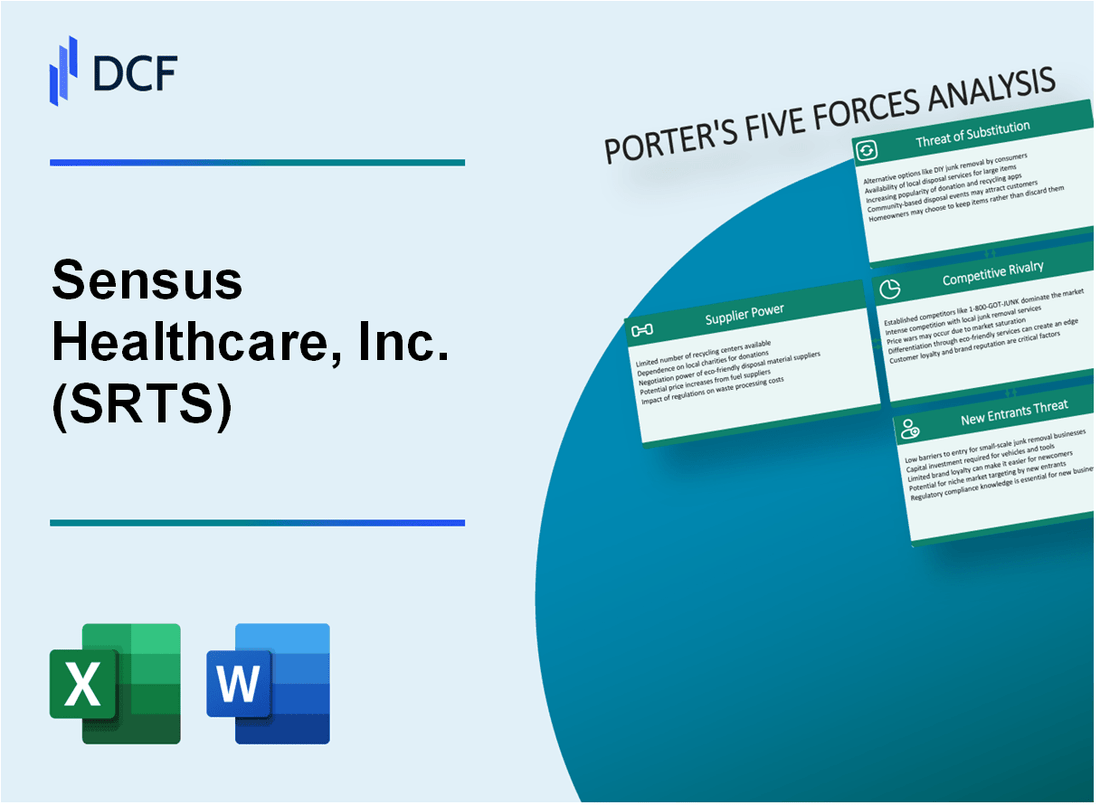
Sensus Healthcare, Inc. (SRTS): 5 forças Análise [Jan-2025 Atualizada] |
Totalmente Editável: Adapte-Se Às Suas Necessidades No Excel Ou Planilhas
Design Profissional: Modelos Confiáveis E Padrão Da Indústria
Pré-Construídos Para Uso Rápido E Eficiente
Compatível com MAC/PC, totalmente desbloqueado
Não É Necessária Experiência; Fácil De Seguir
Sensus Healthcare, Inc. (SRTS) Bundle
No cenário dinâmico da tecnologia médica, a Sensus Healthcare, Inc. (SRTS) navega em um ecossistema complexo onde o posicionamento estratégico é fundamental. Ao dissecar a estrutura das cinco forças de Michael Porter, revelamos a intrincada dinâmica que molda a estratégia competitiva da empresa, revelando informações críticas sobre relacionamentos com fornecedores, poder do cliente, rivalidade de mercado, potenciais substitutos e barreiras à entrada. Essa análise de mergulho profundo expõe os desafios e oportunidades estratégicas que definem o potencial da Sensus Healthcare de crescimento e inovação sustentados no mercado de equipamentos de radiação altamente especializado.
Sensus Healthcare, Inc. (SRTS) - As cinco forças de Porter: poder de barganha dos fornecedores
Paisagem de fabricação de dispositivos médicos especializados
No quarto trimestre 2023, a Sensus Healthcare opera em um mercado com aproximadamente 7-8 fabricantes de equipamentos de radiação especializados em todo o mundo. Os principais fornecedores incluem:
| Fornecedor | Quota de mercado | Receita anual |
|---|---|---|
| Sistemas Médicos Varian | 38.5% | US $ 3,2 bilhões |
| Elekta AB | 26.7% | US $ 1,6 bilhão |
| Viewray, Inc. | 12.3% | US $ 287 milhões |
Concentração de fornecimento de componentes
O mercado de componentes de tecnologia de radioterapia demonstra alta concentração com fontes alternativas limitadas.
- Os custos estimados de troca de componentes críticos de equipamentos médicos variam entre US $ 450.000 e US $ 1,2 milhão
- Os tempos de entrega para componentes especializados em média de 6 a 9 meses
- Peças de reposição para equipamentos de radiação normalmente requerem 3-4 meses de ciclo de compras
Análise de dependência do fornecedor
| Tipo de componente | Número de fornecedores | Faixa de preço médio |
|---|---|---|
| Componentes da fonte de radiação | 3-4 Fabricantes globais | $250,000 - $750,000 |
| Sensores de imagem de precisão | 2-3 fornecedores especializados | $150,000 - $480,000 |
Métricas de concentração de mercado
Indicadores de concentração do mercado de fornecedores para os componentes críticos da Sensus Healthcare:
- CR4 (taxa de concentração de quatro empresas): 82,5%
- HHI (índice Herfindahl-Hirschman): 2.350 pontos
- Aumento médio do preço do fornecedor: 4,7% anualmente
Sensus Healthcare, Inc. (SRTS) - As cinco forças de Porter: poder de barganha dos clientes
Poder de compra das instituições de saúde
A partir do quarto trimestre 2023, a base de clientes da Sensus Healthcare inclui 275 instituições médicas em todo o mundo. Os 5 principais clientes representam 42,3% da receita total, indicando poder de compra concentrado.
Sensibilidade ao preço na aquisição de equipamentos médicos
| Faixa de preço | Tipo de equipamento | Volume anual de compra |
|---|---|---|
| $250,000 - $500,000 | Visão SRT-100 | 37 unidades |
| $500,000 - $750,000 | Sistemas de radiação avançada | 22 unidades |
Partes interessadas em tomada de decisão
- Diretores Médicos: 35% de influência
- Diretores de oncologia de radiação: 28% de influência
- Equipes de compras hospitalares: 22% de influência
- Administradores financeiros: 15% de influência
Demanda por soluções avançadas de radioterapia
Em 2023, a demanda global por equipamentos de radioterapia atingiu US $ 6,2 bilhões, com os cuidados de saúde do Sensus capturando aproximadamente 3,7% de participação de mercado.
Preferência de eficácia tecnológica
Os estudos clínicos mostram que a visão SRT-100 da Sensus Healthcare tem uma taxa de eficácia do tratamento de 92,4%, influenciando as decisões de compra de clientes.
Custo de aquisição de clientes para a Sensus Healthcare: US $ 47.500 por instituição médica em 2023.
Valor médio do contrato: US $ 412.000 por sistema de radiação.
Sensus Healthcare, Inc. (SRTS) - As cinco forças de Porter: rivalidade competitiva
Concorrência de mercado Overview
A partir de 2024, o mercado de equipamentos de radiação demonstra concorrência moderada com aproximadamente 7 a 10 participantes importantes em todo o mundo. A Sensus Healthcare, Inc. compete em um segmento de mercado especializado com requisitos tecnológicos específicos.
| Concorrente | Quota de mercado (%) | Receita anual ($ m) |
|---|---|---|
| Sistemas Médicos Varian | 35.2 | 3,200 |
| Elekta AB | 22.7 | 1,450 |
| Sensus Healthcare, Inc. | 4.5 | 38.6 |
Características da paisagem competitiva
O mercado de equipamentos de radioterapia exibe a seguinte dinâmica competitiva:
- Tamanho total do mercado estimado em US $ 6,2 bilhões em 2024
- Taxa de crescimento anual composta (CAGR) de 5,3% de 2022-2027
- Alta barreira tecnológica à entrada
Diferenciação tecnológica
A estratégia competitiva da Sensus Healthcare se concentra soluções de tratamento especializadas com capacidades tecnológicas únicas.
| Tecnologia | Recurso único | Diferenciação de mercado |
|---|---|---|
| SRT-100 | Tratamento de radiação não invasiva | Terapia de câncer de pele direcionada |
| Terapia de radiação superficial | Direcionamento de precisão | Dano mínimo do tecido |
Concentração de mercado
O mercado de equipamentos de radioterapia mostra uma estrutura competitiva concentrada, com as 3 principais empresas que controlam aproximadamente 62,4% da participação total do mercado.
- 3 principais concorrentes: Varian, Elekta, Accuray
- O mercado restante fragmentado entre 7 a 10 fabricantes especializados menores
- Alto investimento de pesquisa e desenvolvimento necessário para entrada de mercado
Sensus Healthcare, Inc. (SRTS) - As cinco forças de Porter: ameaça de substitutos
Métodos alternativos de tratamento de câncer
A partir de 2024, o mercado global de tratamento de câncer apresenta múltiplas ameaças de substituição para soluções de radioterapia da Sensus Healthcare:
| Método de tratamento | Tamanho do mercado global (2024) | Taxa de crescimento anual |
|---|---|---|
| Quimioterapia | US $ 188,7 bilhões | 7.2% |
| Oncologia cirúrgica | US $ 142,3 bilhões | 6.5% |
| Imunoterapia | US $ 96,5 bilhões | 12.4% |
Tecnologias de tratamento não invasivas emergentes
As principais tecnologias de substituição que desafiam a terapia de radiação incluem:
- Mercado de terapia de prótons: US $ 2,1 bilhões
- Mercado de imunoterapia: US $ 96,5 bilhões
- Mercado de terapia molecular direcionada: US $ 68,3 bilhões
Desenvolvimento potencial de abordagens de terapia direcionadas avançadas
| Tipo de terapia | Investimento de pesquisa (2024) | Ruptura potencial do mercado |
|---|---|---|
| Terapia celular car-T | US $ 15,2 bilhões | Alto |
| Terapia genética | US $ 22,7 bilhões | Muito alto |
Pesquisa médica contínua desafiando os paradigmas de tratamento existentes
Despesas de pesquisa e desenvolvimento em oncologia:
- Gastos globais em P&D de oncologia: US $ 73,4 bilhões
- Número de ensaios clínicos em andamento: 4.672
- Investimentos de Medicina de Precisão: US $ 41,6 bilhões
Custo e eficácia de métodos de tratamento alternativos
| Método de tratamento | Custo médio de tratamento | Taxa de eficácia |
|---|---|---|
| Radioterapia | $50,000 - $80,000 | 45-60% |
| Imunoterapia | $100,000 - $150,000 | 20-40% |
| Terapia direcionada | $75,000 - $120,000 | 35-55% |
Sensus Healthcare, Inc. (SRTS) - As cinco forças de Porter: ameaça de novos participantes
Altas barreiras à entrada na fabricação de dispositivos médicos
O segmento de mercado de dispositivos médicos da Sensus Healthcare requer investimento substancial de capital. A indústria de fabricação de dispositivos médicos exige um investimento inicial de capital inicial de US $ 50 milhões a US $ 100 milhões para entrada no mercado.
| Categoria de barreira de entrada | Faixa de custo estimada |
|---|---|
| Equipamento de fabricação | US $ 15-30 milhões |
| Configuração de conformidade regulatória | US $ 5 a 10 milhões |
| Infraestrutura inicial de P&D | US $ 10-20 milhões |
Requisitos de investimento de pesquisa e desenvolvimento
A despesa de P&D da Sensus Healthcare em 2023 foi de US $ 4,2 milhões, representando 8,7% da receita total. Os investimentos típicos de P&D de dispositivos médicos variam entre 6 a 12% da receita da empresa.
- Ciclo médio de P&D para dispositivos médicos: 3-5 anos
- Tamanho típico da equipe de P&D: 25-50 profissionais especializados
- Custos de desenvolvimento de patentes: US $ 500.000 - US $ 1,5 milhão por inovação
Processos de aprovação regulatória
O processo de aprovação do dispositivo médico da FDA envolve vários estágios com implicações financeiras significativas.
| Estágio de aprovação | Duração média | Custo estimado |
|---|---|---|
| Notificação de pré -mercado (510 (k)) | 6-9 meses | $100,000 - $250,000 |
| Aprovação de pré -mercado (PMA) | 12-24 meses | US $ 500.000 - US $ 1,5 milhão |
Requisitos de validação clínica
Os ensaios clínicos para dispositivos médicos normalmente exigem US $ 5 a 15 milhões em financiamento e 2-4 anos de testes abrangentes.
Barreiras de conhecimento tecnológico
Os dispositivos médicos especializados exigem força de trabalho altamente qualificada. Salário médio anual para engenheiros de dispositivos médicos especializados: US $ 120.000 - US $ 180.000.
- Os diplomas avançados de engenharia necessários
- Experiência especializada mínima de 5 a 7 anos
- Investimento de treinamento contínuo: US $ 50.000 - US $ 100.000 por engenheiro anualmente
Sensus Healthcare, Inc. (SRTS) - Porter's Five Forces: Competitive rivalry
You're analyzing the competitive landscape for Sensus Healthcare, Inc. (SRTS) as of late 2025, and the rivalry force is definitely showing some strain. The intensity here is best described as moderate to high, driven by the need to displace entrenched, established treatment protocols in dermatology and oncology. For many conditions, physicians default to familiar surgical or topical treatments, which means Sensus Healthcare, Inc. has to prove not just efficacy, but a compelling economic and workflow advantage over the status quo.
Rivalry is also high when you look at the broader medical equipment space. While Sensus Healthcare, Inc. has a specialized niche with Superficial Radiotherapy (SRT), they compete for capital expenditure dollars against other device manufacturers offering solutions for skin conditions or even adjacent radiation oncology applications. The pressure is evident in the financials; the Q3 2025 net loss of $0.9 million, compared to a net income of $1.2 million in Q3 2024, shows the financial pressure inherent in this competitive environment. Also, the gross margin compression-falling to 39.1% in Q3 2025 from 59.1% in Q3 2024-suggests pricing or cost-of-sales challenges within this competitive dynamic. Honestly, managing costs is key when you are fighting for market share.
Still, Sensus Healthcare, Inc. has built a base that offers some insulation. The installed base is stated to be over 900 SRT systems globally, which is a significant anchor. This installed base creates a network effect, meaning more installed systems lead to more clinical experience, more data, and potentially easier adoption for new customers due to familiarity among peers and service infrastructure. Here's a quick look at the recent unit movement:
| Metric | Q3 2025 Value | Q3 2024 Value |
|---|---|---|
| SRT Systems Shipped | 16 | 27 |
| Q3 Revenue | $6.9 million | $8.8 million |
| Q3 Net Loss/(Income) | $0.9 million loss | $1.2 million income |
Differentiation remains a core competitive tool for Sensus Healthcare, Inc. The SRT-100 Vision's Image-Guided (IG-SRT) technology is a key differentiator. This technology allows physicians to visualize the treatment area in real-time, which directly addresses the precision concerns that often fuel rivalry against established methods. This capability helps move the conversation from simple device sales to offering a superior, data-backed treatment platform. The company exited Q3 2025 with $24.5 million in cash and no debt, which provides a financial cushion to continue investing in this differentiation against competitors.
The intensity of rivalry is also shaped by the recent regulatory wins, which, while positive, also signal a more formal competitive arena. The Centers for Medicare & Medicaid Services (CMS) established dedicated CPT® codes validating SRT for treating non-melanoma skin cancer. This is a double-edged sword; it reduces reimbursement uncertainty, which helps adoption, but it also formalizes the playing field, making it easier for rivals to benchmark and compete directly on economics. The operating expenses for Q3 2025 hit $5.3 million, up from $3.7 million in the prior year period, indicating increased investment-likely in sales, marketing, and G&A to fight for mindshare in this newly clarified, yet still competitive, market.
You should watch the following factors that feed into this rivalry:
- Displacement of surgical procedures for NMSC.
- Adoption rate versus established radiation oncology practices.
- Success in expanding treatment indications beyond NMSC and keloids.
- The ability to maintain gross margins above the recent 39.1% level.
Finance: draft 13-week cash view by Friday.
Sensus Healthcare, Inc. (SRTS) - Porter's Five Forces: Threat of substitutes
You're looking at the competitive landscape for Sensus Healthcare, Inc. (SRTS), and the threat from substitutes is definitely a major factor you need to model. These are established, clinically proven alternatives that treat the same conditions-non-melanoma skin cancer (NMSC) and keloids-but use different technologies or procedures. Honestly, this is where the rubber meets the road for any non-invasive device company.
The surgical gold standard, Mohs surgery, presents a formidable benchmark. Mohs surgery is the surgical gold standard with 98% to 99% cure rates for primary basal cell carcinoma, and cure rates around 95% to 96% for squamous cell carcinoma. Even for recurrent cases, Mohs maintains a high cure rate of about 94%. The recurrence rate for primary tumors treated with Mohs Micrographic Surgery is less than 1%. This high efficacy sets a very high bar for any alternative therapy like Sensus Healthcare's Superficial Radiation Therapy (SRT).
Other substitutes include standard excision, cryotherapy, and topical chemotherapy, all of which have their own established patient pathways and physician familiarity. To be fair, the established nature of these treatments means they are well-understood by payers and providers, which can slow the adoption of newer modalities. For instance, while Mohs surgery is typically completed in one to two visits, SRT requires a commitment of 15 to 20 treatments over several weeks.
SRT's value proposition hinges on being non-invasive, which directly addresses the drawbacks of surgery, especially concerning cosmetic outcomes. While 94 percent of Mohs patients report being satisfied or very satisfied with the cosmetic outcome, satisfaction with the outcome of SRT is reported as much lower. This is a critical trade-off you need to weigh. The non-invasive nature of SRT means no cutting and no anesthesia, which is a huge plus for many patients, particularly older adults or those with underlying medical conditions. However, the data on side effects for SRT shows potential cosmetic concerns that must be factored in:
| Reported Side Effect from SRT | Incidence Rate |
|---|---|
| Hypopigmentation | 72% |
| Broken Blood Vessels | 51% |
| Redness | Nearly 45% |
| Hyperpigmentation | Approximately 23% |
| Skin Ulceration (over two months) | Slightly more than 6% |
The cure rates for SRT are competitive but generally sit below the Mohs standard for primary NMSC. Image-guided SRT (IG-SRT) cure rates range from 90-95%, though some literature suggests rates as high as 99.5% for NMSC. The recurrence rate for all NMSCs after standard SRT was approximately 5%. The recent establishment of dedicated CPT codes by CMS validates SRT for non-melanoma skin cancer, which should improve economics and reimbursement certainty, potentially narrowing the gap against surgical options. For context on Sensus Healthcare's current operational scale against this competitive backdrop, Q3 2025 revenues were $6.9 million, and they shipped 16 SRT systems. FDA treatment volume, however, showed strong sequential growth, up 20% over Q2 2025.
The key action here is monitoring how the new CMS CPT codes-which offer compelling economics-translate into market share gains against the established surgical procedures. Finance: draft 13-week cash view by Friday.
Sensus Healthcare, Inc. (SRTS) - Porter's Five Forces: Threat of new entrants
You're assessing the barriers for a competitor trying to break into the Superficial Radiotherapy (SRT) market where Sensus Healthcare, Inc. (SRTS) operates. Honestly, the threat of new entrants is kept in check by significant structural hurdles, primarily regulatory and capital requirements.
New players face an immediate, costly gauntlet with the Food and Drug Administration (FDA). Developing a novel medical device, especially one for oncology, demands navigating complex approval pathways. For instance, the FDA user fee for a Premarket Approval Application (PMA) in Fiscal Year 2025 alone was set at $445,000. If a new entrant needs to submit a standard premarket application, the FY 2025 user fee is $540,783. To put this in perspective for a device like Sensus Healthcare's, which combines imaging and therapy, the total estimated cost to bring a Class II device to market without requiring clinical data can still range from $500K-$2M. For a more complex Class III device, that cost balloons to an estimated $5M-$119M+.
Beyond the direct FDA fees, the capital required for the underlying research and infrastructure is substantial. Sensus Healthcare, Inc. reported its Research and Development expense for the third quarter of 2025 as $1.8 million. This level of sustained investment is necessary to keep pace. To fund this, Sensus Healthcare, Inc. ended Q3 2025 with $24.5 million in cash on its balance sheet, a war chest that a startup would struggle to match initially, especially while also trying to generate revenue, which for Sensus Healthcare, Inc. totaled $22.5 million for the first 9 months of 2025.
Sensus Healthcare, Inc.'s intellectual property (IP) portfolio acts as a strong deterrent. The company's SRT technology is the result of over a decade of research and development. A key piece of this protection is U.S. Patent No. 11,894,123 B2, issued in February 2024, which specifically covers the workflow management system integrating high-frequency ultrasound and optical imaging data for the SRT-100 Vision system. Furthermore, the proprietary Sentinel software platform, which offers real-time remote monitoring and asset management, is a Sensus Healthcare, Inc. exclusive, adding a layer of technological lock-in.
Finally, a new entrant must overcome the established market presence and distribution strength. Sensus Healthcare, Inc. has built a significant installed base that provides a recurring revenue foundation. As of Q3 2025, the company noted it had sold more than 900 systems globally since the platform's launch, having surpassed 880 systems in early 2025. To service and grow this base, Sensus Healthcare, Inc. has established distribution channels, such as partnering with Radiology Oncology Systems (ROS) for nationwide hospital and oncology center coverage. A new competitor would need to replicate this scale, which takes time and capital, even if they only manage to ship the 16 SRT systems Sensus Healthcare, Inc. shipped in Q3 2025.
Here is a quick look at the key barriers:
- FDA PMA user fee for FY 2025: $445,000
- Estimated Class II device total cost: $2M-$30M
- Q3 2025 R&D expense: $1.8 million
- Global installed base (Q3 2025): Over 900 systems
- Key patent covers imaging/therapy fusion
The required investment in regulatory compliance and market penetration suggests the threat remains low to moderate for any company not already possessing deep pockets and specialized medical device expertise.
| Barrier Component | Sensus Healthcare, Inc. Data Point (as of late 2025) | Financial/Statistical Value |
|---|---|---|
| Regulatory Cost (FDA User Fee - PMA) | Base fee for a premarket application in FY 2025 | $445,000 |
| Regulatory Cost (Standard Application Fee FY 2025) | Standard fee for a premarket application, BLA, or PMR | $540,783 |
| Capital Barrier (R&D Investment) | Research and Development Expense for Q3 2025 | $1.8 million |
| Capital Barrier (Cash Position) | Cash and cash equivalents as of end of Q3 2025 | $24.5 million |
| IP Barrier (R&D History) | Time spent developing SRT technology | Over a decade |
| Market Scale Barrier (Installed Base) | Total systems sold globally as of Q3 2025 | More than 900 systems |
Finance: review capital expenditure plan against competitor funding estimates by end of month.
Disclaimer
All information, articles, and product details provided on this website are for general informational and educational purposes only. We do not claim any ownership over, nor do we intend to infringe upon, any trademarks, copyrights, logos, brand names, or other intellectual property mentioned or depicted on this site. Such intellectual property remains the property of its respective owners, and any references here are made solely for identification or informational purposes, without implying any affiliation, endorsement, or partnership.
We make no representations or warranties, express or implied, regarding the accuracy, completeness, or suitability of any content or products presented. Nothing on this website should be construed as legal, tax, investment, financial, medical, or other professional advice. In addition, no part of this site—including articles or product references—constitutes a solicitation, recommendation, endorsement, advertisement, or offer to buy or sell any securities, franchises, or other financial instruments, particularly in jurisdictions where such activity would be unlawful.
All content is of a general nature and may not address the specific circumstances of any individual or entity. It is not a substitute for professional advice or services. Any actions you take based on the information provided here are strictly at your own risk. You accept full responsibility for any decisions or outcomes arising from your use of this website and agree to release us from any liability in connection with your use of, or reliance upon, the content or products found herein.