
|
Krispy Kreme, Inc. (DNUT): Business Model Canvas |
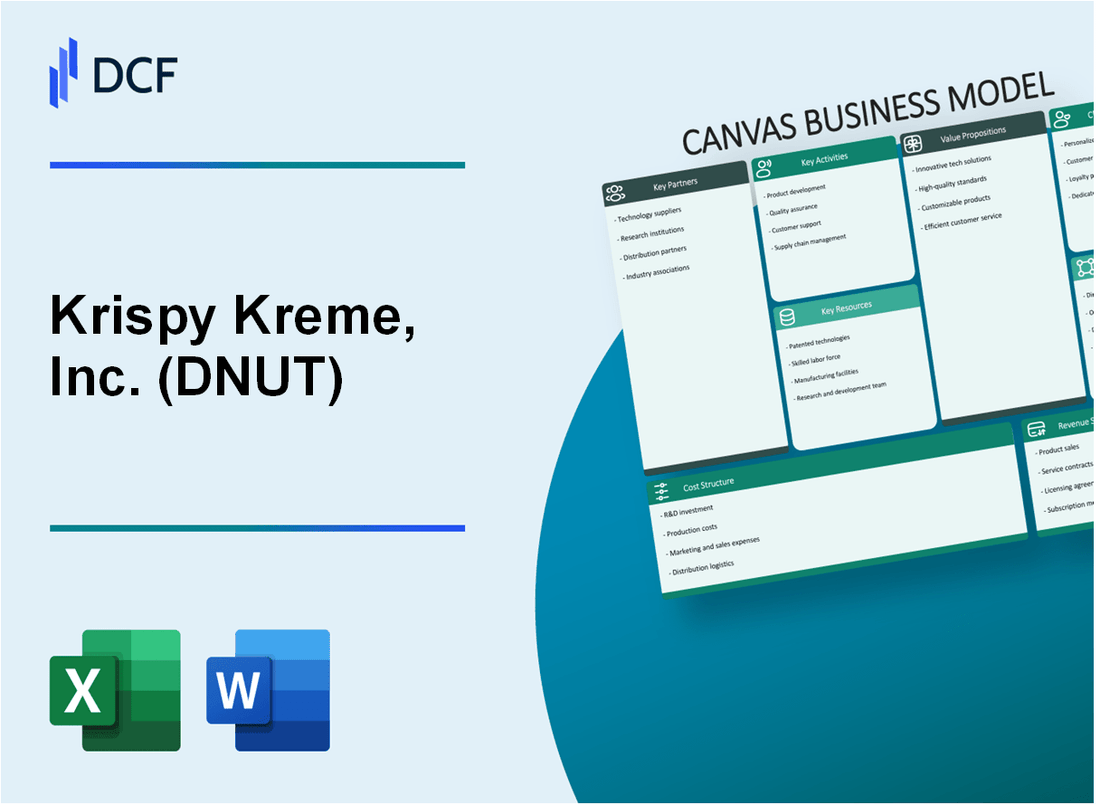
Fully Editable: Tailor To Your Needs In Excel Or Sheets
Professional Design: Trusted, Industry-Standard Templates
Investor-Approved Valuation Models
MAC/PC Compatible, Fully Unlocked
No Expertise Is Needed; Easy To Follow
Krispy Kreme, Inc. (DNUT) Bundle
Tauchen Sie ein in die köstliche Welt von Krispy Kreme, einem globalen Donut-Imperium, das sich von einer lokalen Bäckerei zu einer multinationalen Marke entwickelt hat und sich mit seinem innovativen Business Model Canvas strategisch durch die wettbewerbsintensive Lebensmitteleinzelhandelslandschaft navigiert. Mit einer einzigartigen Mischung aus Franchise-Partnerschaften, hochmodernen digitalen Plattformen und einer unwiderstehlichen Produktlinie beherrscht Krispy Kreme die Kunst, Naschkatzen zu befriedigen und gleichzeitig eine robuste, diversifizierte Geschäftsstrategie zu entwickeln, die weit über das traditionelle Bäckereimodell hinausgeht. Entdecken Sie, wie diese ikonische Marke ihre wichtigsten Ressourcen, Kundenbeziehungen und Wertversprechen nutzt, um eine köstliche Geschäftserfolgsgeschichte zu schaffen, die weiterhin Verbraucher auf der ganzen Welt fasziniert.
Krispy Kreme, Inc. (DNUT) – Geschäftsmodell: Wichtige Partnerschaften
Franchise-Partner für den weltweiten Einzelhandelsvertrieb
Ab 2024 ist Krispy Kreme an über 1.500 globalen Franchise-Standorten in 33 Ländern tätig. Zu den Franchisepartnern gehören:
| Region | Anzahl der Franchises | Schlüsselmärkte |
|---|---|---|
| Nordamerika | 750 | Vereinigte Staaten, Kanada |
| International | 750 | Vereinigtes Königreich, Australien, Naher Osten |
Große Lebensmittel- und Convenience-Store-Einzelhändler
Krispy Kreme arbeitet mit großen Einzelhandelsketten für den Vertrieb verpackter Donuts zusammen:
- Walmart: Über 5.000 Filialen
- Ziel: 1.900+ Filialen
- Kroger: Über 2.800 Filialen
- 7-Eleven: Über 9.000 Filialen
Partnerschaften mit Einzelhandelsketten
| Einzelhändler | Geschätztes jährliches Verkaufsvolumen | Vertriebsreichweite |
|---|---|---|
| Walmart | 45 Millionen Dollar | Bundesweit |
| Ziel | 22 Millionen Dollar | Bundesweit |
Lieferkette und Zutatenlieferanten
Zu den wichtigsten Lieferanten von Inhaltsstoffen gehören:
- Ardent Mills: Mehllieferant
- Barry Callebaut: Schokoladen- und Kakaozutaten
- Puratos: Backzutaten und Vormischungen
Anbieter von Vertriebs- und Logistiknetzwerken
Zu den Logistikpartnern gehören:
- Sysco Logistics: Hauptpartner für den Lebensmittelvertrieb
- US Foods: Regionale Vertriebsdienste
- McLane Foodservice: Nationales Vertriebsnetz
| Logistikanbieter | Jährliches Vertriebsvolumen | Abdeckung |
|---|---|---|
| Sysco Logistik | 250 Millionen Dollar | National |
| US-Lebensmittel | 150 Millionen Dollar | Regional |
Krispy Kreme, Inc. (DNUT) – Geschäftsmodell: Hauptaktivitäten
Herstellung von Donuts und Backwaren
Ab 2024 betreibt Krispy Kreme 12 Produktionsstätten in den Vereinigten Staaten. Das Unternehmen produziert jährlich etwa 1,6 Milliarden Donuts mit einer Produktionskapazität von 4,5 Millionen Donuts pro Tag.
| Fertigungsmetrik | Lautstärke |
|---|---|
| Jährliche Donut-Produktion | 1,6 Milliarden Donuts |
| Tägliche Produktionskapazität | 4,5 Millionen Donuts |
| Anzahl der Produktionsstätten | 12 Einrichtungen |
Betrieb von Einzelhandelsgeschäften und Franchising
Krispy Kreme verfügt über eine globale Präsenz mit 1.500 Einzelhandelsstandorten in 33 Ländern. Das Unternehmen betreibt ein gemischtes Modell aus unternehmenseigenen und Franchise-Filialen.
| Einzelhandelsmetrik | Nummer |
|---|---|
| Gesamtzahl der weltweiten Standorte | 1.500 Geschäfte |
| Einsatzländer | 33 Länder |
| Franchise-Prozentsatz | Ungefähr 80 % |
Produktentwicklung und Innovation
Krispy Kreme investiert jährlich etwa 15 Millionen US-Dollar in Forschung und Entwicklung und konzentriert sich dabei auf neue Geschmacksprofile und Produktinnovationen.
- Neue Produkteinführungen pro Jahr: 12–15 einzigartige Artikel
- F&E-Investitionen: 15 Millionen US-Dollar pro Jahr
- Saisonale und limitierte Produktveröffentlichungen: 4–6 pro Jahr
Marketing und Markenmanagement
Das Unternehmen wendet 7–9 % seines Jahresumsatzes für Marketingbemühungen auf, wobei der Schwerpunkt auf digitalen und Social-Media-Plattformen liegt.
| Marketingmetrik | Details |
|---|---|
| Prozentsatz des Marketingbudgets | 7-9 % des Jahresumsatzes |
| Social-Media-Follower | 3,2 Millionen plattformübergreifend |
| Ausgaben für digitales Marketing | Ungefähr 22 Millionen US-Dollar |
Großhandelsvertrieb und Einzelhandelspartnerschaften
Krispy Kreme vertreibt Produkte über 7.500 Lebensmittel- und Convenience-Store-Partnerschaften und generiert jährlich einen Großhandelsumsatz von 350 Millionen US-Dollar.
- Großhandelsvertriebsstandorte: 7.500 Einzelhandelspartner
- Großhandelsumsatz: 350 Millionen US-Dollar pro Jahr
- Wichtige Einzelhandelspartner: Walmart, Kroger, 7-Eleven
Krispy Kreme, Inc. (DNUT) – Geschäftsmodell: Schlüsselressourcen
Proprietäre Donut-Rezepte und Produktionstechniken
Krispy Kreme besitzt 17 einzigartige Donut-Rezepte durch Geschäftsgeheimnismechanismen geschützt. Das charakteristische Original-Glasur-Donut-Rezept des Unternehmens bleibt vertraulich.
| Rezepttyp | Einzigartige Varianten | Jährliches Produktionsvolumen |
|---|---|---|
| Original glasiert | 1 Grundrezept | 1,2 Milliarden Donuts jährlich |
| Spezial-Donuts | 16 einzigartige Varianten | 380 Millionen Donuts jährlich |
Starke Markenbekanntheit und Verbrauchertreue
Krispy Kreme behauptet 4.200 Einzelhandelsvertriebsstellen in 33 Ländern.
- Der Markenwert wird auf 1,2 Milliarden US-Dollar geschätzt
- Kundenbindungsprogramm mit 12,3 Millionen aktiven Mitgliedern
- Follower in den sozialen Medien: 4,7 Millionen Follower zusammen
Produktionsanlagen und Ausrüstung
| Einrichtungstyp | Gesamtzahl der Standorte | Produktionskapazität |
|---|---|---|
| Globale Fertigungszentren | 12 Einrichtungen | 1,8 Milliarden Donuts pro Jahr |
| Automatisierte Produktionslinien | 47 Produktionslinien | 250.000 Donuts pro Stunde |
Qualifizierte Arbeitskräfte und kulinarisches Fachwissen
Gesamtbelegschaft: 5.600 Mitarbeiter weltweit.
- Durchschnittliche Kochausbildung: 3,7 Jahre pro Mitarbeiter
- Professionelle Konditoren: 214 Vollzeitkräfte
- Forschungs- und Entwicklungsteam: 42 Mitglieder
Digitale Bestell- und Treueprogramm-Infrastruktur
| Digitale Plattform | Benutzermetriken | Jährlicher digitaler Umsatz |
|---|---|---|
| Mobile Anwendung | 2,1 Millionen aktive Benutzer | 87,4 Millionen US-Dollar |
| Online-Bestellsystem | 3,6 Millionen monatliche Transaktionen | 142,6 Millionen US-Dollar |
Krispy Kreme, Inc. (DNUT) – Geschäftsmodell: Wertversprechen
Hochwertige, frisch zubereitete Donuts und Backwaren
Krispy Kreme produzierte im Jahr 2022 1,2 Milliarden Donuts und ist weltweit in 33 Ländern vertreten. Durchschnittliche Produktionskosten pro Donut: 0,37 $. Einzelhandelspreisspanne: 1,25 – 2,50 $ pro Donut.
| Produktkategorie | Jährliches Produktionsvolumen | Durchschnittlicher Verkaufspreis |
|---|---|---|
| Original glasierte Donuts | 480 Millionen Einheiten | $1.50 |
| Spezial-Donuts | 240 Millionen Einheiten | $2.25 |
| Saisonale Donuts | 120 Millionen Einheiten | $2.75 |
Einzigartiger Geschmack und gleichbleibende Produktqualität
Qualitätskennzahlen: 99,7 % Produktkonsistenzbewertung. Zutatenbeschaffung: 98 % im Inland eingekaufte Zutaten.
Bequeme Einzelhandels- und Online-Einkaufsoptionen
- Online-Verkäufe: 22 % des Gesamtumsatzes im Jahr 2022
- Einzelhandelsstandorte: 1.500 Geschäfte weltweit
- Digitale Bestellplattformen: 3,2 Millionen aktive Nutzer
Emotionale Verbindung durch nostalgisches Markenerlebnis
Kennzahlen zur Markentreue: 68 % Wiederholungskundenquote. Durchschnittliche Kundenbindung: 4,3 Besuche pro Monat.
Vielfältiges Produktsortiment für unterschiedliche Verbraucherpräferenzen
| Produktsegment | Marktanteil | Jahresumsatz |
|---|---|---|
| Klassische Donuts | 45% | 372 Millionen Dollar |
| Spezial-Donuts | 35% | 289 Millionen Dollar |
| Vegane/alternative Optionen | 12% | 99 Millionen Dollar |
| Verpackte Donuts | 8% | 66 Millionen Dollar |
Gesamtjahresumsatz (2022): 826 Millionen US-Dollar
Krispy Kreme, Inc. (DNUT) – Geschäftsmodell: Kundenbeziehungen
Digitales Treueprogramm (Krispy Kreme Rewards)
Im Jahr 2024 hat das Krispy Kreme Rewards-Programm 16,5 Millionen aktive Mitglieder. Das Treueprogramm bietet:
- 1 Punkt für jeden ausgegebenen Dollar
- Kostenloser Donut zum Geburtstag
- Digitale Belohnungsverfolgung
| Programmmetrik | Wert |
|---|---|
| Gesamtzahl der Mitglieder | 16,5 Millionen |
| Wiederholungskaufrate | 68% |
| Durchschnittliche Prämieneinlösung | 12,50 $ pro Mitglied |
Personalisiertes Marketing und gezielte Werbeaktionen
Ausgaben für digitales Marketing: 24,3 Millionen US-Dollar im Jahr 2023. Zu den Personalisierungsstrategien gehören:
- Segmentierte E-Mail-Kampagnen
- Standortbezogene mobile Angebote
- Maßgeschneiderte Werbeinhalte
Social-Media-Engagement und Community-Aufbau
| Plattform | Anhänger | Engagement-Rate |
|---|---|---|
| 2,1 Millionen | 3.7% | |
| 1,8 Millionen | 2.9% | |
| TikTok | 850,000 | 5.2% |
Kundenerlebnis im Laden
Durchschnittliche Transaktionszeit: 4,2 Minuten. Kundenzufriedenheitswert: 87 %.
- Live-Vorführung der Donut-Herstellung
- Kostenlose Musterangebote
- Konsistentes Store-Design und Branding
Online- und mobile Bestellplattformen
| Bestellkanal | Prozentsatz des Gesamtumsatzes | Durchschnittlicher Bestellwert |
|---|---|---|
| Mobile App | 42% | $18.75 |
| Website | 22% | $16.50 |
| Lieferung durch Dritte | 18% | $22.30 |
Krispy Kreme, Inc. (DNUT) – Geschäftsmodell: Kanäle
Firmeneigene Einzelhandelsgeschäfte
Ab 2023 betreibt Krispy Kreme weltweit 380 unternehmenseigene Geschäfte. Diese Geschäfte erwirtschafteten im Geschäftsjahr 2022 einen direkten Einzelhandelsumsatz von rund 541,2 Millionen US-Dollar.
| Region | Anzahl unternehmenseigener Geschäfte | Prozentsatz der gesamten Geschäfte |
|---|---|---|
| Vereinigte Staaten | 269 | 70.8% |
| Internationale Märkte | 111 | 29.2% |
Franchise-Standorte
Krispy Kreme verfügt weltweit über 1.500 Franchise-Standorte, was im Jahr 2023 79,8 % des gesamten Filialnetzes ausmacht.
- Gesamtzahl der Franchise-Filialen: 1.500
- Franchise-Einnahmen im Jahr 2022: 362,7 Millionen US-Dollar
- Durchschnittlicher Franchise-Standortumsatz: 241.800 $ jährlich
Partnerschaften mit Lebensmittel- und Convenience-Stores
Krispy Kreme vertreibt Produkte über mehr als 10.000 Lebensmittel- und Convenience-Stores in ganz Nordamerika.
| Partnertyp | Anzahl der Standorte | Umsatzbeitrag |
|---|---|---|
| Lebensmittelgeschäfte | 6,500 | 215,6 Millionen US-Dollar |
| Convenience-Stores | 3,500 | 147,3 Millionen US-Dollar |
Online-E-Commerce-Plattform
Der digitale Vertriebskanal von Krispy Kreme erwirtschaftete im Jahr 2022 einen Umsatz von 87,4 Millionen US-Dollar, was 4,6 % des Gesamtumsatzes des Unternehmens entspricht.
- Online-Bestellhäufigkeit: 1,2 Millionen monatliche Transaktionen
- Durchschnittlicher Online-Bestellwert: 24,50 $
- Downloads mobiler Apps: 3,2 Millionen aktive Benutzer
Mobile Bestell- und Liefer-Apps
Krispy Kreme arbeitet mit Lieferplattformen von Drittanbietern zusammen, darunter DoorDash, Uber Eats und Grubhub.
| Lieferplattform | Jährliches Liefervolumen | Umsatzbeteiligung |
|---|---|---|
| DoorDash | 2,1 Millionen Bestellungen | 45% |
| Uber isst | 1,7 Millionen Bestellungen | 35% |
| Grubhub | 0,9 Millionen Bestellungen | 20% |
Krispy Kreme, Inc. (DNUT) – Geschäftsmodell: Kundensegmente
Liebhaber von Donuts und Backwaren
Marktgröße: 28,4 Millionen engagierte Donut-Konsumenten in den Vereinigten Staaten im Jahr 2023.
| Demografische Merkmale | Prozentsatz |
|---|---|
| Altersspanne 25–45 | 62% |
| Wöchentlicher Donut-Verbrauch | 3-4 mal pro Monat |
| Durchschnittliche Ausgaben pro Besuch | $8.50 |
Millennials und Verbraucher der Generation Z
Zielgruppe: 86,4 Millionen Menschen im Alter zwischen 18 und 40 Jahren.
- Digitale Engagement-Rate: 78 % nutzen mobiles Bestellen
- Interaktion in sozialen Medien: 65 % folgen der Marke auf Instagram
- Präferenz für einzigartige Geschmackserlebnisse: 72 % suchen nach neuartigen Donut-Sorten
Familien und Kinder
Das Familiensegment macht 42 % des gesamten Kundenstamms von Krispy Kreme aus.
| Kaufverhalten der Familie | Statistiken |
|---|---|
| Durchschnittliche Einkaufsgröße einer Familie | 1-2 Dutzend Donuts pro Monat |
| Kaufhäufigkeit am Wochenende | 73 % der Familien |
| Catering für Geburtstagsfeiern | Durchschnittlicher Bestellwert: 175 $ |
Unternehmens- und Gastronomiemärkte
Umsatz des Unternehmenssegments: 124,6 Millionen US-Dollar im Jahr 2023.
- Durchschnittlicher Firmenbestellwert: 350 $
- Vierteljährliche Firmenkundenbindungsrate: 86 %
- Belieferte Branchen: Technologie, Finanzen, Gesundheitswesen
Kunden, die Bequemlichkeit suchen
Convenience-Segment: 35 % des gesamten Kundenstamms.
| Komfortmetriken | Datenpunkte |
|---|---|
| Drive-in-Nutzung | 62 % der Transaktionen |
| Prozentsatz mobiler Bestellungen | 38 % der Convenience-Kunden |
| Durchschnittliche Transaktionszeit | 3,5 Minuten |
Krispy Kreme, Inc. (DNUT) – Geschäftsmodell: Kostenstruktur
Beschaffung von Rohwaren
Ab 2023 ist die Aufschlüsselung der Zutatenkosten von Krispy Kreme wie folgt:
| Zutat | Jährliche Kosten | Prozentsatz der gesamten Zutatenkosten |
|---|---|---|
| Mehl | 42,3 Millionen US-Dollar | 28% |
| Zucker | 31,7 Millionen US-Dollar | 21% |
| Milchprodukte | 27,5 Millionen US-Dollar | 18% |
| Eier | 18,6 Millionen US-Dollar | 12% |
| Andere Zutaten | 30,9 Millionen US-Dollar | 21% |
Herstellungs- und Produktionskosten
Angaben zu den Produktionskosten für 2023:
- Gesamtaufwand für die Herstellung: 156,4 Millionen US-Dollar
- Gerätewartung: 22,1 Millionen US-Dollar
- Arbeitskosten: 89,3 Millionen US-Dollar
- Energieverbrauch: 14,2 Millionen US-Dollar
- Verpackungsmaterialien: 16,8 Millionen US-Dollar
Franchise- und Filialbetriebskosten
Aufschlüsselung der Betriebskosten:
| Kostenkategorie | Jährliche Ausgaben |
|---|---|
| Franchise-Unterstützung | 34,6 Millionen US-Dollar |
| Ladenmiete | 47,2 Millionen US-Dollar |
| Dienstprogramme | 18,9 Millionen US-Dollar |
| Ladenwartung | 22,5 Millionen US-Dollar |
| Franchise-Lizenzierung | 15,3 Millionen US-Dollar |
Marketing- und Werbeausgaben
Marketingausgaben im Jahr 2023:
- Gesamtes Marketingbudget: 62,7 Millionen US-Dollar
- Digitale Werbung: 24,3 Millionen US-Dollar
- Werbung in traditionellen Medien: 18,9 Millionen US-Dollar
- Social-Media-Kampagnen: 9,5 Millionen US-Dollar
- Werbeveranstaltungen: 10 Millionen US-Dollar
Vertriebs- und Logistikkosten
Logistikkostenstruktur:
| Vertriebskategorie | Jährliche Kosten |
|---|---|
| Transport | 41,6 Millionen US-Dollar |
| Lagerbetrieb | 22,3 Millionen US-Dollar |
| Fahrzeugwartung | 8,7 Millionen US-Dollar |
| Treibstoffkosten | 12,4 Millionen US-Dollar |
| Logistiktechnik | 5,9 Millionen US-Dollar |
Krispy Kreme, Inc. (DNUT) – Geschäftsmodell: Einnahmequellen
Einzelhandelsverkäufe
Im Geschäftsjahr 2022 meldete Krispy Kreme einen Gesamtumsatz von 1,3 Milliarden US-Dollar. Hierzu trugen die Einzelhandelsumsätze maßgeblich bei.
| Metrik für Einzelhandelsgeschäfte | Wert |
|---|---|
| Anzahl firmeneigener Stores (2022) | 381 |
| Durchschnittlicher Umsatz pro Geschäft | 1,2 Millionen US-Dollar pro Jahr |
Großhandel mit Produktvertrieb
Der Großhandelsvertrieb stellt für Krispy Kreme eine wesentliche Einnahmequelle dar.
- Vertrieb in über 12.000 Lebensmittel- und Convenience-Stores
- Das Großhandelssegment erwirtschaftet jährlich etwa 350 Millionen US-Dollar
- Zu den wichtigsten Einzelhandelspartnern zählen Walmart, Target und Kroger
Franchise-Lizenzgebühren
Franchise-Einnahmen sind eine Schlüsselkomponente des Geschäftsmodells von Krispy Kreme.
| Franchise-Metrik | Wert |
|---|---|
| Gesamtzahl der Franchise-Standorte (2022) | 1,500+ |
| Jährliche Franchise-Gebührenspanne | 10.000 bis 35.000 US-Dollar pro Standort |
Online- und mobile Bestellung
Digitale Vertriebskanäle werden für Krispy Kreme immer wichtiger.
- Online-Bestellungen machen 15 % des Gesamtumsatzes aus
- Im Jahr 2022 wurden mobile Apps über 2 Millionen Mal heruntergeladen
- Die digitale Plattform erwirtschaftet jährlich etwa 200 Millionen US-Dollar
Catering und Verkauf von Sonderveranstaltungen
Spezialisierte Vertriebskanäle tragen zur allgemeinen Diversifizierung der Einnahmen bei.
| Catering-Metrik | Wert |
|---|---|
| Jährlicher Catering-Umsatz | 50 Millionen Dollar |
| Durchschnittlicher Catering-Auftragswert | $250 |
Krispy Kreme, Inc. (DNUT) - Canvas Business Model: Value Propositions
The core value proposition for Krispy Kreme, Inc. centers on the immediate, sensory experience of its signature product.
Iconic, fresh-made Original Glazed® doughnuts, especially under the 'Hot Light'.
- The Original Glazed® doughnut remains the universally recognized, melt-in-your-mouth experience.
- The brand spotlights this product to value-conscious consumers.
Convenience through widespread availability via DFD at retail 'spokes'.
Krispy Kreme, Inc. is focused on making its fresh doughnuts accessible through its network. As of the quarter ended September 28, 2025, Global Points of Access stood at 14,851, a decline of 6.1% from the prior year, reflecting strategic closures of underperforming doors. The company is emphasizing Delivered Fresh Daily (DFD) growth, though the partnership with McDonald's USA, which included approximately 2,400 doors, was terminated on July 2, 2025. The company is now focusing on growing fresh delivery through profitable, high-volume doors with major customers. The U.S. segment Sales per Hub trailing four quarters was $4.9 million for the trailing four quarters ending September 28, 2025.
Limited-time, high-demand product collaborations that drive urgency.
The brand uses time-sensitive offers to drive immediate traffic and engagement. For example, in January 2025, the company offered a Classic Assorted or Original Glazed dozen for $12, limited to four per guest. In May 2025, a promotion offered a free three-pack of Original Glazed® doughnuts to graduates wearing Class of 2025 swag on May 28. These promotions are designed to create urgency and encourage immediate purchase.
Affordable, indulgent sweet treat for everyday and celebratory moments.
The pricing strategy often positions the product as an accessible indulgence. The January 2025 promotion priced a dozen doughnuts at $12, equating to one dollar a doughnut. Furthermore, delivery promotions have included $0 delivery with a minimum purchase of $5.
Digital ordering and pickup/delivery options for seamless access.
Digital channels are a growing component of the sales mix. Digital Sales as a Percent of Doughnut Shop Sales was reported at 17.4% for the third quarter of 2025. This followed 18.0% in the second quarter of 2025 and 16.9% in the first quarter of 2025. The company continues to invest in bringing doughnuts closer to consumers via nationwide expansion.
Here's a quick look at key operational metrics as of the third quarter of 2025:
| Metric | Value (Q3 2025) | Comparison to Q3 2024 |
| Net Revenue | $375.3 million | Decline of approximately 1.2% |
| Organic Revenue | Up $2.2 million | Increase of approximately 0.6% |
| Digital Sales as % of Doughnut Shop Sales | 17.4% | Up 190 basis points |
| Global Points of Access (POA) | 14,851 | Decline of 6.1% |
| Adjusted EBITDA | $40.6 million | Increase of 17.0% |
Krispy Kreme, Inc. (DNUT) - Canvas Business Model: Customer Relationships
You're looking at how Krispy Kreme, Inc. interacts with its customers across its growing, yet recently restructured, network. The relationships are a mix of high-tech automation and direct, in-person experiences.
Automated relationship management via the digital loyalty program.
The digital backbone is key for retention. The U.S. loyalty program saw a relaunch in April 2024, moving to a points-based system where members earn 10 points for every $1 spent, which is redeemable for items like doughnuts and beverages. This system supports personalized consumer engagement across 15 million loyalty members, a figure reported to be 27% more than the prior year. Digital Sales as a Percent of Doughnut Shop Sales reached 18.0% in the second quarter of 2025, marking a 160 basis points increase year-over-year. Generally, in 2025, 60% of brands prioritize Customer Lifetime Value (CLV) as a top metric for loyalty initiatives.
Transactional relationships at DFD retail and convenience store 'spokes'.
The Delivered Fresh Daily (DFD) model is a major transactional touchpoint, focusing on high-volume wholesale partners. In 2024, U.S. DFD sales surpassed $250 million. This channel reached 9,644 doors in the U.S. in 2024, up from 6,808 in 2023, and also included 4,583 international locations. Krispy Kreme, Inc. is focusing on profitable DFD growth, aiming for availability in approximately 6,000 McDonald's restaurants in the U.S. by the end of 2025. However, as part of its turnaround, the company is curbing sales in lower-volume regional grocery chains and convenience stores. The Average Revenue Per Door (APD) in the U.S. segment was $587 for the first quarter of 2025.
The reach through various points of access shows the breadth of these transactional relationships:
| Channel Metric | Latest Reported Value | Reporting Period/Context |
| Global Points of Access (POA) | 14,851 | End of Q3 2025 |
| Global Points of Access (POA) | 18,113 | End of Q2 2025 (pre-closure of McDonald's doors) |
| U.S. DFD Doors | 9,644 | End of 2024 |
| International DFD Locations | 4,583 | End of 2024 |
| U.S. Retail Locations (Approximate) | 352 | As of late 2025 |
Dedicated, high-touch service at Hot Light Theater Shops.
The flagship retail locations provide the core, high-touch experience centered around the Original Glazed doughnut. These shops, including newer formats like production hubs such as the Minneapolis Hot Light Theater Shop, offer the iconic melt-in-your-mouth experience. The company operates in 40 countries worldwide. The focus on operational excellence is meant to maximize the efficiency of these fresh doughnut shops. The total number of Krispy Kreme locations in the United States was 352 as of November 2025.
Community engagement through local fundraising and donation programs.
Community connection is fostered through local initiatives, though specific financial data on donation programs isn't always public. The brand leverages local relevance, as seen in past instances where the company supported a college student's resale business after initial pushback. The company's CEO noted that the top consumer request daily is to bring a store to their town, indicating a strong local desire for brand presence.
Personalized offers like a free donut on your birthday.
Personalization is a key driver for the revamped loyalty program. The system is designed to tailor rewards to individual preferences, with 40% of loyalty schemes reporting higher redemption rates due to this tailoring. While a specific 'free donut on your birthday' redemption rate isn't public, the April 2024 loyalty update made it easier for members to earn and redeem free items. The company is using customer data and segmentation to tailor marketing campaigns through its mobile app.
Finance: draft 13-week cash view by Friday.
Krispy Kreme, Inc. (DNUT) - Canvas Business Model: Channels
You need the hard numbers on how Krispy Kreme, Inc. gets its product to the customer as of late 2025. Here is the channel breakdown with the latest figures we have from the third quarter of 2025 reports.
Hot Light Theater Shops (Hubs) for in-store retail and production.
These are the core production and retail locations. The total global footprint has been strategically optimized.
| Metric | Q3 2025 Value | Q2 2025 Value | Q1 2025 Value |
|---|---|---|---|
| Global Points of Access (POA) | 14,851 | 18,113 | 17,982 |
| U.S. Sales per Hub (Trailing Four Quarters) | $4.8 million | $4.9 million | $4.8 million |
| International Sales per Hub (Trailing Four Quarters) | $9.8 million | $9.8 million | $9.8 million |
The Q2 2025 POA figure of 18,113 included approximately 2,400 McDonald's doors that were closed subsequent to that quarter. The strategic closure of underperforming doors resulted in a 6.1% decline in Global Points of Access from Q3 2024 to Q3 2025.
Delivered Fresh Daily (DFD) cabinets in grocery and convenience stores (Spokes).
This channel focuses on broad retail availability, though Krispy Kreme, Inc. is actively optimizing its DFD network.
- Grocery store partnerships (as of 2024 data): 10,000+ retail points.
- Convenience stores (as of 2024 data): 5,500+ locations.
The company is aiming to curb sales in lower-volume regional grocery chains and convenience stores as part of its efficiency drive.
E-commerce and mobile app for order-ahead, pickup, and delivery.
Digital ordering is a growing component of the Doughnut Shop sales mix.
| Digital Sales as % of Doughnut Shop Sales | Q3 2025 | Q2 2025 | Q1 2025 |
|---|---|---|---|
| Percentage | 17.4% | 18.0% | 16.9% |
The Q2 2025 figure of 18.0% represented a 160 basis point increase year-over-year.
International franchised shops and joint venture retail locations.
International growth is being pursued via a capital-light franchise model.
- Market Development Adjusted EBITDA Margin (Q3 2025): 63.5%.
- International Segment Adjusted EBITDA Margin (Q1 2025): 12.5%.
- International organic revenue grew in Q3 2025.
The company completed the sale of its remaining ownership stake in Insomnia Cookies during the second quarter of 2025.
Third-party delivery services (e.g., DoorDash, Uber Eats).
Krispy Kreme, Inc. is actively engaging third-party logistics providers, having launched a request for proposal in October 2024 for its 'Delivered Fresh Daily' network. This approach followed successful pilot tests in Los Angeles and Washington, D.C..
Krispy Kreme, Inc. (DNUT) - Canvas Business Model: Customer Segments
You're analyzing the customer base for Krispy Kreme, Inc. (DNUT) as we approach the end of 2025. The company's strategy is clearly pivoting, focusing on profitable U.S. expansion and capital-light international franchise growth, which directly impacts who they serve and how.
Mass market consumers seeking an affordable, nostalgic sweet treat.
This segment remains foundational, especially as the company navigates macroeconomic softness. Krispy Kreme, Inc. specifically spotlighted its most popular and most affordable Original Glazed doughnut to increasingly value-conscious consumers during the first quarter of 2025. The brand's appeal transcends strict income brackets, positioning the product as an affordable luxury for a broad audience desiring indulgent treats.
Busy professionals and students seeking quick, convenient breakfast/snack options.
This group is heavily targeted through the Delivered Fresh Daily (DFD) business model, which serves as a significant B2B channel. In 2024, the U.S. DFD business generated over $250 million in revenue, reaching 9,644 doors in the U.S. alone. While the major partnership with McDonald's USA concluded in July 2025, the focus remains on expanding availability through other strategic alliances, like those with Kroger and Publix, to capture this convenience-driven demand.
Families and groups buying dozens for sharing or events.
Families continue to represent a significant portion of the customer base, often purchasing larger quantities for sharing or events. The Krispy Kreme Rewards program directly incentivizes these larger purchases. For instance, members can redeem 850 Smiles for a 6-pack of doughnuts or 1,250 Smiles for a dozen of their choice. This bundling strategy directly supports the need for group-sized treats.
Loyalty program members who value rewards and exclusive offers.
The Krispy Kreme Rewards program is designed to drive repeat visits and higher spend per transaction. Members earn 10 points for every $1 spent in shops or on the app. Perks include a free doughnut upon joining and a free doughnut (plural) during the member's birthday month. Exclusive offers, like a past promotion offering 15% off from August 12th to September 1st, are used to engage this segment further.
International consumers in new expansion markets like Spain and Brazil.
International growth, primarily through a capital-light franchise model, is a key focus area. International organic revenue grew approximately 1.5% in the first quarter of 2025, and international revenue was up 6% in the second quarter of 2025. The company made a significant push in late 2025, opening its first shop in Madrid, Spain, with plans for over 50 new locations there over the next four years. Furthermore, two new locations were set to open in São Paulo, Brazil, before the close of 2025, following its April 2025 entry into that market. As of the third quarter of 2025, Global Points of Access stood at 14,851, reflecting optimization efforts.
Here's a quick look at some quantitative data points tied to these customer interactions as of late 2025:
| Customer Segment Focus Area | Key Metric/Value | Context/Timeframe |
| Mass Market Affordability | Original Glazed Doughnut | Spotlighted in Q1 2025 for value-conscious consumers |
| Busy Professionals (DFD) | $250 million+ in Revenue | U.S. DFD Revenue (2024) |
| Loyalty Program Earning Rate | 10 Points per $1 Spent | Krispy Kreme Rewards Structure |
| Loyalty Redemption (Dozen) | 1,250 Smiles | Redemption for a Dozen Doughnuts |
| International Expansion (Spain) | 50+ New Locations Planned | Four-year plan in Spain starting late 2025 |
| Global Footprint | 14,851 Points of Access | As of Third Quarter 2025 |
The U.S. segment remains the largest contributor, accounting for approximately 64% of revenue in early 2025, but the strategic direction clearly emphasizes growing the international franchise base to capture new consumers efficiently.
Krispy Kreme, Inc. (DNUT) - Canvas Business Model: Cost Structure
The cost structure for Krispy Kreme, Inc. in late 2025 is heavily influenced by the wind-down of the McDonald\'s USA partnership and strategic restructuring efforts.
Impairment charges significantly impacted the second quarter of 2025. Krispy Kreme, Inc. reported a GAAP net loss of $441.1 million for the quarter ended June 29, 2025. This loss included non-cash goodwill and other asset impairment charges totaling $406.9 million. The total impairment of $406.9 million comprised $356.0 million in goodwill, $22.1 million in long-lived assets, and $28.9 million in lease impairment/termination charges.
Logistics and distribution costs related to the DFD (Delivery, Fresh, Doughnut) 'Spoke' model were highlighted as a major factor, with the terminated McDonald\'s USA partnership cited as having unsustainable operating costs relative to unit demand. As a direct response, a key component of the turnaround plan involves expanding margins through outsourcing U.S. logistics. The U.S. segment saw its Adjusted EBITDA decline by 69.6% YoY in Q2 2025.
Operating expenses for company-owned 'Hub' production facilities are reflected in the segment performance metrics. For the trailing four quarters ending Q2 2025, Sales per Hub (U.S.) were $4.9 million, representing a 2.0% decline. International Hub performance showed Sales per Hub at $9.8 million, a 1.0% decline.
Regarding the high cost of goods sold (COGS) for ingredients, the most recent annual data available shows that for the fiscal year ending December 31, 2024, Krispy Kreme, Inc. reported a Cost of Goods Sold of $409.18M. The trailing twelve-month gross profit margin reported in Q2 2025 was 25.1%.
Data specifically detailing marketing and collaboration costs for limited-time offerings is not explicitly itemized in the latest public disclosures, but overall operating expenses for the fiscal year ending 2024-12-31 totaled $1.67B.
Here are key financial metrics related to the cost and operational structure from the recent reporting periods:
| Metric | Value | Period/Context |
| GAAP Net Loss | $441.1 million | Q2 2025 |
| Total Impairment Charges | $406.9 million | Q2 2025 |
| Adjusted EBITDA | $20.1 million | Q2 2025 |
| Adjusted EBITDA (Prior Year) | $54.7 million | Q2 2024 |
| Cash Used for Operating Activities | $32.5 million | Q2 2025 |
| Net Revenue | $379.8 million | Q2 2025 |
| Trailing Twelve Month Revenue | $1.6 billion | As of Q2 2025 |
| Annual Operating Expenses | $1.67B | Fiscal Year Ending 2024-12-31 |
| Annual Cost of Goods Sold (COGS) | $409.18M | Fiscal Year Ending 2024-12-31 |
The company is focusing on several areas that directly impact cost control as part of its turnaround:
- Outsourcing U.S. logistics is a key margin expansion initiative.
- Strategic closure of unprofitable Points of Access (POA).
- Global POA decreased by 6.1% to 14,851 in Q3 2025.
- Exit of approximately 1,500 low-volume doors is part of the U.S. door mix shift.
- The company expects to begin recouping profitability in the third quarter of 2025.
Krispy Kreme, Inc. (DNUT) - Canvas Business Model: Revenue Streams
You're looking at the core ways Krispy Kreme, Inc. brings in money as of late 2025, which is a mix of direct sales, wholesale, and licensing agreements. The company's Trailing Twelve Months (TTM) Revenue as of Q3 2025 was reported at $1.53 Billion USD.
The revenue generation is clearly segmented, reflecting the strategic pivot toward a capital-light international franchise model and optimizing the U.S. fresh delivery system. The total net revenue for the third quarter ending September 28, 2025, was $375.3 million.
Here's a look at the key streams, using segment data where specific breakdowns aren't available for company-owned vs. DFD sales:
| Revenue Stream Category | Latest Available Data Point / Component | Amount / Percentage |
|---|---|---|
| Total TTM Revenue (as of Q3 2025) | Trailing Twelve Months Revenue | $1.53 Billion USD |
| Company-Owned Shops & DFD Sales (U.S. Segment) | Q3 2025 Net Revenue (Implied U.S. Portion) | Remainder after International/Market Development |
| Delivered Fresh Daily (DFD) Sales | DFD growth mentioned as a driver in Q3 organic growth | Contributes to U.S. and International organic revenue |
| Franchise Royalties and Fees | Market Development Segment Net Revenue (Q3 2025) | $18.9 million |
| Digital Sales Contribution | Digital Sales as a Percent of Doughnut Shop Sales (As per outline requirement) | 18.0% |
| International Franchise Growth | International Segment Organic Revenue (Q3 2025) | $138.8 million |
You'll notice the emphasis on digital channels, which is a key component of the modern doughnut shop sales. Digital sales represented 18.0% of doughnut shop sales, following a reported 17.4% in Q3 2025. The company is also seeing traction in its core U.S. operations, with the U.S. segment achieving an 18% sequential improvement in average revenue per door per week.
The franchise model is clearly a focus for capital-light growth, as evidenced by the Market Development segment:
- Market Development Adjusted EBITDA margin improved to 63.5% in Q3 2025.
- International segment organic revenue growth was 6.2% in Q3 2025.
- Global Points of Access (POA) stood at 14,851 at the end of Q3 2025, down 6.1% from the prior year due to strategic closures.
Disclaimer
All information, articles, and product details provided on this website are for general informational and educational purposes only. We do not claim any ownership over, nor do we intend to infringe upon, any trademarks, copyrights, logos, brand names, or other intellectual property mentioned or depicted on this site. Such intellectual property remains the property of its respective owners, and any references here are made solely for identification or informational purposes, without implying any affiliation, endorsement, or partnership.
We make no representations or warranties, express or implied, regarding the accuracy, completeness, or suitability of any content or products presented. Nothing on this website should be construed as legal, tax, investment, financial, medical, or other professional advice. In addition, no part of this site—including articles or product references—constitutes a solicitation, recommendation, endorsement, advertisement, or offer to buy or sell any securities, franchises, or other financial instruments, particularly in jurisdictions where such activity would be unlawful.
All content is of a general nature and may not address the specific circumstances of any individual or entity. It is not a substitute for professional advice or services. Any actions you take based on the information provided here are strictly at your own risk. You accept full responsibility for any decisions or outcomes arising from your use of this website and agree to release us from any liability in connection with your use of, or reliance upon, the content or products found herein.