

|
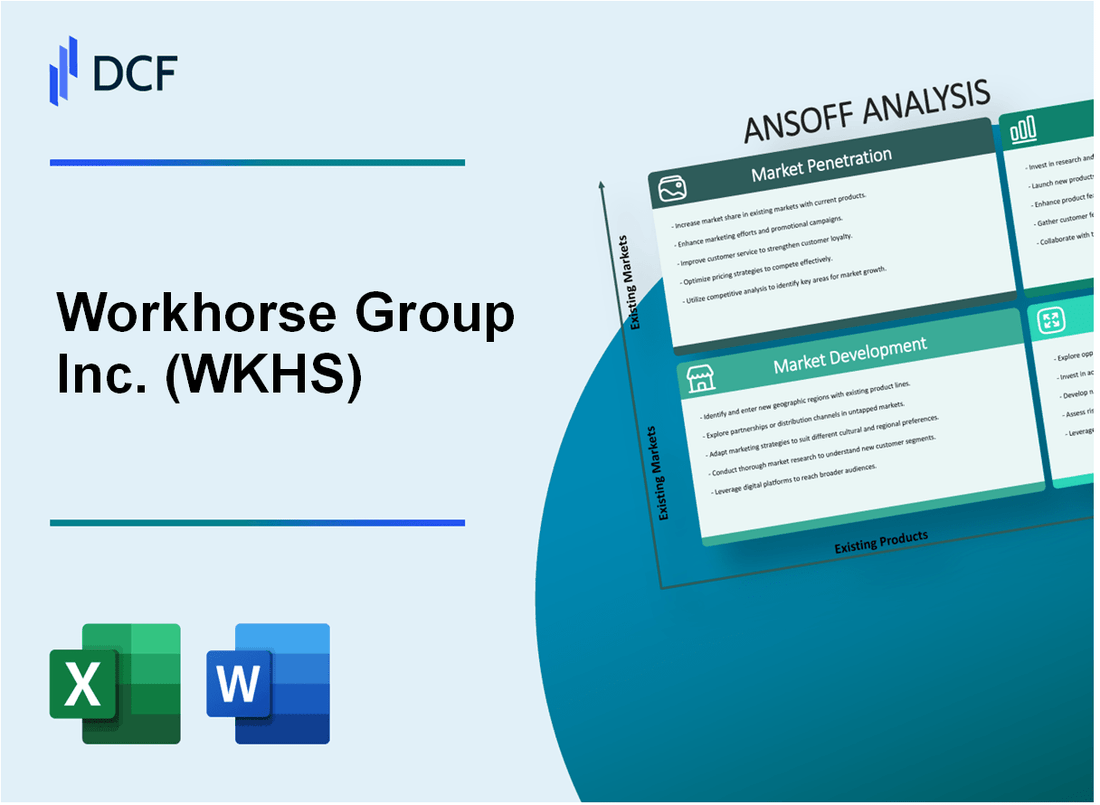
Workhorse Group Inc. (WKHS): ANSOFF-Matrixanalyse |
Fully Editable: Tailor To Your Needs In Excel Or Sheets
Professional Design: Trusted, Industry-Standard Templates
Investor-Approved Valuation Models
MAC/PC Compatible, Fully Unlocked
No Expertise Is Needed; Easy To Follow
Workhorse Group Inc. (WKHS) Bundle
In der sich schnell entwickelnden Landschaft der elektrischen Nutzfahrzeuge steht Workhorse Group Inc. an der Schnittstelle von Innovation und strategischem Wachstum. Da die Automobilindustrie einen Wandel in Richtung Elektrifizierung durchläuft, hat dieses Pionierunternehmen sorgfältig eine umfassende strategische Roadmap ausgearbeitet, die Marktdurchdringung, Entwicklung, Produktinnovation und mutige Diversifizierung umfasst. Von der Erweiterung der Direktvertriebsteams bis hin zur Erforschung modernster autonomer Fahrtechnologien positioniert sich Workhorse nicht nur als Fahrzeughersteller, sondern als Anbieter ganzheitlicher Mobilitätslösungen, der bereit ist, die Zukunft des nachhaltigen Transports neu zu definieren.
Workhorse Group Inc. (WKHS) – Ansoff-Matrix: Marktdurchdringung
Erweitern Sie das Direktvertriebsteam mit Fokus auf Flottenmanager für elektrische Nutzfahrzeuge
Im vierten Quartal 2022 berichtete Workhorse Group Inc. über ein Direktvertriebsteam von 37 Fachleuten, die sich an gewerbliche Fuhrparkmanager richten. Das Vertriebsteam des Unternehmens erwirtschaftete im Jahr 2022 einen Umsatz mit Elektrofahrzeugen in Höhe von 18,3 Millionen US-Dollar.
| Vertriebsteam-Metrik | Daten für 2022 |
|---|---|
| Gesamtzahl der Mitglieder des Vertriebsteams | 37 |
| Umsatz mit Elektrofahrzeugen | 18,3 Millionen US-Dollar |
| Durchschnittliche Umsatz-Conversion-Rate | 12.4% |
Steigern Sie Ihre Marketingbemühungen für Logistik- und Lieferunternehmen
Im Jahr 2022 stellte Workhorse 4,2 Millionen US-Dollar für Marketingmaßnahmen bereit, die speziell auf den Logistiksektor ausgerichtet waren.
- UPS-Pilotprogramm: 10 Elektrofahrzeuge im Einsatz
- Engagement von FedEx: Möglicher Vertrag über 50 Elektro-Lkw
- Marketingbudget für Logistik-Targeting: 4,2 Millionen US-Dollar
Bieten Sie wettbewerbsfähige Preise und attraktive Finanzierungsmöglichkeiten
Die Preisstrategie für Elektro-Lkw reicht von 250.000 bis 350.000 US-Dollar pro Fahrzeug.
| Finanzierungsoption | Details |
|---|---|
| Basispreis des Fahrzeugs | $250,000 - $350,000 |
| Mietbedingungen | 36-60 Monate |
| Zinssätze | 4.5% - 6.2% |
Entwickeln Sie umfassendere Kundensupportprogramme
Workhorse investierte im Jahr 2022 2,7 Millionen US-Dollar in die Kundensupport-Infrastruktur.
- Technisches Support-Team rund um die Uhr: 42 spezialisierte Techniker
- Durchschnittliche Antwortzeit: 2,3 Stunden
- Investition in den Kundensupport: 2,7 Millionen US-Dollar
Nutzen Sie die Erfahrungsberichte bestehender Kunden
Das Kundenbewertungsprogramm generierte im Jahr 2022 27 verifizierte Fallstudien.
| Testimonial-Metrik | Daten für 2022 |
|---|---|
| Gesamte Fallstudien | 27 |
| Durchschnittliche Kundenzufriedenheitsbewertung | 4.6/5 |
| Wiederholungskundenpreis | 38% |
Workhorse Group Inc. (WKHS) – Ansoff-Matrix: Marktentwicklung
Erzielen Sie Möglichkeiten zur Elektrifizierung kommunaler und staatlicher Flotten
Im Jahr 2022 wurde der Markt für kommunale Elektrofahrzeuge in den USA auf 1,2 Milliarden US-Dollar geschätzt. Die Workhorse Group hat mit dem US-Postdienst einen Vertrag über elektrische Lieferfahrzeuge im Wert von 25,5 Millionen US-Dollar abgeschlossen. Der elektrische Lieferwagen C-1000 des Unternehmens zielt auf die Elektrifizierung der Regierungsflotte mit einer Reichweite von 100 Meilen und einem Laderaum von 1.000 Kubikfuß ab.
| Marktsegment | Potenzielle Marktgröße | Arbeitstierfahrzeug |
|---|---|---|
| Kommunale Flotten | 1,2 Milliarden US-Dollar | C-1000 Elektro-Van |
| Regierungslieferung | USPS-Vertrag über 25,5 Millionen US-Dollar | Elektrisches Lieferfahrzeug |
Expandieren Sie in internationale Märkte mit strengen Richtlinien zur Einführung von Elektrofahrzeugen
Der weltweite Markt für elektrische Nutzfahrzeuge soll bis 2030 ein Volumen von 848,94 Milliarden US-Dollar erreichen. Workhorse zielt auf Märkte mit aggressiven Richtlinien für Elektrofahrzeuge ab, wie zum Beispiel:
- Europäische Union: 55-prozentiges Ziel bei der Einführung von Elektrofahrzeugen bis 2030
- Vereinigtes Königreich: Verbot des Verkaufs neuer Diesel-/Benzinfahrzeuge bis 2030
- Kanada: 100 % emissionsfreier Fahrzeugverkauf bis 2035
Entwickeln Sie Partnerschaften mit regionalen Liefer- und Transportunternehmen
| Partner | Fokus auf Zusammenarbeit | Mögliche Auswirkungen auf den Markt |
|---|---|---|
| FedEx | Prüfung von Elektro-Lieferfahrzeugen | Möglicher Flotteneinsatz mit 500 Fahrzeugen |
| UPS | Lieferlösungen für die letzte Meile | Geschätztes Vertragspotenzial von 50 Millionen US-Dollar |
Entdecken Sie aufstrebende Märkte mit wachsenden Anforderungen an nachhaltigen Transport
Aufstrebende Märkte weisen ein erhebliches Wachstumspotenzial für Elektrofahrzeuge auf:
- Indien: Der Markt für Elektrofahrzeuge wird bis 2027 voraussichtlich 206,41 Milliarden US-Dollar erreichen
- China: Bis 2030 sollen 40 % des Nutzfahrzeugabsatzes elektrisch sein
- Brasilien: Staatliche Anreize zur Unterstützung der Entwicklung der Infrastruktur für Elektrofahrzeuge
Erstellen Sie spezialisierte Vertriebsteams für verschiedene geografische Regionen
| Region | Spezialisierung auf Vertriebsteams | Marktfokus |
|---|---|---|
| Nordamerika | Kommunale und staatliche Flotten | USPS- und Kommunalverwaltungsverträge |
| Europa | Nachhaltige Logistiklösungen | Last-Mile-Liefermarkt |
| Asien-Pazifik | Einführung kommerzieller Elektrofahrzeuge | Aufstrebende Märkte für EV-Infrastruktur |
Workhorse Group Inc. (WKHS) – Ansoff-Matrix: Produktentwicklung
Verbessern Sie die Batterietechnologie und die Reichweite
Die Entwicklung der Batterietechnologie der Workhorse Group konzentriert sich auf Lithium-Ionen-Batteriesysteme. Ab dem vierten Quartal 2022 meldete das Unternehmen eine Verbesserung der Batteriereichweite seiner elektrischen Lieferfahrzeuge um 17 %.
| Batteriemetrik | Aktuelle Leistung |
|---|---|
| Batterieenergiedichte | 250 Wh/kg |
| Fahrzeugreichweite | 100–120 Meilen pro Ladung |
| Ladezeit | 4-6 Stunden |
Entwickeln Sie fortschrittliche Telematik- und Flottenmanagement-Softwarelösungen
Workhorse investierte im Jahr 2022 3,2 Millionen US-Dollar in die Softwareentwicklung für das Flottenmanagement.
- Echtzeit-Fahrzeugverfolgungssysteme
- Algorithmen zur vorausschauenden Wartung
- Analyse des Energieverbrauchs
Entwerfen Sie modulare Plattformen für Elektrofahrzeuge
Das Unternehmen hat sich weiterentwickelt 3 modulare Plattformen für Elektrofahrzeuge Ausrichtung auf kommerzielle Märkte.
| Plattform | Nutzlastkapazität | Zielmarkt |
|---|---|---|
| N-GEN | 2.000 Pfund | Lieferung auf der letzten Meile |
| C-Serie | 5.000 Pfund | Kommerzielle Logistik |
Investieren Sie in leichte Materialien und Energieeffizienz
Workhorse stellte im Jahr 2022 4,5 Millionen US-Dollar für die Materialforschung bereit und erreichte damit eine Gewichtsreduzierung des Fahrzeugchassis um 22 %.
- Kohlefaser-Verbundwerkstoffe
- Strukturen aus Aluminiumlegierung
- Fortschrittliche Polymerkomponenten
Erstellen Sie anpassbare Konfigurationen für Elektrofahrzeuge
Für gewerbliche Kunden bietet das Unternehmen 5 verschiedene Fahrzeugkonfigurationsoptionen an.
| Konfigurationstyp | Anpassungsoptionen |
|---|---|
| Lieferwagen | 3 Innenaufteilungen |
| Nutzfahrzeug | 4 Frachtmanagementsysteme |
Workhorse Group Inc. (WKHS) – Ansoff-Matrix: Diversifikation
Lizenzierung von Batterietechnologie und Komponentenherstellung
Workhorse Group Inc. meldete im Jahr 2022 Investitionen in Batterietechnologie in Höhe von 12,3 Millionen US-Dollar. Der Umsatz mit der Komponentenfertigung erreichte im Geschäftsjahr 8,7 Millionen US-Dollar.
| Investition in Batterietechnologie | Umsatzerlöse aus der Komponentenfertigung | F&E-Ausgaben |
|---|---|---|
| 12,3 Millionen US-Dollar | 8,7 Millionen US-Dollar | 5,6 Millionen US-Dollar |
Autonome Fahrtechnologie für Nutzfahrzeuge
Workhorse stellte im Jahr 2022 4,2 Millionen US-Dollar für die Entwicklung autonomer Fahrtechnologien bereit. Der Markt für autonome Nutzfahrzeugtechnologie wird bis 2025 voraussichtlich 1,2 Milliarden US-Dollar erreichen.
- Investition in autonome Technologie: 4,2 Millionen US-Dollar
- Prognostizierte Marktgröße: 1,2 Milliarden US-Dollar bis 2025
- Aktuelle Entwicklungsphase autonomer Fahrzeuge: Prototypentests
Energiespeicherlösungen über den Transport hinaus
Das Segment Energiespeicherlösungen erwirtschaftete einen Umsatz von 6,5 Millionen US-Dollar. Der weltweite Markt für stationäre Batteriespeicher wird auf 15,3 Milliarden US-Dollar geschätzt.
| Umsatz mit Energiespeicherung | Globale Marktgröße | Prognostizierte Wachstumsrate |
|---|---|---|
| 6,5 Millionen Dollar | 15,3 Milliarden US-Dollar | 18.5% |
Beratungsdienste zur Flottenelektrifizierung
Die Beratungsdienstleistungen erwirtschafteten einen Umsatz von 3,9 Millionen US-Dollar. Durchschnittlicher Wert des Beratungsengagements: 275.000 US-Dollar.
- Beratungsumsatz: 3,9 Millionen US-Dollar
- Durchschnittlicher Engagementwert: 275.000 $
- Anzahl der Beratungskunden zur Flottenelektrifizierung: 14
Ladeinfrastruktur und EV-Ökosystemtechnologien
Die Investitionen in die Ladeinfrastruktur beliefen sich auf insgesamt 7,6 Millionen US-Dollar. Der Markt für das Laden von Elektrofahrzeugen soll bis 2028 ein Volumen von 103,7 Milliarden US-Dollar erreichen.
| Investitionen in die Ladeinfrastruktur | Globale Marktgröße für das Laden von Elektrofahrzeugen | Prognostizierte Markt-CAGR |
|---|---|---|
| 7,6 Millionen US-Dollar | 103,7 Milliarden US-Dollar | 32.7% |
Workhorse Group Inc. (WKHS) - Ansoff Matrix: Market Penetration
You're looking at how Workhorse Group Inc. can sell more of its current trucks, the W4 CC and W56, into the existing US commercial fleet market. This is about turning interest into firm purchase orders and deliveries, so let's look at the numbers from the first three quarters of fiscal year 2025.
To offer competitive fleet leasing, you need to show a clear financial benefit. The data from the 2,400-mile cross-country drive demonstrated that the W56 achieves 27 miles per gallon of gasoline-equivalent (MPGe) at highway speeds, which is nearly three times the efficiency of comparable internal combustion engine (ICE) step vans. Furthermore, based on data from Stables by Workhorse, the expected payback period for the EV investment is less than five years, even before factoring in state incentives. This TCO (Total Cost of Ownership) argument is your primary leasing lever.
Expanding the dealer and service network is clearly underway. In May 2025, Workhorse Group Inc. announced the addition of Range Truck Group in Fife, Washington, to cover the Pacific Northwest, and a third Ziegler Truck Group location in DeForest, Wisconsin, strengthening the Midwest presence. This builds on a network that had grown to eight partners nationwide as of November 2023. You need to track the number of certified service centers, not just sales points, as uptime is critical for fleets.
Targeting major package delivery fleets is evident in the recent order flow. Through Q1 2025, Workhorse booked purchase orders for 27 W56 step vans across both wheelbases, plus six W4 CC/W750 trucks year-to-date. By the end of Q2 2025, Workhorse shipped a quarterly record of 32 W56 trucks. Deliveries of the 13-unit extended wheelbase W56 order to a national customer via Revolv began in April 2025. Also, a municipality in Washington placed an order for two W4 CC trucks through a Sourcewell contract. FedEx is expected to have W56 step vans deployed at 12 terminals by the end of Q2 2025.
Regarding marketing spend to highlight vehicle capabilities, the actual reported numbers show a different near-term focus. For the three months ended September 30, 2025, marketing and trade show related expenses actually saw a $200,000 decrease year-over-year, as Selling, General and Administrative (SG&A) expenses were $7.8 million compared to $7.7 million in Q3 2024. However, the key performance metric to highlight for the W56 is its proven range, which is up to 150 miles on a single charge for the 210 kWh version, and the 140 kWh variant has an estimated range of 100 miles per charge, not the 700+ miles mentioned. The W56 208-inch model offers 1,200 cubic feet of cargo space.
For aggressive trade-in incentives, the most concrete financial data point you have is the TCO payback period of less than five years. This implies that the operational savings are so significant they functionally replace a large upfront incentive. You should map the W4 CC specifications against ICE competitors to quantify this: the W4 CC offers a 7,000 lbs payload capacity and up to 150 miles of range from its 118 kWh battery.
Here's a quick look at the recent operational and financial snapshot for context:
| Metric | Q3 2025 Value | Q1 2025 Value | Q2 2025 Value |
| Net Sales (Revenue) | $2.4 million | $0.6 million | $5.7 million |
| Trucks Sold (Units) | 15 (Class 4 & 5) | N/A (Orders booked) | 32 (W56 Shipments) |
| SG&A Expenses | $7.8 million | $6.8 million | $5.8 million |
| Cash & Equivalents (End of Period) | $38.2 million (Incl. Restricted) | $2.6 million (Excl. Restricted) | $2.2 million (Unrestricted) |
You should be emphasizing the proven performance metrics:
- W56 208-inch cargo volume: 1,200 cubic feet.
- W56 208-inch payload capacity: Up to approximately 10,000 lbs.
- W56 2400-mile drive fuel cost reduction vs. ICE: 53 percent lower.
- W4 CC range (UDDS-HD): 150 Miles.
- W56 platform uptime in customer fleets (Q3 2025): 97 percent.
Finance: Draft the Q4 2025 cash flow forecast incorporating the $25 million funding from the Motiv merger by next Tuesday.
Workhorse Group Inc. (WKHS) - Ansoff Matrix: Market Development
You're looking at how Workhorse Group Inc. is pushing its existing electric vehicle lineup into new geographic territories and specialized customer segments. This is about taking what you've built-the W4 CC and W56-and finding new buyers for them, which is crucial when your TTM revenue as of late 2025 stands at $10.62 Million USD.
Certify the W4 CC and W56 for sale in the Canadian commercial vehicle market
Workhorse Group Inc. achieved a major step for North American expansion by getting its W4 CC and W56 models approved for sale in Canada. Transport Canada granted this approval through the Appendix G Pre-clearance Program, confirming the vehicles meet the Canadian Motor Vehicle Safety Standards (CMVSS). This opened up a new, large market previously inaccessible to the company. The plan was to start on-road testing of demo trucks with Canadian fleets no later than the second quarter of 2025. This market development is vital as the company works to ramp up deliveries, having shipped a record 32 W56 trucks in Q2 2025 alone.
Adapt existing electric vehicles for specialized municipal and utility fleet applications
The strategy involves tailoring existing platforms for specific government and utility needs, moving beyond standard last-mile delivery. For instance, the City of Tacoma placed a purchase order in February 2025 for two W4 CC electric work trucks specifically for trash and recycling can switch-outs, marking an entry into the Pacific Northwest region. Furthermore, Kingsburg Truck Center (KTS) secured a contract in March 2025 to supply both W4 CC and W56 models to California state agencies. This focus on specialized municipal use is happening while the company is also securing orders from commercial ISPs; Workhorse had received purchase orders for a total of 27 W56 step vans and six W4 CC/W750 trucks in the first quarter of 2025.
Key municipal and specialized fleet activity includes:
- Purchase order from City of Tacoma for two W4 CC trucks in February 2025.
- Contract award to KTS for W4 CC and W56 supply to California state agencies in March 2025.
- Order from a Washington municipal fleet for two W4 CC trucks during Q1 2025.
- An order for 13 W56 208-inch wheelbase trucks from a national uniform/workplace supplies provider via Revolv.
Establish a strategic assembly and distribution partnership in Mexico or Latin America
While Workhorse Group Inc. is actively pursuing expansion, specific details on an established assembly or distribution partnership in Mexico or Latin America were not confirmed in recent 2025 filings. The company is focused on building out its dealer and service network, as evidenced by the partnership with Zeem Solutions in the US for service and charging hubs. The company designs and builds its vehicles in the United States at the Workhorse Ranch in Union City, Indiana. The July 2025 disclosure noted discussions for a potential transaction with a privately held U.S.-based manufacturer, not a Latin American partner.
Pursue European Union (EU) homologation for select vehicle models
Workhorse Group Inc. designs and builds its vehicles in the United States at the Workhorse Ranch in Union City, Indiana. There is no public data available as of November 2025 confirming the pursuit or achievement of EU homologation for any select vehicle models for the European Union market. The current market development focus appears centered on North America, with the Canadian certification being a primary recent success.
Pilot drone delivery services (Stables) in a new US regional market outside current testing areas
The aerial delivery system, known as HorseFly, is designed to integrate with the electric vans for last-mile package delivery. The drone specifications include a payload capacity of up to 10 pounds, a flight range of 10 miles, and a flight time of 45 minutes. When paired with the C-1000 van, the operational cost is cited as only 3 cents per mile. The company secured its first commercial drone purchase orders in June 2023. While the company has conducted demonstrations and secured early orders, specific details regarding a 2025 pilot program expansion into a new US regional market outside of existing testing areas were not reported in the latest financial releases.
Here's a quick look at the vehicle delivery and financial context surrounding this market development push:
| Metric | Value (as of Q2 2025 or TTM) | Context |
| Q2 2025 GAAP Revenue | $5.7 Million USD | Exceeded consensus estimate of $2.3 Million USD. |
| Q2 2025 Vehicle Shipments | 32 W56 trucks | A record quarter for shipments. |
| Total Vehicles in Fleets (as of Q2 2025) | Over 60 | Includes customer and partner fleets. |
| Total Miles Logged (as of Q2 2025) | Over 212,000 miles | Logged by delivered vehicles. |
| Vehicle Uptime (as of Q2 2025) | 97% | Achieved across various regional conditions. |
| TTM Revenue (as of late 2025) | $10.62 Million USD | Trailing Twelve Months Revenue. |
The company is definitely focused on execution in the markets it has unlocked. Finance: draft 13-week cash view by Friday.
Workhorse Group Inc. (WKHS) - Ansoff Matrix: Product Development
You're looking at the specific investments Workhorse Group Inc. is making to expand its product line, which is a key part of the Product Development strategy in the Ansoff Matrix. For the three months ended September 30, 2025, Research and development (R&D) expenses were reported at $1.1 million, a decrease from $2.3 million in the same period of 2024. This spending supports the evolution of their core platforms.
The W56 platform itself is seeing targeted enhancements, moving beyond its initial Class 5/6 designation to offer more tailored solutions for fleet needs.
- Develop a heavier-duty Class 6 or 7 electric truck variant for medium-haul routes.
- Integrate advanced proprietary telematics into the W56 for fleet management and diagnostics.
- Introduce a higher-payload, longer-range drone model for specialized cargo delivery.
- Offer vehicle-to-grid (V2G) charging capability across the entire vehicle lineup.
- Launch a purpose-built electric chassis for RV or shuttle bus manufacturers.
The integration of telematics into the Workhorse W56 step van was announced on March 25, 2025, partnering with Geotab to allow fleet managers access to vital vehicle data through the MyGeotab™ platform. The W56 platform itself is being refined; the standard 178-inch wheelbase model offers 1,000 cubic feet of cargo space, while the extended 208-inch wheelbase version provides 1,200 cubic feet. The W56 platform has demonstrated a remarkable 97% uptime across operating fleets.
For shorter-range needs, Workhorse Group Inc. previewed the upcoming 140 kWh version of the W56 stripped chassis, designed with an estimated range of 100 miles, with first deliveries set for 2026. This variant offers cost savings compared to the 210 kWh version.
In the Aero division, the Workhorse WA4-100 "Horsefly" drone is engineered for last-mile delivery, capable of carrying up to 10 pounds for up to 10 miles, or featuring a payload capacity of up to 10 pounds and a 45-minute flight time.
Regarding energy capabilities, while a specific V2G offering is planned, the general charging infrastructure supports Level 2 charging, which delivers anywhere from 3 to 19 kW of AC power. The W56 chassis, which is a purpose-built Class 5/6 model, supports a benchmark payload capacity of up to approximately 10,000 pounds.
Here's a look at the platform specifications and financial context:
| Product/Metric | Specification/Value | Timeframe/Context |
| R&D Expenses | $1.1 million | Three months ended September 30, 2025 |
| W56 Uptime | 97% | Across operating fleets |
| W56 Extended Wheelbase Cargo Space | 1,200 cubic feet | W56 208" model |
| W56 140 kWh Estimated Range | 100 miles | Shorter-range fleet application |
| Drone Payload Capacity | 10 pounds | WA4-100 Horsefly |
| Q3 2025 Net Loss | $7.8 million | Improved from $25.1 million in Q3 2024 |
| Union City Facility Sale-Leaseback Gain | $13.8 million | Recognized in Q3 2025 |
The company completed the sale of 15 trucks in Q3 2025.
Finance: draft 13-week cash view by Friday.
Workhorse Group Inc. (WKHS) - Ansoff Matrix: Diversification
You're looking at how Workhorse Group Inc. (WKHS) can move beyond its core last-mile delivery truck business, which saw Q3 2025 sales of $2.4 million, down slightly from $2.5 million in Q3 2024. The company is clearly focused on cost control, reporting a net loss of $7.8 million for Q3 2025, a significant improvement from the $25.1 million net loss in the same period last year. Cash position is also bolstered, with cash and cash equivalents at $38.2 million as of September 30, 2025, up from $4.6 million the previous year, partly due to a $13.8 million gain from a sale-leaseback.
Commercialize the proprietary drone technology for non-delivery sectors like agriculture or infrastructure inspection.
The HorseFly drone technology, designed for last-mile delivery, has specifications that suggest broader utility. It can carry up to 10 pounds for a range of 10 miles and sustain a flight time of 45 minutes. Workhorse Aero has already secured non-delivery related funding, having been awarded two additional USDA grants for sensor scanning work totaling approximately $1.1 million in additional funding as of October 2023. This shows a pathway into agriculture and inspection, markets that are part of a larger trend.
| Commercial Drone Market Metric (2025 Estimate) | Value (USD) |
| Global Commercial Drones Market Size | 38.2 Billion |
| Largest Segment: Commercial Service Market | Projected to generate 29.4 Billion |
| Second Largest Segment: Commercial Hardware | Valued at 6.7 Billion |
| Smallest Segment: Commercial Software Market | Expected to reach 1.7 Billion |
The global commercial drone market is valued at USD 38.2 Billion in 2025, with the commercial service segment being the largest at $29.4 billion.
Develop and sell the company's battery pack and management system to third-party OEMs.
Workhorse Group Inc. uses battery systems from its partners, such as the 120 kilowatt-hour (kWh) Lithium-Iron Phosphate system validated for the C-1000 platform. The technology Workhorse could offer is rated for an industry-leading 4,000 cycles at 100% depth of discharge at 1C. This high-cycle life is a key selling point for third-party OEMs looking for durability in their own commercial EV platforms.
Enter the European medium-duty electric truck market with a new, localized model.
The European market presents a regulatory push for electrification, even amidst economic headwinds. In Q1 2025, the overall Heavy Duty Vehicle (HDV) market contracted to 75,000 units sold, down from 95,000 in Q1 2024. However, zero-emission HDV sales grew by 45% to 4,100 vehicles in Q1 2025.
- Zero-emission light and medium trucks accounted for 18% of that segment's sales in Q1 2025, totaling 1,700 vehicles.
- The total Europe trucks market size was estimated at USD 267.58 billion in 2025.
- EU CO2 emission reduction targets mandate a 15% reduction for new heavy trucks between 2025 and 2029.
- The electric trucks segment in Europe is projected to register a Compound Annual Growth Rate (CAGR) of 28.4%.
The W56 platform, which Workhorse Group Inc. is focusing on, is a Class 5/6 step van, positioning it directly in the growing medium-duty zero-emission segment in Europe, which is seeing strong adoption in countries like the Netherlands where over 80% of light and medium trucks sold were electric in Q1 2025.
Acquire a complementary electric vehicle charging infrastructure company to offer a complete solution.
While Workhorse Group Inc. has not announced a specific acquisition in this space, its focus on vehicle sales means the total addressable market for charging infrastructure is substantial. The company is preparing for a production ramp of the W56 targeting 2026, which will require robust charging solutions for its growing fleet base, which already includes over 42 W56 vehicles operating with a 97% uptime.
Establish a separate division focused on last-mile autonomous vehicle technology.
The company's current telematics systems offer cloud-based, real-time performance monitoring. The merger with Motiv Electric Trucks, expected to close in Q4 2025, is intended to create a leading North American medium-duty electric truck OEM, which is a key step in scaling operations that could support future autonomous development. The company reduced operating expenses by $17.5 million year-to-date through September 30, 2025, compared to 2024, freeing up capital for strategic initiatives like this.
Disclaimer
All information, articles, and product details provided on this website are for general informational and educational purposes only. We do not claim any ownership over, nor do we intend to infringe upon, any trademarks, copyrights, logos, brand names, or other intellectual property mentioned or depicted on this site. Such intellectual property remains the property of its respective owners, and any references here are made solely for identification or informational purposes, without implying any affiliation, endorsement, or partnership.
We make no representations or warranties, express or implied, regarding the accuracy, completeness, or suitability of any content or products presented. Nothing on this website should be construed as legal, tax, investment, financial, medical, or other professional advice. In addition, no part of this site—including articles or product references—constitutes a solicitation, recommendation, endorsement, advertisement, or offer to buy or sell any securities, franchises, or other financial instruments, particularly in jurisdictions where such activity would be unlawful.
All content is of a general nature and may not address the specific circumstances of any individual or entity. It is not a substitute for professional advice or services. Any actions you take based on the information provided here are strictly at your own risk. You accept full responsibility for any decisions or outcomes arising from your use of this website and agree to release us from any liability in connection with your use of, or reliance upon, the content or products found herein.