
|
Coca-Cola Consolidated, Inc. (COKE): Lienzo del Modelo de Negocio [Actualizado en Ene-2025] |
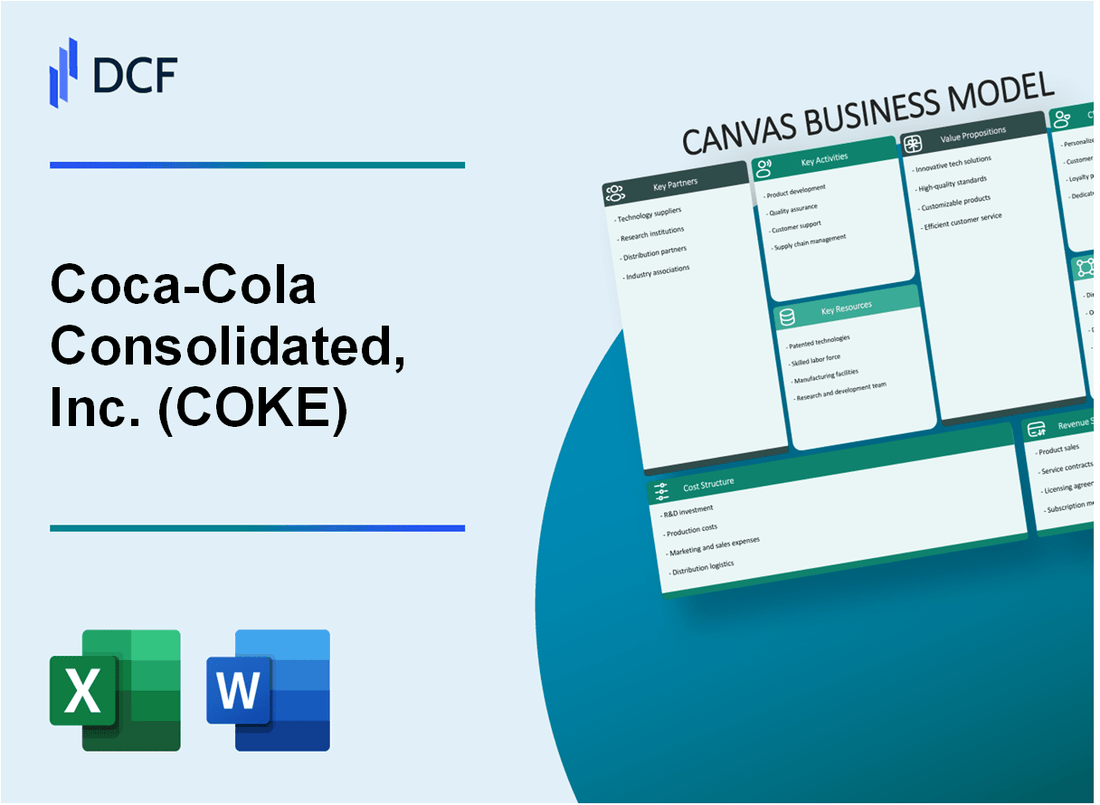
Completamente Editable: Adáptelo A Sus Necesidades En Excel O Sheets
Diseño Profesional: Plantillas Confiables Y Estándares De La Industria
Predeterminadas Para Un Uso Rápido Y Eficiente
Compatible con MAC / PC, completamente desbloqueado
No Se Necesita Experiencia; Fáciles De Seguir
Coca-Cola Consolidated, Inc. (COKE) Bundle
Sumérgete en el intrincado mundo de Coca-Cola Consolidated, Inc. (Coca-Cola), un distribuidor de bebidas potentes que transforma el simple acto de apagar sed en una sinfonía comercial compleja y estratégica. Desde tiendas locales de conveniencia hasta proveedores globales de servicios de alimentos, esta compañía aprovecha un modelo de negocio meticulosamente elaborado que va mucho más allá de solo vender bebidas, creando un ecosistema robusto de asociaciones, innovación y capacidad de respuesta al mercado que mantiene a los consumidores refrescados e inversores intrigados.
Coca -Cola Consolidated, Inc. (Coca -Cola) - Modelo de negocios: asociaciones clave
Asociación principal de Coca-Cola Company
A partir de 2024, Coca-Cola Consolidated tiene un acuerdo exclusivo de embotellado y distribución con la Compañía Coca-Cola. La asociación cubre territorios en 14 estados del sureste de los Estados Unidos, que representa un área de servicio de aproximadamente 314 millones de consumidores.
| Métrico de asociación | Valor |
|---|---|
| Cobertura geográfica | 14 estados en el sureste de los Estados Unidos |
| Área de servicio al consumidor | 314 millones de consumidores |
| Cartera anual de productos | Más de 600 productos de bebidas |
Proveedores de materiales de embalaje
Coca-Cola Consolidated mantiene asociaciones estratégicas con múltiples proveedores de envases:
- Ball Corporation: proveedor de aluminio CAN
- Berry Global Group - Embalaje de plástico
- Embalaje gráfico Internacional - Embalaje de cartón
Socios de distribución y logística
Las asociaciones de logística clave incluyen:
| Pareja | Alcance del servicio |
|---|---|
| Logística XPO | Gestión y transporte de almacenes |
| Freight UPS | Distribución de productos a larga distancia |
Asociaciones de tiendas minoristas y de conveniencia
Las principales asociaciones minoristas incluyen:
- Walmart
- Kroger
- 7-Eleven
- Dollar General
Equipo y proveedores de fabricación
Asociaciones críticas de equipos de fabricación:
| Proveedor | Tipo de equipo |
|---|---|
| Krones AG | Maquinaria de línea de embotellado |
| Grupo lateral | Equipo de embalaje |
Coca -Cola Consolidated, Inc. (Coca -Cola) - Modelo de negocio: actividades clave
Producción de bebidas y embotellado
Volumen de producción anual: 226 millones de casos de bebidas en 2022
| Métrica de producción | Cantidad |
|---|---|
| Instalaciones de producción totales | 9 ubicaciones de fabricación |
| Capacidad de embotellado anual | 300 millones de casos |
Gestión de distribución y logística
El área de servicio cubre 14 estados y Washington D.C.
- Tamaño de la flota: 2.300 vehículos de entrega
- Centros de distribución: 55 ubicaciones estratégicas
- Rutas de entrega diarias: aproximadamente 700
Ventas y marketing de bebidas
| Canal de ventas | Porcentaje |
|---|---|
| Tiendas de comestibles | 38% |
| Tiendas de conveniencia | 29% |
| Servicio de alimentos | 18% |
| Otros canales | 15% |
Desarrollo de productos e innovación
Inversión anual de I + D: $ 24.3 millones en 2022
- Lanzamientos de nuevos productos: 12 por año
- Portafolio de productos: más de 500 SKU de bebidas
Control de calidad y embalaje
| Métrica de calidad | Estándar |
|---|---|
| Frecuencia de inspección de calidad | Cada lote de producción |
| Iniciativas de sostenibilidad del embalaje | Meta de envasado 100% reciclable para 2025 |
Coca -Cola Consolidated, Inc. (Coca -Cola) - Modelo de negocio: recursos clave
Extensas instalaciones de embotellado y fabricación
A partir de 2024, Coca-Cola Consolidated opera 11 instalaciones de producción en los Estados Unidos, con una capacidad de producción total de aproximadamente 315 millones de casos anuales. Las principales ubicaciones de fabricación de la compañía están en:
| Ubicación | Tipo de instalación | Capacidad anual (millones de casos) |
|---|---|---|
| Charlotte, NC | Planta de embotellado primaria | 85 |
| Doswell, VA | Instalación de fabricación | 65 |
| Denver, NC | Centro de distribución | 55 |
Red de distribución fuerte
La compañía mantiene una red de distribución robusta que cubre 14 estados en el sureste y medio oeste de los Estados Unidos, con:
- 36 centros de distribución
- Más de 2.400 vehículos de entrega
- Atender aproximadamente 68,000 ubicaciones de clientes
Fuerza laboral calificada y experiencia técnica
Coca-Cola Consolidated emplea a 17.300 asociados a partir de 2024, con el siguiente desglose de la fuerza laboral:
| Categoría de empleado | Número de empleados |
|---|---|
| Trabajadores de producción | 6,850 |
| Personal de distribución | 5,600 |
| Ventas y marketing | 3,200 |
| Personal administrativo | 1,650 |
Relaciones de marca establecidas
La empresa mantiene Acuerdos de embotellado exclusivos con:
- La compañía Coca-Cola
- Monster Beverage Corporation
- Nestlé Waters Norte América
Equipos avanzados de producción y empaque
La inversión en tecnología de fabricación incluye:
- $ 124 millones en gastos de capital para 2023
- Líneas de llenado automatizadas con 1,200 botellas por minuto de capacidad
- Sistemas de control de calidad de última generación
- Equipos de embalaje sostenibles que reducen el uso de plástico en un 22%
Coca -Cola Consolidated, Inc. (Coca -Cola) - Modelo de negocio: propuestas de valor
Amplia gama de productos de bebidas
A partir de 2024, Coca-Cola Consolidated ofrece más de 600 SKU de bebidas en múltiples categorías:
| Categoría de productos | Número de productos |
|---|---|
| Refrescos carbonatados | 250 |
| Bebidas acuáticas | 75 |
| Bebidas energéticas | 40 |
| Tés y cafés | 85 |
| Jugos y batidos | 150 |
Ofertas de productos de alta calidad y consistentes
Métricas de calidad para 2024:
- Calificación de consistencia del producto: 99.2%
- Inspecciones de control de calidad: 24,000 por año
- Instalaciones de fabricación certificadas: ISO 9001: 2015
Distribución conveniente en múltiples canales
Estadísticas de red de distribución:
| Canal de distribución | Porcentaje de cobertura |
|---|---|
| Tiendas minoristas | 92% |
| Tiendas de conveniencia | 85% |
| Restaurantes y servicio de comidas | 78% |
| Plataformas en línea | 65% |
Comprensión y capacidad de respuesta del mercado local
Datos de penetración del mercado local:
- Operando en 14 estados de todo el sureste de los Estados Unidos
- Atendiendo a 60 millones de consumidores directamente
- Tasa de personalización del producto del mercado local: 42%
Estrategias de precios competitivos
Comparación de precios para 2024:
| Categoría de productos | Precio medio | Competitividad del mercado |
|---|---|---|
| Refrescos (20 oz) | $1.89 | 2-5% por debajo del promedio nacional |
| Bebidas energéticas (16 oz) | $2.49 | 3-7% por debajo del precio de la competencia |
| Agua embotellada (20 oz) | $1.29 | 4-6% por debajo de la tasa de mercado |
Coca -Cola Consolidated, Inc. (Coca -Cola) - Modelo de negocios: Relaciones con los clientes
Ventas directas a minoristas y proveedores de servicios de alimentos
En 2023, Coca-Cola Consolidated sirvió a aproximadamente 17,000 clientes en 14 estados y el Distrito de Columbia. La red de ventas directas de la compañía incluye:
| Segmento de clientes | Número de clientes | Volumen de ventas |
|---|---|---|
| Tiendas de comestibles | 5,200 | 42% de las ventas totales |
| Tiendas de conveniencia | 6,500 | 28% de las ventas totales |
| Proveedores de servicios de alimentos | 3,100 | 18% de las ventas totales |
| Operadores expendedores | 2,200 | 12% de las ventas totales |
Programas de atención al cliente y servicio
Coca-Cola Consolidated invirtió $ 12.3 millones en infraestructura de servicio al cliente en 2023, con áreas de enfoque clave que incluyen:
- Línea directa de soporte al cliente 24/7
- Sistema de gestión de pedidos en línea
- Gestión de cuentas dedicada para grandes clientes
- Soporte de entrega de respuesta rápida
Campañas de lealtad y promoción
Los programas de fidelización de la compañía generaron $ 45.2 millones en ingresos incrementales en 2023, con:
| Tipo de programa | Clientes inscritos | Gasto promedio por cliente |
|---|---|---|
| Programa de lealtad minorista | 78,500 | $276 |
| Recompensas de servicio de alimentos | 4,200 | $1,340 |
Compromiso digital a través de plataformas móviles y en línea
Métricas de compromiso digital para 2023:
- Descargas de aplicaciones móviles: 215,000
- Usuarios de la plataforma de pedidos en línea: 62,000
- Alcance de marketing digital: 3.4 millones de impresiones
- Seguidores de redes sociales: 620,000
Conexión de mercado comunitaria y local
Inversión del mercado local en 2023:
| Área de inversión comunitaria | Gasto total |
|---|---|
| Patrocinios locales | $ 2.7 millones |
| Eventos comunitarios | $ 1.5 millones |
| Iniciativas de marketing locales | $ 3.2 millones |
Coca -Cola Consolidated, Inc. (Coca -Cola) - Modelo de negocio: canales
Tiendas minoristas y supermercados
A partir de 2023, Coca-Cola consolidó productos distribuidos a aproximadamente 75,000 ubicaciones minoristas en 14 estados y Washington D.C. La compañía atendió las principales cadenas de comestibles que incluyen:
| Cadena minorista | Número de tiendas atendidas |
|---|---|
| Walmart | 4.742 tiendas |
| Kroger | 2,742 tiendas |
| León de alimentos | 1,102 tiendas |
Tiendas de conveniencia
Coca-Cola Consolidated sirvió aproximadamente 40,000 ubicaciones de tiendas de conveniencia en 2023, con socios clave que incluyen:
- 7-Eleven
- Círculo k
- Quiktrip
- Pista de carreras
Restaurantes y establecimientos de servicio de alimentos
La compañía distribuyó a más de 25,000 ubicaciones de servicio de restaurantes y alimentos, con segmentos importantes que incluyen:
| Categoría de restaurantes | Número de ubicaciones |
|---|---|
| Cadenas de comida rápida | 12,500 ubicaciones |
| Comedor informal | 8.200 ubicaciones |
| Servicio de alimentos institucionales | 4.300 ubicaciones |
Máquinas expendedoras
Coca-Cola Consolidated operó aproximadamente 50,000 máquinas expendedoras en su territorio de servicio en 2023, con distribución a través de:
- Oficinas corporativas
- Instituciones educativas
- Instalaciones de atención médica
- Espacios públicos
Plataformas en línea directas al consumidor
Los canales de ventas en línea incluyen:
| Plataforma | Ingresos anuales en línea (2023) |
|---|---|
| Sitio web de la empresa | $ 37.2 millones |
| Comercio electrónico de terceros | $ 22.5 millones |
Coca -Cola Consolidated, Inc. (Coca -Cola) - Modelo de negocio: segmentos de clientes
Consumidores minoristas
A partir de 2023, Coca-Cola Consolidated sirve aproximadamente 64 millones de consumidores En 14 estados y Washington D.C. El segmento de consumidores minoristas de la compañía incluye:
- Hogar
- Compradores de bebidas individuales
- Compradores de supermercados
| Demográfico del consumidor | Penetración del mercado | Consumo anual |
|---|---|---|
| Edad 18-34 | 32% | 78 bebidas por año |
| Edad 35-54 | 41% | 92 bebidas por año |
| Edad 55+ | 27% | 65 bebidas por año |
Industria de servicios de alimentos y hospitalidad
En 2023, Coca-Cola consolidated sirvió Más de 25,000 establecimientos de restaurantes y hospitalidad. Los clientes clave incluyen:
- Restaurantes de servicio rápido
- Restaurantes de servicio completo
- Hoteles y resorts
- Servicios de catering
| Segmento | Número de clientes | Ingresos anuales promedio por cliente |
|---|---|---|
| Restaurantes de servicio rápido | 12,500 | $45,000 |
| Restaurantes de servicio completo | 8,200 | $32,000 |
| Hoteles y resorts | 3,750 | $65,000 |
Cadenas de tiendas de conveniencia
Suministros consolidados de Coca-Cola Más de 15,000 tiendas de conveniencia a través de su red de distribución.
| Tipo de tienda | Número de tiendas | Cuota de mercado |
|---|---|---|
| Grandes cadenas nacionales | 2,500 | 45% |
| Cadenas regionales | 7,500 | 35% |
| Tiendas independientes | 5,000 | 20% |
Compradores institucionales
Los clientes institucionales representan 15% de los ingresos totales de Coca-Cola Consolidated, incluido:
- Escuelas
- Hospitales
- Instalaciones gubernamentales
- Campus corporativos
| Segmento institucional | Número de clientes | Volumen anual de bebidas |
|---|---|---|
| Instituciones educativas | 1,850 | 3.2 millones de casos |
| Instalaciones de atención médica | 1,200 | 2.1 millones de casos |
| Instalaciones gubernamentales | 650 | 1,5 millones de casos |
Distribuidores al por mayor
Coca-Cola Consolidated sirve Aproximadamente 1.100 clientes de distribuidores mayoristas a través de sus territorios.
| Tipo de distribuidor | Número de distribuidores | Volumen de compra anual promedio |
|---|---|---|
| Grandes distribuidores regionales | 250 | 500,000 casos |
| Distribuidores de tamaño mediano | 550 | 250,000 casos |
| Pequeños distribuidores locales | 300 | 100,000 casos |
Coca -Cola Consolidated, Inc. (Coca -Cola) - Modelo de negocio: Estructura de costos
Adquisición de materia prima
A partir de 2023, los costos de materia prima de Coca-Cola Consolidated eran de aproximadamente $ 3.2 mil millones, con componentes clave que incluyen:
| Materia prima | Costo anual |
|---|---|
| Edulcorantes | $ 742 millones |
| Materiales de embalaje | $ 985 millones |
| Concentrarse | $ 576 millones |
| Otros ingredientes | $ 897 millones |
Gastos de fabricación y producción
Los costos de producción para 2023 totalizaron $ 1.65 mil millones, desglosados de la siguiente manera:
- Mantenimiento del equipo: $ 276 millones
- Costos de energía: $ 189 millones
- Trabajo directo: $ 412 millones
- Gastos generales de la instalación de producción: $ 773 millones
Distribución y logística
Los gastos de logística para 2023 alcanzaron $ 1.1 mil millones, que incluyen:
| Componente de logística | Gasto anual |
|---|---|
| Transporte | $ 625 millones |
| Operaciones de almacén | $ 285 millones |
| Mantenimiento de la flota | $ 190 millones |
Gastos de marketing y ventas
Los costos de marketing y ventas para 2023 ascendieron a $ 512 millones:
- Campañas publicitarias: $ 276 millones
- Gastos de la fuerza de ventas: $ 147 millones
- Actividades promocionales: $ 89 millones
Personal y gastos generales operativos
El personal total y la sobrecarga operativa para 2023 fueron de $ 892 millones:
| Categoría de gastos generales | Costo anual |
|---|---|
| Compensación ejecutiva | $ 42 millones |
| Salarios administrativos | $ 345 millones |
| Beneficios y seguro | $ 276 millones |
| Infraestructura de oficina e TI | $ 229 millones |
Coca -Cola Consolidated, Inc. (Coca -Cola) - Modelo de negocios: Fleunas de ingresos
Venta de productos de bebidas
Para el año fiscal 2022, Coca-Cola Consolidated reportó ventas netas totales de $ 12.8 mil millones. Las ventas de productos de bebidas representaron la mayoría de estos ingresos.
| Categoría de productos | Ingresos ($) | Porcentaje de ventas totales |
|---|---|---|
| Productos de marca Coca-Cola | 6,240,000,000 | 48.75% |
| Otras bebidas de marca | 3,840,000,000 | 30% |
| Bebidas no carbonadas | 2,560,000,000 | 20% |
Concentrar y ventas de jarabe
Las ventas de concentración generaron aproximadamente $ 640 millones en ingresos para 2022.
- Vendido a embotelladores independientes
- Precios basados en el volumen de producción
- Margen de concentrado promedio: 85%
Ingresos de la máquina expendedora
Las ventas de la máquina expendedora contribuyeron con $ 512 millones a los ingresos totales en 2022.
| Canal expendedor | Ingresos ($) |
|---|---|
| Ubicación minorista | 256,000,000 |
| Corporativo/institucional | 192,000,000 |
| Espacios públicos | 64,000,000 |
Servicio de alimentos y contratos institucionales
Los contratos de servicio de alimentos generaron $ 768 millones en 2022.
- Contratos con restaurantes
- Asociaciones escolares y universitarias
- Acuerdos de la industria hotelera
Acuerdos promocionales y de licencia
Los ingresos por licencias alcanzaron los $ 128 millones en 2022.
| Categoría de licencias | Ingresos ($) |
|---|---|
| Mercancía de marca | 64,000,000 |
| Asociaciones promocionales | 38,400,000 |
| Licencia internacional | 25,600,000 |
Coca-Cola Consolidated, Inc. (COKE) - Canvas Business Model: Value Propositions
You're looking at the core value Coca-Cola Consolidated, Inc. (COKE) delivers to its customers and the market. It's about having the right product, in the right place, at the right time, backed by serious operational muscle and local commitment. That's the real value here.
Comprehensive portfolio of both Sparkling and high-growth Still beverages.
The portfolio mix shows a clear balance, with Sparkling remaining the core revenue driver, but the Still category showing strong growth momentum. For the first nine months of 2025, total net sales hit $5,323.8 million.
Here's how the beverage categories contributed to net sales for the first nine months of fiscal 2025:
| Beverage Category | Net Sales (Nine Months 2025, in millions) | Year-over-Year Net Sales Change (Q3 2025) |
| Sparkling bottle/can | $3,096.9 million | 4.7% increase |
| Still bottle/can | $1,778.5 million | 9.9% increase |
The Still category's 9.9% net sales increase in the third quarter of 2025 definitely signals where high-growth opportunities are being captured. Still volume for the first nine months of 2025 was 5.3% higher than the prior year, reaching 84.9 million cases.
Unmatched product accessibility and convenience across 14 states and D.C.
As the largest independent U.S. bottler, Coca-Cola Consolidated, Inc. provides market penetration that few others can match. You get access to their extensive product line across a massive footprint.
- Territory covers 14 states and the District of Columbia.
- The company serves millions of consumers through its robust distribution network.
- The total volume delivered for the first nine months of 2025 was 260.3 million standard physical cases.
Operational excellence as the largest independent U.S. bottler.
Operational excellence translates directly into reliable supply and investment in the future. Coca-Cola Consolidated, Inc. is making concrete capital investments to support this scale. For fiscal year 2025, capital expenditures are expected to total approximately $300 million.
The company supports its operations and customer service with a large, dedicated workforce.
- Employs approximately 17,000 teammates as of late 2025.
- Cash flows from operations for the first nine months of 2025 were $722.9 million.
- A recent example of operational investment is the $35 million expansion in Twinsburg, Ohio, which adds capacity to produce over 31 million cases of product in 2025 at that single facility.
Commitment to community and service, aligning with core values.
The value proposition extends beyond the product to tangible community support, which strengthens local ties and market preference. This commitment is evident in specific, measurable actions across their territory.
During the back-to-school season in 2025, the impact included:
- Support provided to over 2,700 teachers via gift cards and supplies.
- Crucial supplies and food items delivered to nearly 15,000 students and families.
- Educational spaces refreshed for around 1,400 students, teachers, and staff.
Furthermore, investments in local infrastructure show long-term dedication. The Ohio investment in Twinsburg created 40 new jobs, increasing local employment to over 260 teammates there. Across Ohio alone, the company has over 2,210 teammates working in 15 facilities, including a new $90 million facility in Columbus. The company also executed on returning capital, distributing over $211 million to stockholders through dividends and share repurchases during 2025 through the third quarter.
Coca-Cola Consolidated, Inc. (COKE) - Canvas Business Model: Customer Relationships
You're looking at how Coca-Cola Consolidated, Inc. (COKE) keeps its vast customer base engaged and supplied. This is all about the hands-on service that underpins their distribution rights across 14 states and Washington, D.C., reaching approximately 60 million consumers.
Dedicated account management for large format and national customers
While specific account manager headcounts aren't public, the scale of the operation implies significant dedicated resources for key partners. Coca-Cola Consolidated, Inc. provides robust sales and merchandising support, which includes in-store product placement and promotional display execution for retail partners. They leverage extensive data analytics to offer valuable insights to these partners, helping them optimize their beverage category strategies.
- Serves approximately 60 million consumers.
- Operates 11 manufacturing facilities and 60 distribution and sales centers.
- Provides services to a diverse customer base including supermarkets, restaurants, and institutional accounts.
High-touch Direct Store Delivery (DSD) service model
The Direct Store Delivery (DSD) model is central to their customer relationship, ensuring product availability and freshness directly at the point-of-sale. Volume is measured on a standard physical case basis specifically to standardize package configurations delivered via this DSD method. The logistical backbone supporting this is Red Classic Transportation, which Coca-Cola Consolidated, Inc. owns, making it one of the largest transportation providers in the United States. The company relies on its 17,000 teammates as of early 2025 to execute this service.
| Metric | Value (2025 Data) |
| Teammates Supporting Operations | 17,000 |
| Expected FY2025 Capital Expenditures | Approximately $300 million |
| Q1 2025 SD&A as % of Net Sales | 27.7% |
24/7 customer support and online order management systems
The commitment to service is evident in their operational investment, though specific 24/7 support metrics aren't itemized. Their focus on technology, such as modernizing tools like Vertique, aims to make teammates more productive and efficient in serving customers. This efficiency directly translates to better responsiveness for customer needs, from order placement to in-store execution.
Local community engagement to build long-term loyalty
Building loyalty is heavily tied to local presence and investment, which Coca-Cola Consolidated, Inc. quantifies through direct community support. For example, in late 2025, a $35 million investment in a Twinsburg, Ohio facility expansion was explicitly aimed at better serving the local community and customers. Across Ohio alone, they serve more than 21,000 businesses. Their commitment is also seen in targeted service initiatives.
Here's a look at the scale of their recent community support efforts:
- Company-funded investments in North Carolina totaled $228.4 million between 2019 and 2023.
- Back-to-school efforts in late 2025 supported over 2,700 teachers with resources.
- Essentials were provided for nearly 15,000 students and families during the same initiative.
- Educational spaces serving around 1,400 students and staff were refreshed.
Coca-Cola Consolidated, Inc. (COKE) - Canvas Business Model: Channels
Coca-Cola Consolidated, Inc. is the largest Coca-Cola bottler in the United States, making, selling, and distributing beverages across 14 states and the District of Columbia to approximately 60 million consumers.
Direct Store Delivery (DSD) fleet to retail stores
The Direct Store Delivery (DSD) model remains central to the distribution of many packages, as volume is measured on a standard physical case basis to standardize configurations delivered via DSD. Infrastructure supporting this includes approximately 2,300 delivery vehicles and about 700 daily delivery routes operating out of 55 strategic distribution centers. Distribution method shifts impact reported volume; for instance, a shift in casepack Dasani water distribution to a non-DSD method for Walmart stores in Q2 2024 reduced reported case volume by 0.8% for fiscal year 2024. In the first quarter of 2025, the impact of a distribution change further reduced reported case sales volume by 1.3%. Overall volume for Coca-Cola Consolidated in Q1 2025 was 76.7 million cases, a 6.6% decrease year-over-year.
Large Format Retailers: Supermarkets, club stores, and mass merchants
This segment is a key driver of net sales growth, particularly for the Sparkling category. For the third quarter of 2025, the increase in Sparkling category net sales was driven primarily by sales of multi-pack, take-home packages sold within these large store, club, and value channels. The Still category also saw solid performance in large retail channels during Q3 2025. Sales within supermarkets, club stores, and value channels were noted as strong during the second quarter of 2025, as consumers sought value in take-home packages.
Small Format Retailers: Convenience stores and gas stations
Performance in this channel showed some softening in the near term. Sales slowed in small store convenience outlets during the second quarter of 2025 compared to the prior year period. This softness contrasts with the strength seen in the large format channels during the same quarter.
On-Premise: Restaurants, entertainment venues, and vending machines
The on-premise channel also experienced a slowdown in Q2 2025. Sales slowed in eating and drinking on-premise locations compared to Q2 2024. For context on the vending component, Coca-Cola Consolidated operated approximately 50,000 vending machines across its service territory in 2023.
Here's a quick look at the beverage sales breakdown for Q2 2025, which reflects the output through these channels:
| Beverage Sales Category | Net Sales (Millions USD) Q2 2025 | Volume (Millions of Cases) Q2 2025 |
| Sparkling bottle/can | $1,080.0 | Not explicitly provided separately from total volume |
| Still bottle/can | $626.1 | Not explicitly provided separately from total volume |
The total volume for Q2 2025 was 90.7 million cases. Sparkling bottle/can net sales represented $1,080.0 million of the $1,855.5 million in total net sales for the quarter.
Coca-Cola Consolidated, Inc. (COKE) - Canvas Business Model: Customer Segments
You're looking at the core groups Coca-Cola Consolidated, Inc. (COKE) serves across its massive territory. As the largest Coca-Cola bottler in the United States, its customer base is both broad and deeply embedded in the daily routines of millions.
The primary focus remains on the end consumer, but the path to that consumer is managed through distinct business-to-business (B2B) relationships. Coca-Cola Consolidated, Inc. makes, sells, and distributes beverages from The Coca-Cola Company and other partners across 14 states and the District of Columbia.
The customer segments can be broken down as follows, reflecting the channels through which their products reach the market:
- Retail Consumers: Approximately 60 million consumers across the territory.
- Large Format Retailers: Grocery and club store chains seeking value packages.
- Foodservice and On-Premise Operators: Restaurants, hotels, and offices.
- National Accounts: Large corporate partners like Lowe's and Hilton.
To give you a clearer picture of the scale of these segments, here is a breakdown based on the operational scope and reported volume. Remember, these are the customers that drive the case volume, such as the 76.7 million standard physical cases reported in the first quarter of 2025.
| Customer Segment Category | Key Characteristics & Examples | Scale/Metric Context |
| Retail Consumers | Individuals purchasing for immediate or at-home consumption. | Serves approximately 60 million consumers. |
| Large Format Retailers | Major grocery chains and club stores that move high volume, often through multi-pack or value packaging. | Distribution includes thousands of retail customers, such as grocery stores. |
| Foodservice and On-Premise Operators | Locations where beverages are consumed immediately after purchase. | Includes restaurants, convenience stores, and other food service outlets. |
| National Accounts | Large, often multi-location corporate partners requiring standardized supply agreements. | Distribution includes institutional accounts. |
The sheer breadth of the distribution network is designed to service these varied needs. Coca-Cola Consolidated, Inc. supports its retail partners with robust sales and merchandising services, which includes in-store product placement and promotional display execution to drive visibility for its portfolio of over 300 brands and flavors.
The foodservice channel is critical for brand visibility, much like the broader Coca-Cola system's fountain syrup division. For Coca-Cola Consolidated, Inc., this means ensuring their products, including Dasani Water and Powerade, are available where people are eating or seeking refreshment outside the home.
The company's operational footprint, managed by its 17,000 teammates, is structured to maintain high service levels across this diverse customer base, which is essential for managing the flow of physical cases sold.
Coca-Cola Consolidated, Inc. (COKE) - Canvas Business Model: Cost Structure
You're looking at the major drains on the cash flow for Coca-Cola Consolidated, Inc. (COKE) as they operate their massive distribution network. The cost structure is heavily weighted toward getting the product from the plant to the shelf.
The High cost of goods sold (COGS) for concentrate and raw materials is the first big bucket. For the first nine months of 2025, the Gross Profit hit $2,118.1 million, resulting in a Gross Margin of approximately 39.8%. This margin reflects the ongoing effort to offset increased commodity costs, like the volatility in aluminum tariffs, through annual pricing actions.
Next up is the Selling, Delivery, and Administrative (SD&A) expenses for the DSD model (Direct Store Delivery). This model is inherently cost-intensive because it relies on the company's own fleet and drivers. For the third quarter of 2025, SD&A expenses were up 6.6% year-over-year, though they were leveraged slightly to 26.6% of net sales. For the first nine months of 2025, SD&A expenses were 26.5% of net sales.
The primary driver behind the rise in SD&A is personnel. Labor costs are significant, constituting about 60% of SD&A expenses. The increase in Q3 2025 was directly tied to the cost of labor, including annual wage adjustments and an additional investment in the base wages for front-line teammates that took effect at the start of the quarter.
Here's a quick look at the key expense and investment metrics from the 9M 2025 period:
| Metric | Amount (9M 2025) | Change YoY |
| Net Sales | $5,323.8 million | 3.3% increase |
| Gross Profit | $2,118.1 million | 3.1% increase |
| SD&A Expenses | Not explicitly stated, but increased $55.9 million | 4.1% increase |
| Income from Operations | $708.5 million | 1.0% increase |
Finally, you have Capital expenditures for fleet and manufacturing facility upgrades. These are necessary investments to maintain the DSD backbone and optimize the supply chain. For the first nine months of 2025, Coca-Cola Consolidated, Inc. invested approximately $210 million in capital expenditures. The full-year 2025 outlook for CapEx remains steady at approximately $300 million.
The allocation of these capital dollars focuses on tangible assets:
- Supply chain optimization investments.
- Investments for future growth initiatives.
- Fleet maintenance and upgrades.
- Manufacturing facility enhancements.
Finance: draft 13-week cash view by Friday.
Coca-Cola Consolidated, Inc. (COKE) - Canvas Business Model: Revenue Streams
You're looking at how Coca-Cola Consolidated, Inc. (COKE) actually brings in the money, which, as of late 2025, is heavily concentrated in beverage sales across its vast territory. The top-line number for the trailing twelve months ending September 2025 was a solid $7.070 billion in net sales from beverage product sales. That's the big picture for the year leading up to the third quarter report.
The real story in that period, especially in Q3 2025, was the strong execution on pricing and product mix, which helped drive net sales growth of 7% year-over-year for the quarter, reaching $1.89 billion in that single period. Honestly, that growth shows the pricing actions taken earlier in the year were effective in offsetting higher input costs, including the volatility around aluminum tariffs.
The revenue streams are clearly segmented by beverage type, and you can see where the momentum is building. The Still beverages category is definitely the growth driver right now, outpacing the more established Sparkling segment in percentage growth for the third quarter.
Here's a quick look at the Q3 2025 breakdown for the core bottle/can sales, showing the relative size and growth:
| Beverage Category | Q3 2025 Net Sales (in millions) | Year-over-Year Growth (Q3 2025) |
| Sparkling bottle/can | $1,083.1 | +4.7% |
| Still bottle/can | $643.3 | +9.9% |
The Still category's strong performance, up 9.9% year-over-year in Q3 2025, is supported by key brands. You see this strength across the portfolio, which is great for diversification within the core business. For context, the overall volume for the company in Q3 2025 was up 3.3%, showing that while price/mix was a huge factor, volume growth was still present.
To give you a clearer picture of what makes up those revenue streams beyond the top-line growth, think about the specific product drivers:
- Sales of Sparkling beverages, which include Trademark Coca-Cola, saw net sales grow 4.7% in Q3 2025.
- Sales of Still beverages, including Monster, Powerade, and smartwater, were a major growth driver, with net sales increasing 9.9% year-over-year in Q3 2025.
- The growth in Sparkling was led by zero-sugar and flavor innovations, offsetting some moderating demand for Coca-Cola Original Taste.
- Still category growth was broad-based, driven by strong performances across sports drinks, protein, and enhanced water products.
Also remember that net sales for the first nine months of fiscal 2025 totaled $5,323.8 million, representing a 3.3% increase over the same period in 2024. The company, which employs about 17,000 teammates, structures its sales into two main reported categories for granular analysis:
- Bottle/can sales, which are products packaged in plastic bottles and aluminum cans.
- Other sales, which cover post-mix sales, transportation revenue, and equipment maintenance revenue, plus sales to other Coca-Cola bottlers.
Finance: draft 13-week cash view by Friday.
Disclaimer
All information, articles, and product details provided on this website are for general informational and educational purposes only. We do not claim any ownership over, nor do we intend to infringe upon, any trademarks, copyrights, logos, brand names, or other intellectual property mentioned or depicted on this site. Such intellectual property remains the property of its respective owners, and any references here are made solely for identification or informational purposes, without implying any affiliation, endorsement, or partnership.
We make no representations or warranties, express or implied, regarding the accuracy, completeness, or suitability of any content or products presented. Nothing on this website should be construed as legal, tax, investment, financial, medical, or other professional advice. In addition, no part of this site—including articles or product references—constitutes a solicitation, recommendation, endorsement, advertisement, or offer to buy or sell any securities, franchises, or other financial instruments, particularly in jurisdictions where such activity would be unlawful.
All content is of a general nature and may not address the specific circumstances of any individual or entity. It is not a substitute for professional advice or services. Any actions you take based on the information provided here are strictly at your own risk. You accept full responsibility for any decisions or outcomes arising from your use of this website and agree to release us from any liability in connection with your use of, or reliance upon, the content or products found herein.