
|
Coca-Cola Consolidated, Inc. (COKE): Business Model Canvas |
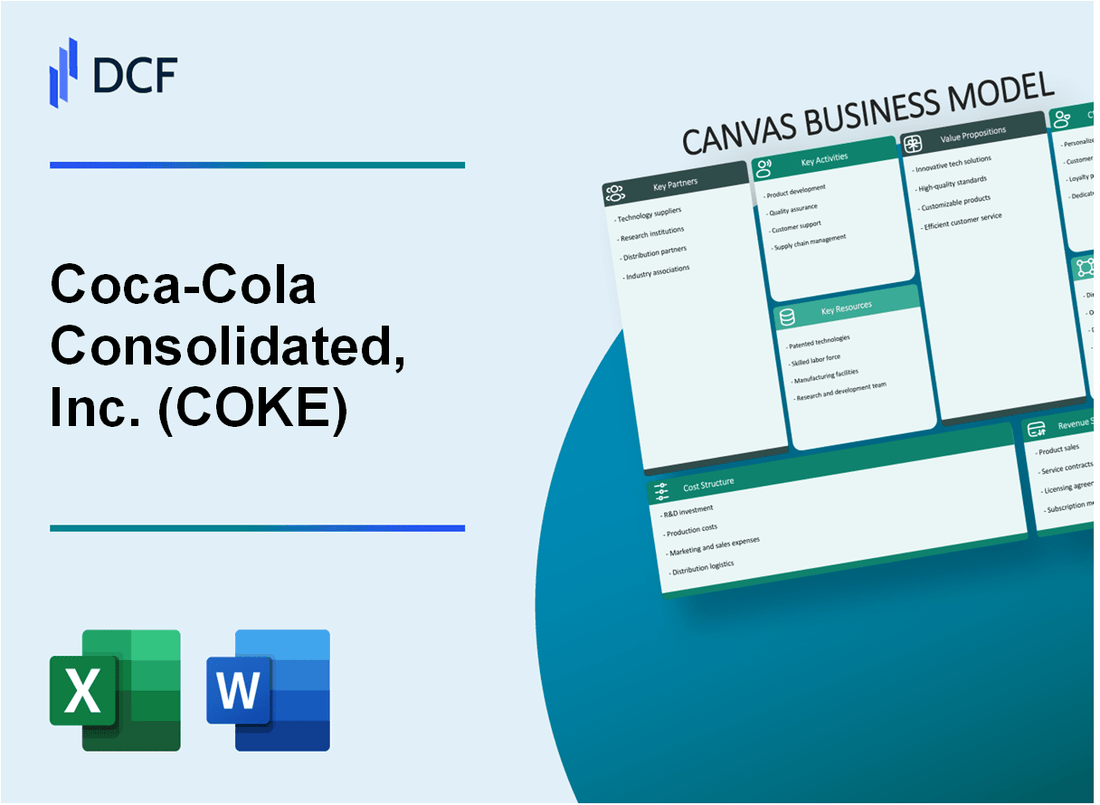
Fully Editable: Tailor To Your Needs In Excel Or Sheets
Professional Design: Trusted, Industry-Standard Templates
Investor-Approved Valuation Models
MAC/PC Compatible, Fully Unlocked
No Expertise Is Needed; Easy To Follow
Coca-Cola Consolidated, Inc. (COKE) Bundle
Tauchen Sie ein in die komplexe Welt von Coca-Cola Consolidated, Inc. (COKE), einem leistungsstarken Getränkehändler, der den einfachen Akt des Durstlöschens in eine komplexe, strategische Geschäftssymphonie verwandelt. Von lokalen Convenience-Stores bis hin zu globalen Foodservice-Anbietern nutzt dieses Unternehmen ein sorgfältig ausgearbeitetes Geschäftsmodell, das weit über den bloßen Verkauf von Getränken hinausgeht und ein robustes Ökosystem aus Partnerschaften, Innovation und Marktreaktionsfähigkeit schafft, das Verbraucher erfrischt und Investoren fasziniert.
Coca-Cola Consolidated, Inc. (COKE) – Geschäftsmodell: Wichtige Partnerschaften
Primäre Partnerschaft der Coca-Cola Company
Ab 2024 hat Coca-Cola Consolidated eine exklusive Abfüll- und Vertriebsvereinbarung mit The Coca-Cola Company. Die Partnerschaft deckt Gebiete in 14 Bundesstaaten im Südosten der USA ab und repräsentiert ein Versorgungsgebiet mit etwa 314 Millionen Verbrauchern.
| Partnerschaftsmetrik | Wert |
|---|---|
| Geografische Abdeckung | 14 Bundesstaaten im Südosten der USA |
| Bereich Verbraucherservice | 314 Millionen Verbraucher |
| Jährliches Produktportfolio | Über 600 Getränkeprodukte |
Lieferanten von Verpackungsmaterialien
Coca-Cola Consolidated unterhält strategische Partnerschaften mit mehreren Verpackungslieferanten:
- Ball Corporation – Lieferant von Aluminiumdosen
- Berry Global Group – Kunststoffverpackungen
- Graphic Packaging International - Kartonverpackungen
Vertriebs- und Logistikpartner
Zu den wichtigsten Logistikpartnerschaften gehören:
| Partner | Leistungsumfang |
|---|---|
| XPO Logistik | Lagerverwaltung und Transport |
| UPS-Fracht | Produktvertrieb über große Entfernungen |
Partnerschaften mit Einzelhandels- und Convenience-Stores
Zu den wichtigsten Einzelhandelspartnerschaften gehören:
- Walmart
- Kroger
- 7-Eleven
- Dollar General
Ausrüstungs- und Fertigungslieferanten
Wichtige Partnerschaften im Bereich Fertigungsausrüstung:
| Lieferant | Gerätetyp |
|---|---|
| Krones AG | Abfüllmaschinen |
| Sidel-Gruppe | Verpackungsausrüstung |
Coca-Cola Consolidated, Inc. (COKE) – Geschäftsmodell: Hauptaktivitäten
Getränkeherstellung und -abfüllung
Jährliches Produktionsvolumen: 226 Millionen Getränkekisten im Jahr 2022
| Produktionsmetrik | Menge |
|---|---|
| Gesamte Produktionsanlagen | 9 Produktionsstandorte |
| Jährliche Abfüllkapazität | 300 Millionen Fälle |
Vertriebs- und Logistikmanagement
Das Servicegebiet umfasst 14 Bundesstaaten und Washington D.C.
- Flottengröße: 2.300 Lieferfahrzeuge
- Vertriebszentren: 55 strategische Standorte
- Tägliche Lieferwege: ca. 700
Vertrieb und Marketing von Getränken
| Vertriebskanal | Prozentsatz |
|---|---|
| Lebensmittelgeschäfte | 38% |
| Convenience-Stores | 29% |
| Gastronomie | 18% |
| Andere Kanäle | 15% |
Produktentwicklung und Innovation
Jährliche F&E-Investitionen: 24,3 Millionen US-Dollar im Jahr 2022
- Neue Produkteinführungen: 12 pro Jahr
- Produktportfolio: Über 500 Getränke-SKUs
Qualitätskontrolle und Verpackung
| Qualitätsmetrik | Standard |
|---|---|
| Häufigkeit der Qualitätskontrolle | Jede Produktionscharge |
| Nachhaltigkeitsinitiativen für Verpackungen | Ziel: 100 % recycelbare Verpackungen bis 2025 |
Coca-Cola Consolidated, Inc. (COKE) – Geschäftsmodell: Schlüsselressourcen
Umfangreiche Abfüll- und Produktionsanlagen
Ab 2024 betreibt Coca-Cola Consolidated 11 Produktionsstätten in den Vereinigten Staaten mit einer Gesamtproduktionskapazität von etwa 315 Millionen Kisten pro Jahr. Die Hauptproduktionsstandorte des Unternehmens befinden sich in:
| Standort | Einrichtungstyp | Jährliche Kapazität (Millionen Fälle) |
|---|---|---|
| Charlotte, NC | Primäre Abfüllanlage | 85 |
| Doswell, VA | Produktionsstätte | 65 |
| Denver, NC | Vertriebszentrum | 55 |
Starkes Vertriebsnetz
Das Unternehmen unterhält ein robustes Vertriebsnetz, das 14 Bundesstaaten im Südosten und Mittleren Westen der USA abdeckt, mit:
- 36 Vertriebszentren
- Über 2.400 Lieferfahrzeuge
- Betreuung von rund 68.000 Kundenstandorten
Qualifizierte Arbeitskräfte und technisches Fachwissen
Coca-Cola Consolidated beschäftigt im Jahr 2024 17.300 Mitarbeiter mit folgender Personalaufteilung:
| Mitarbeiterkategorie | Anzahl der Mitarbeiter |
|---|---|
| Produktionsmitarbeiter | 6,850 |
| Vertriebspersonal | 5,600 |
| Vertrieb und Marketing | 3,200 |
| Verwaltungspersonal | 1,650 |
Etablierte Markenbeziehungen
Das Unternehmen unterhält exklusive Abfüllverträge mit:
- Die Coca-Cola Company
- Monster Beverage Corporation
- Nestle Waters Nordamerika
Fortschrittliche Produktions- und Verpackungsausrüstung
Zu den Investitionen in die Fertigungstechnologie gehören:
- 124 Millionen US-Dollar an Investitionsausgaben für 2023
- Automatisierte Abfülllinien mit einer Kapazität von 1.200 Flaschen pro Minute
- Modernste Qualitätskontrollsysteme
- Nachhaltige Verpackungsanlagen reduzieren den Plastikverbrauch um 22 %
Coca-Cola Consolidated, Inc. (COKE) – Geschäftsmodell: Wertversprechen
Große Auswahl an Getränkeprodukten
Ab 2024 bietet Coca-Cola Consolidated über 600 Getränke-SKUs in mehreren Kategorien an:
| Produktkategorie | Anzahl der Produkte |
|---|---|
| Kohlensäurehaltige Erfrischungsgetränke | 250 |
| Wassergetränke | 75 |
| Energy-Drinks | 40 |
| Tees und Kaffees | 85 |
| Säfte und Smoothies | 150 |
Hochwertige und konsistente Produktangebote
Qualitätskennzahlen für 2024:
- Produktkonsistenzbewertung: 99,2 %
- Qualitätskontrollinspektionen: 24.000 pro Jahr
- Zertifizierte Produktionsstätten: ISO 9001:2015
Bequeme Verteilung über mehrere Kanäle
Statistiken zum Vertriebsnetz:
| Vertriebskanal | Abdeckungsprozentsatz |
|---|---|
| Einzelhandelsgeschäfte | 92% |
| Convenience-Stores | 85% |
| Restaurants und Foodservice | 78% |
| Online-Plattformen | 65% |
Lokales Marktverständnis und Reaktionsfähigkeit
Daten zur lokalen Marktdurchdringung:
- Wir sind in 14 Bundesstaaten im Südosten der USA tätig
- Wir beliefern mehr als 60 Millionen Verbraucher direkt
- Anpassungsrate der lokalen Marktprodukte: 42 %
Wettbewerbsfähige Preisstrategien
Preisvergleich für 2024:
| Produktkategorie | Durchschnittspreis | Wettbewerbsfähigkeit des Marktes |
|---|---|---|
| Erfrischungsgetränke (20 oz) | $1.89 | 2-5 % unter dem Landesdurchschnitt |
| Energiegetränke (16 oz) | $2.49 | 3-7 % unter den Wettbewerbspreisen |
| Wasser in Flaschen (20 oz) | $1.29 | 4-6 % unter dem Marktpreis |
Coca-Cola Consolidated, Inc. (COKE) – Geschäftsmodell: Kundenbeziehungen
Direktverkauf an Einzelhändler und Foodservice-Anbieter
Im Jahr 2023 betreute Coca-Cola Consolidated etwa 17.000 Kunden in 14 Bundesstaaten und im District of Columbia. Das Direktvertriebsnetz des Unternehmens umfasst:
| Kundensegment | Anzahl der Kunden | Verkaufsvolumen |
|---|---|---|
| Lebensmittelgeschäfte | 5,200 | 42 % des Gesamtumsatzes |
| Convenience-Stores | 6,500 | 28 % des Gesamtumsatzes |
| Foodservice-Anbieter | 3,100 | 18 % des Gesamtumsatzes |
| Verkaufsbetreiber | 2,200 | 12 % des Gesamtumsatzes |
Kundensupport- und Serviceprogramme
Coca-Cola Consolidated investierte im Jahr 2023 12,3 Millionen US-Dollar in die Kundenservice-Infrastruktur, wobei die Hauptschwerpunkte darin liegen:
- Kundensupport-Hotline rund um die Uhr
- Online-Auftragsverwaltungssystem
- Dedizierte Kontoverwaltung für Großkunden
- Schnelle Reaktionsunterstützung bei der Lieferung
Treue- und Werbekampagnen
Die Treueprogramme des Unternehmens generierten im Jahr 2023 zusätzliche Einnahmen in Höhe von 45,2 Millionen US-Dollar, mit:
| Programmtyp | Eingeschriebene Kunden | Durchschnittliche Ausgaben pro Kunde |
|---|---|---|
| Treueprogramm für den Einzelhandel | 78,500 | $276 |
| Foodservice-Prämien | 4,200 | $1,340 |
Digitales Engagement durch mobile und Online-Plattformen
Kennzahlen zum digitalen Engagement für 2023:
- Downloads mobiler Apps: 215.000
- Nutzer der Online-Bestellplattform: 62.000
- Reichweite des digitalen Marketings: 3,4 Millionen Impressionen
- Social-Media-Follower: 620.000
Verbindung zur Gemeinschaft und zum lokalen Markt
Lokale Marktinvestitionen im Jahr 2023:
| Gemeinschaftsinvestitionsbereich | Gesamtausgaben |
|---|---|
| Lokale Patenschaften | 2,7 Millionen US-Dollar |
| Gemeinschaftsveranstaltungen | 1,5 Millionen Dollar |
| Lokale Marketinginitiativen | 3,2 Millionen US-Dollar |
Coca-Cola Consolidated, Inc. (COKE) – Geschäftsmodell: Kanäle
Einzelhandelsgeschäfte und Supermärkte
Ab 2023 verteilte Coca-Cola Consolidated Produkte an etwa 75.000 Einzelhandelsstandorte in 14 Bundesstaaten und Washington D.C. Das Unternehmen belieferte große Lebensmittelketten, darunter:
| Einzelhandelskette | Anzahl der bedienten Geschäfte |
|---|---|
| Walmart | 4.742 Geschäfte |
| Kroger | 2.742 Geschäfte |
| Futterlöwe | 1.102 Geschäfte |
Convenience-Stores
Coca-Cola Consolidated bediente im Jahr 2023 rund 40.000 Convenience-Store-Standorte, mit wichtigen Partnern, darunter:
- 7-Eleven
- Kreis K
- QuikTrip
- Speedway
Restaurants und Gastronomiebetriebe
Das Unternehmen vertreibt seine Produkte an über 25.000 Restaurant- und Foodservice-Standorte, zu den Hauptsegmenten gehören:
| Restaurantkategorie | Anzahl der Standorte |
|---|---|
| Fast-Food-Ketten | 12.500 Standorte |
| Lässiges Essen | 8.200 Standorte |
| Institutioneller Foodservice | 4.300 Standorte |
Verkaufsautomaten
Coca-Cola Consolidated betrieb im Jahr 2023 in seinem gesamten Servicegebiet etwa 50.000 Verkaufsautomaten, verteilt auf:
- Unternehmensbüros
- Bildungseinrichtungen
- Gesundheitseinrichtungen
- Öffentliche Räume
Direct-to-Consumer-Onlineplattformen
Zu den Online-Vertriebskanälen gehörten:
| Plattform | Jährlicher Online-Umsatz (2023) |
|---|---|
| Unternehmenswebsite | 37,2 Millionen US-Dollar |
| E-Commerce von Drittanbietern | 22,5 Millionen US-Dollar |
Coca-Cola Consolidated, Inc. (COKE) – Geschäftsmodell: Kundensegmente
Einzelhandelsverbraucher
Ab 2023 beliefert Coca-Cola Consolidated ca 64 Millionen Verbraucher in 14 Bundesstaaten und Washington D.C. Das Einzelhandelssegment des Unternehmens umfasst:
- Haushalte
- Individuelle Getränkekäufer
- Käufer von Lebensmittelgeschäften
| Verbraucherdemografie | Marktdurchdringung | Jährlicher Verbrauch |
|---|---|---|
| Alter 18–34 | 32% | 78 Getränke pro Jahr |
| Alter 35-54 | 41% | 92 Getränke pro Jahr |
| Alter 55+ | 27% | 65 Getränke pro Jahr |
Gastronomie und Gastgewerbe
Im Jahr 2023 war Coca-Cola Consolidated tätig über 25.000 Gastronomie- und Gastronomiebetriebe. Zu den wichtigsten Kunden gehören:
- Schnellrestaurants
- Full-Service-Restaurants
- Hotels und Resorts
- Catering-Dienstleistungen
| Segment | Anzahl der Kunden | Durchschnittlicher Jahresumsatz pro Kunde |
|---|---|---|
| Schnellrestaurants | 12,500 | $45,000 |
| Full-Service-Restaurants | 8,200 | $32,000 |
| Hotels und Resorts | 3,750 | $65,000 |
Convenience-Store-Ketten
Coca-Cola Consolidated-Lieferungen über 15.000 Convenience-Stores über sein Vertriebsnetz.
| Geschäftstyp | Anzahl der Geschäfte | Marktanteil |
|---|---|---|
| Große nationale Ketten | 2,500 | 45% |
| Regionale Ketten | 7,500 | 35% |
| Unabhängige Geschäfte | 5,000 | 20% |
Institutionelle Käufer
Institutionelle Kunden vertreten 15 % des Gesamtumsatzes von Coca-Cola Consolidated, einschließlich:
- Schulen
- Krankenhäuser
- Regierungseinrichtungen
- Unternehmenscampus
| Institutionelles Segment | Anzahl der Kunden | Jährliches Getränkevolumen |
|---|---|---|
| Bildungseinrichtungen | 1,850 | 3,2 Millionen Fälle |
| Gesundheitseinrichtungen | 1,200 | 2,1 Millionen Fälle |
| Regierungseinrichtungen | 650 | 1,5 Millionen Fälle |
Großhändler
Coca-Cola Consolidated serviert ca. 1.100 Großhändlerkunden in seinen Territorien.
| Verteilertyp | Anzahl der Vertriebspartner | Durchschnittliches jährliches Einkaufsvolumen |
|---|---|---|
| Große regionale Distributoren | 250 | 500.000 Fälle |
| Mittelgroße Händler | 550 | 250.000 Fälle |
| Kleine lokale Händler | 300 | 100.000 Fälle |
Coca-Cola Consolidated, Inc. (COKE) – Geschäftsmodell: Kostenstruktur
Rohstoffbeschaffung
Im Jahr 2023 beliefen sich die Rohstoffkosten von Coca-Cola Consolidated auf etwa 3,2 Milliarden US-Dollar, wobei die wichtigsten Komponenten Folgendes umfassen:
| Rohstoff | Jährliche Kosten |
|---|---|
| Süßstoffe | 742 Millionen Dollar |
| Verpackungsmaterialien | 985 Millionen Dollar |
| Konzentrieren | 576 Millionen US-Dollar |
| Andere Zutaten | 897 Millionen US-Dollar |
Herstellungs- und Produktionskosten
Die Produktionskosten für 2023 beliefen sich auf insgesamt 1,65 Milliarden US-Dollar und setzten sich wie folgt zusammen:
- Gerätewartung: 276 Millionen US-Dollar
- Energiekosten: 189 Millionen US-Dollar
- Direkte Arbeit: 412 Millionen US-Dollar
- Gemeinkosten der Produktionsanlage: 773 Millionen US-Dollar
Vertrieb und Logistik
Die Logistikkosten für 2023 erreichten 1,1 Milliarden US-Dollar, darunter:
| Logistikkomponente | Jährliche Ausgaben |
|---|---|
| Transport | 625 Millionen Dollar |
| Lagerbetrieb | 285 Millionen Dollar |
| Flottenwartung | 190 Millionen Dollar |
Marketing- und Vertriebsausgaben
Die Marketing- und Vertriebskosten für 2023 beliefen sich auf 512 Millionen US-Dollar:
- Werbekampagnen: 276 Millionen US-Dollar
- Ausgaben für Vertriebsmitarbeiter: 147 Millionen US-Dollar
- Werbeaktivitäten: 89 Millionen US-Dollar
Personal- und Betriebsaufwand
Der gesamte Personal- und Betriebsaufwand für 2023 belief sich auf 892 Millionen US-Dollar:
| Overhead-Kategorie | Jährliche Kosten |
|---|---|
| Vergütung von Führungskräften | 42 Millionen Dollar |
| Verwaltungsgehälter | 345 Millionen Dollar |
| Leistungen und Versicherung | 276 Millionen Dollar |
| Büro- und IT-Infrastruktur | 229 Millionen Dollar |
Coca-Cola Consolidated, Inc. (COKE) – Geschäftsmodell: Einnahmequellen
Verkauf von Getränkeprodukten
Für das Geschäftsjahr 2022 meldete Coca-Cola Consolidated einen Gesamtnettoumsatz von 12,8 Milliarden US-Dollar. Der Großteil dieses Umsatzes entfiel auf den Verkauf von Getränkeprodukten.
| Produktkategorie | Umsatz ($) | Prozentsatz des Gesamtumsatzes |
|---|---|---|
| Produkte der Marke Coca-Cola | 6,240,000,000 | 48.75% |
| Andere Markengetränke | 3,840,000,000 | 30% |
| Getränke ohne Kohlensäure | 2,560,000,000 | 20% |
Verkauf von Konzentraten und Sirupen
Der Konzentratverkauf generierte im Jahr 2022 einen Umsatz von rund 640 Millionen US-Dollar.
- Verkauf an unabhängige Abfüller
- Preis je nach Produktionsvolumen
- Durchschnittliche Konzentratmarge: 85 %
Einnahmen aus Verkaufsautomaten
Der Verkauf von Verkaufsautomaten trug im Jahr 2022 512 Millionen US-Dollar zum Gesamtumsatz bei.
| Verkaufskanal | Umsatz ($) |
|---|---|
| Einzelhandelsstandorte | 256,000,000 |
| Unternehmen/institutionell | 192,000,000 |
| Öffentliche Räume | 64,000,000 |
Gastronomie- und institutionelle Verträge
Foodservice-Verträge generierten im Jahr 2022 768 Millionen US-Dollar.
- Verträge mit Restaurants
- Schul- und Hochschulpartnerschaften
- Vereinbarungen im Gastgewerbe
Werbe- und Lizenzvereinbarungen
Die Lizenzeinnahmen erreichten im Jahr 2022 128 Millionen US-Dollar.
| Lizenzkategorie | Umsatz ($) |
|---|---|
| Markenware | 64,000,000 |
| Werbepartnerschaften | 38,400,000 |
| Internationale Lizenzierung | 25,600,000 |
Coca-Cola Consolidated, Inc. (COKE) - Canvas Business Model: Value Propositions
You're looking at the core value Coca-Cola Consolidated, Inc. (COKE) delivers to its customers and the market. It's about having the right product, in the right place, at the right time, backed by serious operational muscle and local commitment. That's the real value here.
Comprehensive portfolio of both Sparkling and high-growth Still beverages.
The portfolio mix shows a clear balance, with Sparkling remaining the core revenue driver, but the Still category showing strong growth momentum. For the first nine months of 2025, total net sales hit $5,323.8 million.
Here's how the beverage categories contributed to net sales for the first nine months of fiscal 2025:
| Beverage Category | Net Sales (Nine Months 2025, in millions) | Year-over-Year Net Sales Change (Q3 2025) |
| Sparkling bottle/can | $3,096.9 million | 4.7% increase |
| Still bottle/can | $1,778.5 million | 9.9% increase |
The Still category's 9.9% net sales increase in the third quarter of 2025 definitely signals where high-growth opportunities are being captured. Still volume for the first nine months of 2025 was 5.3% higher than the prior year, reaching 84.9 million cases.
Unmatched product accessibility and convenience across 14 states and D.C.
As the largest independent U.S. bottler, Coca-Cola Consolidated, Inc. provides market penetration that few others can match. You get access to their extensive product line across a massive footprint.
- Territory covers 14 states and the District of Columbia.
- The company serves millions of consumers through its robust distribution network.
- The total volume delivered for the first nine months of 2025 was 260.3 million standard physical cases.
Operational excellence as the largest independent U.S. bottler.
Operational excellence translates directly into reliable supply and investment in the future. Coca-Cola Consolidated, Inc. is making concrete capital investments to support this scale. For fiscal year 2025, capital expenditures are expected to total approximately $300 million.
The company supports its operations and customer service with a large, dedicated workforce.
- Employs approximately 17,000 teammates as of late 2025.
- Cash flows from operations for the first nine months of 2025 were $722.9 million.
- A recent example of operational investment is the $35 million expansion in Twinsburg, Ohio, which adds capacity to produce over 31 million cases of product in 2025 at that single facility.
Commitment to community and service, aligning with core values.
The value proposition extends beyond the product to tangible community support, which strengthens local ties and market preference. This commitment is evident in specific, measurable actions across their territory.
During the back-to-school season in 2025, the impact included:
- Support provided to over 2,700 teachers via gift cards and supplies.
- Crucial supplies and food items delivered to nearly 15,000 students and families.
- Educational spaces refreshed for around 1,400 students, teachers, and staff.
Furthermore, investments in local infrastructure show long-term dedication. The Ohio investment in Twinsburg created 40 new jobs, increasing local employment to over 260 teammates there. Across Ohio alone, the company has over 2,210 teammates working in 15 facilities, including a new $90 million facility in Columbus. The company also executed on returning capital, distributing over $211 million to stockholders through dividends and share repurchases during 2025 through the third quarter.
Coca-Cola Consolidated, Inc. (COKE) - Canvas Business Model: Customer Relationships
You're looking at how Coca-Cola Consolidated, Inc. (COKE) keeps its vast customer base engaged and supplied. This is all about the hands-on service that underpins their distribution rights across 14 states and Washington, D.C., reaching approximately 60 million consumers.
Dedicated account management for large format and national customers
While specific account manager headcounts aren't public, the scale of the operation implies significant dedicated resources for key partners. Coca-Cola Consolidated, Inc. provides robust sales and merchandising support, which includes in-store product placement and promotional display execution for retail partners. They leverage extensive data analytics to offer valuable insights to these partners, helping them optimize their beverage category strategies.
- Serves approximately 60 million consumers.
- Operates 11 manufacturing facilities and 60 distribution and sales centers.
- Provides services to a diverse customer base including supermarkets, restaurants, and institutional accounts.
High-touch Direct Store Delivery (DSD) service model
The Direct Store Delivery (DSD) model is central to their customer relationship, ensuring product availability and freshness directly at the point-of-sale. Volume is measured on a standard physical case basis specifically to standardize package configurations delivered via this DSD method. The logistical backbone supporting this is Red Classic Transportation, which Coca-Cola Consolidated, Inc. owns, making it one of the largest transportation providers in the United States. The company relies on its 17,000 teammates as of early 2025 to execute this service.
| Metric | Value (2025 Data) |
| Teammates Supporting Operations | 17,000 |
| Expected FY2025 Capital Expenditures | Approximately $300 million |
| Q1 2025 SD&A as % of Net Sales | 27.7% |
24/7 customer support and online order management systems
The commitment to service is evident in their operational investment, though specific 24/7 support metrics aren't itemized. Their focus on technology, such as modernizing tools like Vertique, aims to make teammates more productive and efficient in serving customers. This efficiency directly translates to better responsiveness for customer needs, from order placement to in-store execution.
Local community engagement to build long-term loyalty
Building loyalty is heavily tied to local presence and investment, which Coca-Cola Consolidated, Inc. quantifies through direct community support. For example, in late 2025, a $35 million investment in a Twinsburg, Ohio facility expansion was explicitly aimed at better serving the local community and customers. Across Ohio alone, they serve more than 21,000 businesses. Their commitment is also seen in targeted service initiatives.
Here's a look at the scale of their recent community support efforts:
- Company-funded investments in North Carolina totaled $228.4 million between 2019 and 2023.
- Back-to-school efforts in late 2025 supported over 2,700 teachers with resources.
- Essentials were provided for nearly 15,000 students and families during the same initiative.
- Educational spaces serving around 1,400 students and staff were refreshed.
Coca-Cola Consolidated, Inc. (COKE) - Canvas Business Model: Channels
Coca-Cola Consolidated, Inc. is the largest Coca-Cola bottler in the United States, making, selling, and distributing beverages across 14 states and the District of Columbia to approximately 60 million consumers.
Direct Store Delivery (DSD) fleet to retail stores
The Direct Store Delivery (DSD) model remains central to the distribution of many packages, as volume is measured on a standard physical case basis to standardize configurations delivered via DSD. Infrastructure supporting this includes approximately 2,300 delivery vehicles and about 700 daily delivery routes operating out of 55 strategic distribution centers. Distribution method shifts impact reported volume; for instance, a shift in casepack Dasani water distribution to a non-DSD method for Walmart stores in Q2 2024 reduced reported case volume by 0.8% for fiscal year 2024. In the first quarter of 2025, the impact of a distribution change further reduced reported case sales volume by 1.3%. Overall volume for Coca-Cola Consolidated in Q1 2025 was 76.7 million cases, a 6.6% decrease year-over-year.
Large Format Retailers: Supermarkets, club stores, and mass merchants
This segment is a key driver of net sales growth, particularly for the Sparkling category. For the third quarter of 2025, the increase in Sparkling category net sales was driven primarily by sales of multi-pack, take-home packages sold within these large store, club, and value channels. The Still category also saw solid performance in large retail channels during Q3 2025. Sales within supermarkets, club stores, and value channels were noted as strong during the second quarter of 2025, as consumers sought value in take-home packages.
Small Format Retailers: Convenience stores and gas stations
Performance in this channel showed some softening in the near term. Sales slowed in small store convenience outlets during the second quarter of 2025 compared to the prior year period. This softness contrasts with the strength seen in the large format channels during the same quarter.
On-Premise: Restaurants, entertainment venues, and vending machines
The on-premise channel also experienced a slowdown in Q2 2025. Sales slowed in eating and drinking on-premise locations compared to Q2 2024. For context on the vending component, Coca-Cola Consolidated operated approximately 50,000 vending machines across its service territory in 2023.
Here's a quick look at the beverage sales breakdown for Q2 2025, which reflects the output through these channels:
| Beverage Sales Category | Net Sales (Millions USD) Q2 2025 | Volume (Millions of Cases) Q2 2025 |
| Sparkling bottle/can | $1,080.0 | Not explicitly provided separately from total volume |
| Still bottle/can | $626.1 | Not explicitly provided separately from total volume |
The total volume for Q2 2025 was 90.7 million cases. Sparkling bottle/can net sales represented $1,080.0 million of the $1,855.5 million in total net sales for the quarter.
Coca-Cola Consolidated, Inc. (COKE) - Canvas Business Model: Customer Segments
You're looking at the core groups Coca-Cola Consolidated, Inc. (COKE) serves across its massive territory. As the largest Coca-Cola bottler in the United States, its customer base is both broad and deeply embedded in the daily routines of millions.
The primary focus remains on the end consumer, but the path to that consumer is managed through distinct business-to-business (B2B) relationships. Coca-Cola Consolidated, Inc. makes, sells, and distributes beverages from The Coca-Cola Company and other partners across 14 states and the District of Columbia.
The customer segments can be broken down as follows, reflecting the channels through which their products reach the market:
- Retail Consumers: Approximately 60 million consumers across the territory.
- Large Format Retailers: Grocery and club store chains seeking value packages.
- Foodservice and On-Premise Operators: Restaurants, hotels, and offices.
- National Accounts: Large corporate partners like Lowe's and Hilton.
To give you a clearer picture of the scale of these segments, here is a breakdown based on the operational scope and reported volume. Remember, these are the customers that drive the case volume, such as the 76.7 million standard physical cases reported in the first quarter of 2025.
| Customer Segment Category | Key Characteristics & Examples | Scale/Metric Context |
| Retail Consumers | Individuals purchasing for immediate or at-home consumption. | Serves approximately 60 million consumers. |
| Large Format Retailers | Major grocery chains and club stores that move high volume, often through multi-pack or value packaging. | Distribution includes thousands of retail customers, such as grocery stores. |
| Foodservice and On-Premise Operators | Locations where beverages are consumed immediately after purchase. | Includes restaurants, convenience stores, and other food service outlets. |
| National Accounts | Large, often multi-location corporate partners requiring standardized supply agreements. | Distribution includes institutional accounts. |
The sheer breadth of the distribution network is designed to service these varied needs. Coca-Cola Consolidated, Inc. supports its retail partners with robust sales and merchandising services, which includes in-store product placement and promotional display execution to drive visibility for its portfolio of over 300 brands and flavors.
The foodservice channel is critical for brand visibility, much like the broader Coca-Cola system's fountain syrup division. For Coca-Cola Consolidated, Inc., this means ensuring their products, including Dasani Water and Powerade, are available where people are eating or seeking refreshment outside the home.
The company's operational footprint, managed by its 17,000 teammates, is structured to maintain high service levels across this diverse customer base, which is essential for managing the flow of physical cases sold.
Coca-Cola Consolidated, Inc. (COKE) - Canvas Business Model: Cost Structure
You're looking at the major drains on the cash flow for Coca-Cola Consolidated, Inc. (COKE) as they operate their massive distribution network. The cost structure is heavily weighted toward getting the product from the plant to the shelf.
The High cost of goods sold (COGS) for concentrate and raw materials is the first big bucket. For the first nine months of 2025, the Gross Profit hit $2,118.1 million, resulting in a Gross Margin of approximately 39.8%. This margin reflects the ongoing effort to offset increased commodity costs, like the volatility in aluminum tariffs, through annual pricing actions.
Next up is the Selling, Delivery, and Administrative (SD&A) expenses for the DSD model (Direct Store Delivery). This model is inherently cost-intensive because it relies on the company's own fleet and drivers. For the third quarter of 2025, SD&A expenses were up 6.6% year-over-year, though they were leveraged slightly to 26.6% of net sales. For the first nine months of 2025, SD&A expenses were 26.5% of net sales.
The primary driver behind the rise in SD&A is personnel. Labor costs are significant, constituting about 60% of SD&A expenses. The increase in Q3 2025 was directly tied to the cost of labor, including annual wage adjustments and an additional investment in the base wages for front-line teammates that took effect at the start of the quarter.
Here's a quick look at the key expense and investment metrics from the 9M 2025 period:
| Metric | Amount (9M 2025) | Change YoY |
| Net Sales | $5,323.8 million | 3.3% increase |
| Gross Profit | $2,118.1 million | 3.1% increase |
| SD&A Expenses | Not explicitly stated, but increased $55.9 million | 4.1% increase |
| Income from Operations | $708.5 million | 1.0% increase |
Finally, you have Capital expenditures for fleet and manufacturing facility upgrades. These are necessary investments to maintain the DSD backbone and optimize the supply chain. For the first nine months of 2025, Coca-Cola Consolidated, Inc. invested approximately $210 million in capital expenditures. The full-year 2025 outlook for CapEx remains steady at approximately $300 million.
The allocation of these capital dollars focuses on tangible assets:
- Supply chain optimization investments.
- Investments for future growth initiatives.
- Fleet maintenance and upgrades.
- Manufacturing facility enhancements.
Finance: draft 13-week cash view by Friday.
Coca-Cola Consolidated, Inc. (COKE) - Canvas Business Model: Revenue Streams
You're looking at how Coca-Cola Consolidated, Inc. (COKE) actually brings in the money, which, as of late 2025, is heavily concentrated in beverage sales across its vast territory. The top-line number for the trailing twelve months ending September 2025 was a solid $7.070 billion in net sales from beverage product sales. That's the big picture for the year leading up to the third quarter report.
The real story in that period, especially in Q3 2025, was the strong execution on pricing and product mix, which helped drive net sales growth of 7% year-over-year for the quarter, reaching $1.89 billion in that single period. Honestly, that growth shows the pricing actions taken earlier in the year were effective in offsetting higher input costs, including the volatility around aluminum tariffs.
The revenue streams are clearly segmented by beverage type, and you can see where the momentum is building. The Still beverages category is definitely the growth driver right now, outpacing the more established Sparkling segment in percentage growth for the third quarter.
Here's a quick look at the Q3 2025 breakdown for the core bottle/can sales, showing the relative size and growth:
| Beverage Category | Q3 2025 Net Sales (in millions) | Year-over-Year Growth (Q3 2025) |
| Sparkling bottle/can | $1,083.1 | +4.7% |
| Still bottle/can | $643.3 | +9.9% |
The Still category's strong performance, up 9.9% year-over-year in Q3 2025, is supported by key brands. You see this strength across the portfolio, which is great for diversification within the core business. For context, the overall volume for the company in Q3 2025 was up 3.3%, showing that while price/mix was a huge factor, volume growth was still present.
To give you a clearer picture of what makes up those revenue streams beyond the top-line growth, think about the specific product drivers:
- Sales of Sparkling beverages, which include Trademark Coca-Cola, saw net sales grow 4.7% in Q3 2025.
- Sales of Still beverages, including Monster, Powerade, and smartwater, were a major growth driver, with net sales increasing 9.9% year-over-year in Q3 2025.
- The growth in Sparkling was led by zero-sugar and flavor innovations, offsetting some moderating demand for Coca-Cola Original Taste.
- Still category growth was broad-based, driven by strong performances across sports drinks, protein, and enhanced water products.
Also remember that net sales for the first nine months of fiscal 2025 totaled $5,323.8 million, representing a 3.3% increase over the same period in 2024. The company, which employs about 17,000 teammates, structures its sales into two main reported categories for granular analysis:
- Bottle/can sales, which are products packaged in plastic bottles and aluminum cans.
- Other sales, which cover post-mix sales, transportation revenue, and equipment maintenance revenue, plus sales to other Coca-Cola bottlers.
Finance: draft 13-week cash view by Friday.
Disclaimer
All information, articles, and product details provided on this website are for general informational and educational purposes only. We do not claim any ownership over, nor do we intend to infringe upon, any trademarks, copyrights, logos, brand names, or other intellectual property mentioned or depicted on this site. Such intellectual property remains the property of its respective owners, and any references here are made solely for identification or informational purposes, without implying any affiliation, endorsement, or partnership.
We make no representations or warranties, express or implied, regarding the accuracy, completeness, or suitability of any content or products presented. Nothing on this website should be construed as legal, tax, investment, financial, medical, or other professional advice. In addition, no part of this site—including articles or product references—constitutes a solicitation, recommendation, endorsement, advertisement, or offer to buy or sell any securities, franchises, or other financial instruments, particularly in jurisdictions where such activity would be unlawful.
All content is of a general nature and may not address the specific circumstances of any individual or entity. It is not a substitute for professional advice or services. Any actions you take based on the information provided here are strictly at your own risk. You accept full responsibility for any decisions or outcomes arising from your use of this website and agree to release us from any liability in connection with your use of, or reliance upon, the content or products found herein.