
|
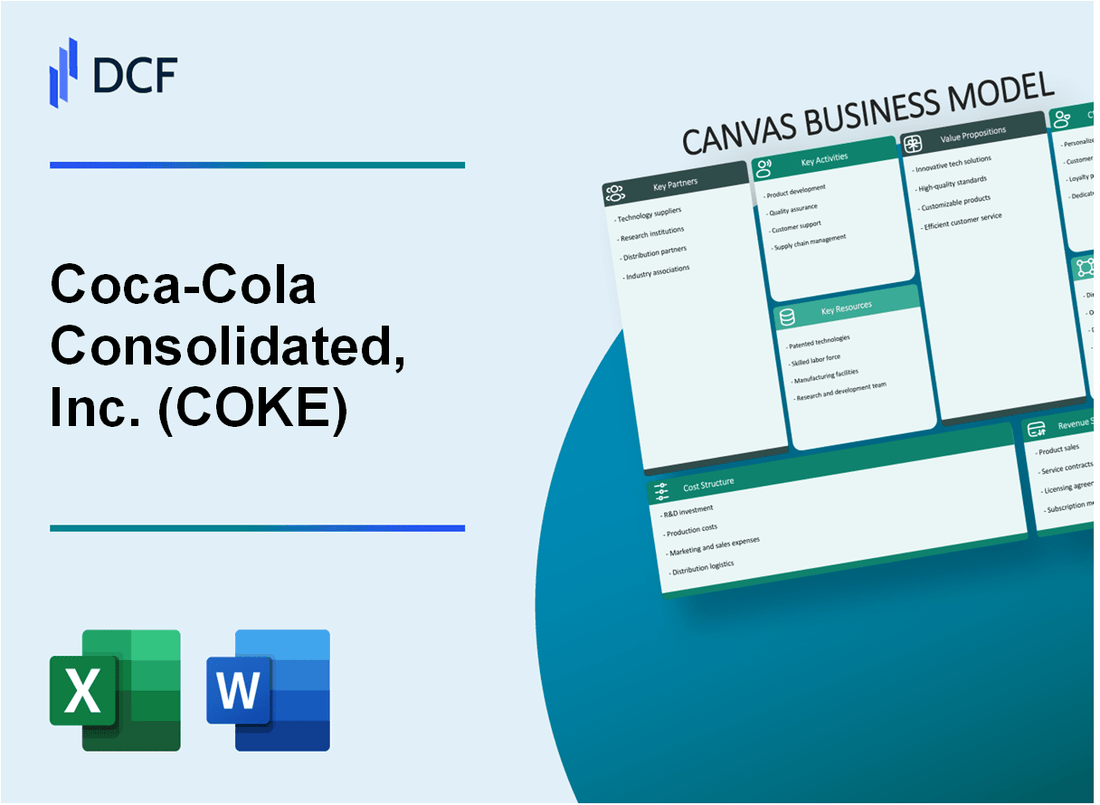
Coca-Cola Consolidated, Inc. (COKE): Business Model Canvas [Dec-2025 Updated] |
Fully Editable: Tailor To Your Needs In Excel Or Sheets
Professional Design: Trusted, Industry-Standard Templates
Investor-Approved Valuation Models
MAC/PC Compatible, Fully Unlocked
No Expertise Is Needed; Easy To Follow
Coca-Cola Consolidated, Inc. (COKE) Bundle
You're looking to dissect the actual engine room of the largest U.S. beverage bottler, Coca-Cola Consolidated, Inc., and honestly, it's a masterclass in capital-intensive logistics. Forget just the syrup; this business is about moving over 300 brands and flavors across 14 states, underpinned by a massive Direct Store Delivery (DSD) network that drove TTM revenue near $7.070 billion as of September 2025. As someone who's spent two decades mapping these giants, I can tell you their value isn't just in the product, but in the physical footprint-the 60 sales and distribution centers and the operational excellence required to manage it all, including a planned $300 million CapEx for 2025. Dive into the canvas below to see exactly how Coca-Cola Consolidated, Inc. structures its key activities and cost base to capture that value.
Coca-Cola Consolidated, Inc. (COKE) - Canvas Business Model: Key Partnerships
You're looking at the core relationships that keep Coca-Cola Consolidated, Inc. (COKE) running day-to-day. These aren't just casual agreements; they are the legally binding structures that define their entire operation, so let's look at the numbers we have for late 2025.
Exclusive franchise and bottling agreement with The Coca-Cola Company
This is the bedrock. Coca-Cola Consolidated, Inc. operates as the largest Coca-Cola bottler in the United States, serving approximately 60 million consumers across 14 states and Washington, D.C.. The standard bottle contracts mandate that the Company purchases its entire requirement of concentrates and syrups for all beverages bearing the "Coca-Cola" or "Coke" trademark directly from The Coca-Cola Company. Critically, these agreements restrict Coca-Cola Consolidated, Inc. from producing or dealing in any other "cola product". Also, for non-carbonated beverages, the Company purchases many products in finished form, while for Dasani water, they produce, market, and distribute under specific marketing and distribution agreements. A significant recent development was the November 7, 2025, event where Coca-Cola Consolidated, Inc. repurchased all outstanding shares held by The Coca-Cola Company.
The relationship also involves specific financial arrangements, such as the terms for expanding franchise territory, which historically included a requirement for Coca-Cola Consolidated, Inc. to make a quarterly sub-bottling payment to an affiliate of The Coca-Cola Company for the exclusive rights in those new areas.
Strategic alliances with key national accounts like Lowe's and Hilton
The National Account team focuses on growth by establishing robust partnerships with major national clients. These relationships are key for securing high-volume distribution points across the Company's territory. Key clients mentioned include Lowe's, Hilton, IHG Hotels, and Menards. While the dedication to these client relationships is clear, we don't have specific revenue contribution figures for these alliances as of late 2025 in the latest reports.
Suppliers for concentrate, raw materials, and packaging components
Your operational efficiency is tied directly to supplier performance, and the Company acknowledges concentration risk among its suppliers in its regulatory filings. The cost of goods sold, which heavily involves raw materials and packaging, is reflected in the gross margin figures. For instance, the Gross Margin for the first quarter of 2025 was reported at 39.7%. By the second quarter of 2025, this margin had slightly improved to 40.0%. The Company expects capital expenditures of approximately $300 million for the full fiscal year 2025, which covers investments to optimize the supply chain.
Here's a quick look at the margin context for the first half of 2025:
| Metric | Q1 2025 Value | Q2 2025 Value |
| Gross Profit (in millions) | $627.1 million | $742 million |
| Gross Margin | 39.7% | 40.0% |
Local non-profit and educational organizations for community initiatives
Community engagement is a stated cornerstone, with the Company employing 17,000 teammates across its operations. The commitment is shown through direct financial support and teammate volunteerism, often partnering with local schools and organizations. For example, between 2019 and 2023, Coca-Cola Consolidated, Inc. made company-funded investments totaling $228.4 million in North Carolina alone.
A recent snapshot of their community partnership efforts during a back-to-school initiative highlights the scale of local support:
- Support for more than 2,700 teachers with gift cards and supplies.
- Provision of essentials for nearly 15,000 students and families.
- Facility refreshment for spaces used by 1,400 students, teachers, and staff.
This focus on local service is a deliberate part of how Coca-Cola Consolidated, Inc. shows it cares about the communities it serves.
Coca-Cola Consolidated, Inc. (COKE) - Canvas Business Model: Key Activities
You're looking at the engine room of Coca-Cola Consolidated, Inc. (COKE), the core actions that turn syrup into revenue across their massive territory. This isn't just about mixing drinks; it's about high-volume, high-precision logistics and commercial execution. The company's operational footprint is substantial, which is why these activities are so critical to their financial health.
Manufacturing and packaging is a major undertaking. Coca-Cola Consolidated operates 11 manufacturing facilities across its service area. Think about the complexity of maintaining quality and efficiency across that many sites while handling over 300 brands and flavors. They are constantly working to refine this process, for example, by upgrading fillers and installing blow mold production equipment to increase capacity and reduce shipping needs.
The distribution muscle is Direct Store Delivery (DSD), which is how they get product directly onto the shelves of thousands of retail customers. This is a non-negotiable activity for maintaining freshness and securing prime shelf space. They serve approximately 60 million consumers across 14 states and the District of Columbia. This DSD network is supported by 60 distribution and sales centers.
To boost margins in a tough environment, strategic pricing and Revenue Growth Management (RGM) are front and center. RGM is essentially how they figure out the right price for the right package at the right time. For instance, in the second quarter of 2025, net sales grew 3.3% to $1.86 billion even though physical case volume actually declined by 0.8%. That disconnect shows RGM working, driven by pricing actions and a favorable mix toward higher-margin products, pushing the gross margin to 40.0% in that quarter.
Supply chain optimization ties all this together, and it requires serious capital investment. For the fiscal year 2025, Coca-Cola Consolidated expects capital expenditures (CapEx) to be approximately $300 million. This investment is for modernizing the supply chain and supporting future growth. To give you a sense of the cash flow supporting this, they generated $406.2 million in cash flows from operations in the first half of 2025.
Here's a quick look at the scale of these key activities and the financial commitment behind them:
| Key Activity Metric | Value | Context/Date |
| Manufacturing Facilities | 11 | Current Operations |
| Expected 2025 CapEx | $300 million | Fiscal Year 2025 Guidance |
| Consumers Served | 60 million | Across Territory |
| Teammates | 17,000 | As of Q3 2025 |
| H1 2025 Operating Cash Flow | $406.2 million | First Half 2025 |
The execution involves several focused areas to keep the system running smoothly:
- Maintain 11 production sites for manufacturing and packaging.
- Execute DSD to maintain shelf presence and availability.
- Drive price/mix, achieving 6% price/mix growth in Q2 2025 for the parent company.
- Invest capital, with $98 million already invested in CapEx in Q1 2025.
- Focus on high-growth categories like zero-sugar and energy drinks to offset softness in core products.
If onboarding takes 14+ days, churn risk rises, which is why the efficiency of their 17,000 teammates in DSD is so important.
Finance: draft 13-week cash view by Friday.
Coca-Cola Consolidated, Inc. (COKE) - Canvas Business Model: Key Resources
You're looking at the core assets that make Coca-Cola Consolidated, Inc. (COKE) the largest independent bottler in the United States. These aren't just line items on a balance sheet; they are the physical and human engines driving their entire operation.
The foundation of their resource strength is the exclusive franchise rights to manufacture and distribute products from The Coca-Cola Company and other partners across a significant footprint. This right is non-negotiable for their business model.
Physically, the scale of their logistics is immense. They rely on an extensive physical distribution network to move product efficiently. This network is anchored by 60 sales and distribution centers, which are critical nodes for getting beverages to customers across 14 states and Washington, D.C.. To give you a concrete example of recent investment in this area, Coca-Cola Consolidated announced a $90 million investment in a new 400,000-square-foot distribution and warehouse facility in Columbus, Ohio, expected to handle over 16 million cases of product annually.
The human capital is just as vital. Coca-Cola Consolidated relies on a workforce of over 17,000 teammates as of late 2024/early 2025. A stable labor pool here is defintely key to managing the complex supply chain. Here's the quick math on that workforce as of December 31, 2024: a team of 17,000, comprised of approximately 15,000 full-time and 2,000 part-time employees. This scale supports their reported 2025 revenue per employee figure of $415,900.
The breadth of their offering is another massive resource. They manage a portfolio of over 300 brands and flavors, covering everything from Still to Sparkling beverages. This variety ensures they capture a wide range of consumer tastes and occasions. For context on their operational scale, their Q1 2025 net income was reported at $103.6 million, and they are planning capital expenditures for fiscal year 2025 to be approximately $300 million as they continue to optimize this resource base.
Here's a snapshot of the key quantitative resources:
| Resource Metric | Value as of Late 2025 Data |
| Total Teammates (approx.) | 17,000 |
| Sales and Distribution Centers | 60 |
| Brands and Flavors Portfolio | Over 300 |
| Trailing 12-Month Revenue (as of Sep 30, 2025) | $7.07B |
| Expected FY 2025 Capital Expenditures | Approximately $300 million |
The operational capability tied to these resources is evident in their service reach. You can see the output of these resources in the markets they cover:
- Consumers served: Approximately 60 million.
- Geographic reach: 14 states and Washington, D.C.
- Manufacturing Facilities: 11.
- Columbus Facility Annual Capacity: Over 16 million cases.
What this estimate hides is the specific allocation of those 17,000 teammates across the 60 centers and 11 manufacturing plants-that internal breakdown is where the next layer of efficiency lives.
Coca-Cola Consolidated, Inc. (COKE) - Canvas Business Model: Value Propositions
You're looking at the core value Coca-Cola Consolidated, Inc. (COKE) delivers to its customers and the market. It's about having the right product, in the right place, at the right time, backed by serious operational muscle and local commitment. That's the real value here.
Comprehensive portfolio of both Sparkling and high-growth Still beverages.
The portfolio mix shows a clear balance, with Sparkling remaining the core revenue driver, but the Still category showing strong growth momentum. For the first nine months of 2025, total net sales hit $5,323.8 million.
Here's how the beverage categories contributed to net sales for the first nine months of fiscal 2025:
| Beverage Category | Net Sales (Nine Months 2025, in millions) | Year-over-Year Net Sales Change (Q3 2025) |
| Sparkling bottle/can | $3,096.9 million | 4.7% increase |
| Still bottle/can | $1,778.5 million | 9.9% increase |
The Still category's 9.9% net sales increase in the third quarter of 2025 definitely signals where high-growth opportunities are being captured. Still volume for the first nine months of 2025 was 5.3% higher than the prior year, reaching 84.9 million cases.
Unmatched product accessibility and convenience across 14 states and D.C.
As the largest independent U.S. bottler, Coca-Cola Consolidated, Inc. provides market penetration that few others can match. You get access to their extensive product line across a massive footprint.
- Territory covers 14 states and the District of Columbia.
- The company serves millions of consumers through its robust distribution network.
- The total volume delivered for the first nine months of 2025 was 260.3 million standard physical cases.
Operational excellence as the largest independent U.S. bottler.
Operational excellence translates directly into reliable supply and investment in the future. Coca-Cola Consolidated, Inc. is making concrete capital investments to support this scale. For fiscal year 2025, capital expenditures are expected to total approximately $300 million.
The company supports its operations and customer service with a large, dedicated workforce.
- Employs approximately 17,000 teammates as of late 2025.
- Cash flows from operations for the first nine months of 2025 were $722.9 million.
- A recent example of operational investment is the $35 million expansion in Twinsburg, Ohio, which adds capacity to produce over 31 million cases of product in 2025 at that single facility.
Commitment to community and service, aligning with core values.
The value proposition extends beyond the product to tangible community support, which strengthens local ties and market preference. This commitment is evident in specific, measurable actions across their territory.
During the back-to-school season in 2025, the impact included:
- Support provided to over 2,700 teachers via gift cards and supplies.
- Crucial supplies and food items delivered to nearly 15,000 students and families.
- Educational spaces refreshed for around 1,400 students, teachers, and staff.
Furthermore, investments in local infrastructure show long-term dedication. The Ohio investment in Twinsburg created 40 new jobs, increasing local employment to over 260 teammates there. Across Ohio alone, the company has over 2,210 teammates working in 15 facilities, including a new $90 million facility in Columbus. The company also executed on returning capital, distributing over $211 million to stockholders through dividends and share repurchases during 2025 through the third quarter.
Coca-Cola Consolidated, Inc. (COKE) - Canvas Business Model: Customer Relationships
You're looking at how Coca-Cola Consolidated, Inc. (COKE) keeps its vast customer base engaged and supplied. This is all about the hands-on service that underpins their distribution rights across 14 states and Washington, D.C., reaching approximately 60 million consumers.
Dedicated account management for large format and national customers
While specific account manager headcounts aren't public, the scale of the operation implies significant dedicated resources for key partners. Coca-Cola Consolidated, Inc. provides robust sales and merchandising support, which includes in-store product placement and promotional display execution for retail partners. They leverage extensive data analytics to offer valuable insights to these partners, helping them optimize their beverage category strategies.
- Serves approximately 60 million consumers.
- Operates 11 manufacturing facilities and 60 distribution and sales centers.
- Provides services to a diverse customer base including supermarkets, restaurants, and institutional accounts.
High-touch Direct Store Delivery (DSD) service model
The Direct Store Delivery (DSD) model is central to their customer relationship, ensuring product availability and freshness directly at the point-of-sale. Volume is measured on a standard physical case basis specifically to standardize package configurations delivered via this DSD method. The logistical backbone supporting this is Red Classic Transportation, which Coca-Cola Consolidated, Inc. owns, making it one of the largest transportation providers in the United States. The company relies on its 17,000 teammates as of early 2025 to execute this service.
| Metric | Value (2025 Data) |
| Teammates Supporting Operations | 17,000 |
| Expected FY2025 Capital Expenditures | Approximately $300 million |
| Q1 2025 SD&A as % of Net Sales | 27.7% |
24/7 customer support and online order management systems
The commitment to service is evident in their operational investment, though specific 24/7 support metrics aren't itemized. Their focus on technology, such as modernizing tools like Vertique, aims to make teammates more productive and efficient in serving customers. This efficiency directly translates to better responsiveness for customer needs, from order placement to in-store execution.
Local community engagement to build long-term loyalty
Building loyalty is heavily tied to local presence and investment, which Coca-Cola Consolidated, Inc. quantifies through direct community support. For example, in late 2025, a $35 million investment in a Twinsburg, Ohio facility expansion was explicitly aimed at better serving the local community and customers. Across Ohio alone, they serve more than 21,000 businesses. Their commitment is also seen in targeted service initiatives.
Here's a look at the scale of their recent community support efforts:
- Company-funded investments in North Carolina totaled $228.4 million between 2019 and 2023.
- Back-to-school efforts in late 2025 supported over 2,700 teachers with resources.
- Essentials were provided for nearly 15,000 students and families during the same initiative.
- Educational spaces serving around 1,400 students and staff were refreshed.
Coca-Cola Consolidated, Inc. (COKE) - Canvas Business Model: Channels
Coca-Cola Consolidated, Inc. is the largest Coca-Cola bottler in the United States, making, selling, and distributing beverages across 14 states and the District of Columbia to approximately 60 million consumers.
Direct Store Delivery (DSD) fleet to retail stores
The Direct Store Delivery (DSD) model remains central to the distribution of many packages, as volume is measured on a standard physical case basis to standardize configurations delivered via DSD. Infrastructure supporting this includes approximately 2,300 delivery vehicles and about 700 daily delivery routes operating out of 55 strategic distribution centers. Distribution method shifts impact reported volume; for instance, a shift in casepack Dasani water distribution to a non-DSD method for Walmart stores in Q2 2024 reduced reported case volume by 0.8% for fiscal year 2024. In the first quarter of 2025, the impact of a distribution change further reduced reported case sales volume by 1.3%. Overall volume for Coca-Cola Consolidated in Q1 2025 was 76.7 million cases, a 6.6% decrease year-over-year.
Large Format Retailers: Supermarkets, club stores, and mass merchants
This segment is a key driver of net sales growth, particularly for the Sparkling category. For the third quarter of 2025, the increase in Sparkling category net sales was driven primarily by sales of multi-pack, take-home packages sold within these large store, club, and value channels. The Still category also saw solid performance in large retail channels during Q3 2025. Sales within supermarkets, club stores, and value channels were noted as strong during the second quarter of 2025, as consumers sought value in take-home packages.
Small Format Retailers: Convenience stores and gas stations
Performance in this channel showed some softening in the near term. Sales slowed in small store convenience outlets during the second quarter of 2025 compared to the prior year period. This softness contrasts with the strength seen in the large format channels during the same quarter.
On-Premise: Restaurants, entertainment venues, and vending machines
The on-premise channel also experienced a slowdown in Q2 2025. Sales slowed in eating and drinking on-premise locations compared to Q2 2024. For context on the vending component, Coca-Cola Consolidated operated approximately 50,000 vending machines across its service territory in 2023.
Here's a quick look at the beverage sales breakdown for Q2 2025, which reflects the output through these channels:
| Beverage Sales Category | Net Sales (Millions USD) Q2 2025 | Volume (Millions of Cases) Q2 2025 |
| Sparkling bottle/can | $1,080.0 | Not explicitly provided separately from total volume |
| Still bottle/can | $626.1 | Not explicitly provided separately from total volume |
The total volume for Q2 2025 was 90.7 million cases. Sparkling bottle/can net sales represented $1,080.0 million of the $1,855.5 million in total net sales for the quarter.
Coca-Cola Consolidated, Inc. (COKE) - Canvas Business Model: Customer Segments
You're looking at the core groups Coca-Cola Consolidated, Inc. (COKE) serves across its massive territory. As the largest Coca-Cola bottler in the United States, its customer base is both broad and deeply embedded in the daily routines of millions.
The primary focus remains on the end consumer, but the path to that consumer is managed through distinct business-to-business (B2B) relationships. Coca-Cola Consolidated, Inc. makes, sells, and distributes beverages from The Coca-Cola Company and other partners across 14 states and the District of Columbia.
The customer segments can be broken down as follows, reflecting the channels through which their products reach the market:
- Retail Consumers: Approximately 60 million consumers across the territory.
- Large Format Retailers: Grocery and club store chains seeking value packages.
- Foodservice and On-Premise Operators: Restaurants, hotels, and offices.
- National Accounts: Large corporate partners like Lowe's and Hilton.
To give you a clearer picture of the scale of these segments, here is a breakdown based on the operational scope and reported volume. Remember, these are the customers that drive the case volume, such as the 76.7 million standard physical cases reported in the first quarter of 2025.
| Customer Segment Category | Key Characteristics & Examples | Scale/Metric Context |
| Retail Consumers | Individuals purchasing for immediate or at-home consumption. | Serves approximately 60 million consumers. |
| Large Format Retailers | Major grocery chains and club stores that move high volume, often through multi-pack or value packaging. | Distribution includes thousands of retail customers, such as grocery stores. |
| Foodservice and On-Premise Operators | Locations where beverages are consumed immediately after purchase. | Includes restaurants, convenience stores, and other food service outlets. |
| National Accounts | Large, often multi-location corporate partners requiring standardized supply agreements. | Distribution includes institutional accounts. |
The sheer breadth of the distribution network is designed to service these varied needs. Coca-Cola Consolidated, Inc. supports its retail partners with robust sales and merchandising services, which includes in-store product placement and promotional display execution to drive visibility for its portfolio of over 300 brands and flavors.
The foodservice channel is critical for brand visibility, much like the broader Coca-Cola system's fountain syrup division. For Coca-Cola Consolidated, Inc., this means ensuring their products, including Dasani Water and Powerade, are available where people are eating or seeking refreshment outside the home.
The company's operational footprint, managed by its 17,000 teammates, is structured to maintain high service levels across this diverse customer base, which is essential for managing the flow of physical cases sold.
Coca-Cola Consolidated, Inc. (COKE) - Canvas Business Model: Cost Structure
You're looking at the major drains on the cash flow for Coca-Cola Consolidated, Inc. (COKE) as they operate their massive distribution network. The cost structure is heavily weighted toward getting the product from the plant to the shelf.
The High cost of goods sold (COGS) for concentrate and raw materials is the first big bucket. For the first nine months of 2025, the Gross Profit hit $2,118.1 million, resulting in a Gross Margin of approximately 39.8%. This margin reflects the ongoing effort to offset increased commodity costs, like the volatility in aluminum tariffs, through annual pricing actions.
Next up is the Selling, Delivery, and Administrative (SD&A) expenses for the DSD model (Direct Store Delivery). This model is inherently cost-intensive because it relies on the company's own fleet and drivers. For the third quarter of 2025, SD&A expenses were up 6.6% year-over-year, though they were leveraged slightly to 26.6% of net sales. For the first nine months of 2025, SD&A expenses were 26.5% of net sales.
The primary driver behind the rise in SD&A is personnel. Labor costs are significant, constituting about 60% of SD&A expenses. The increase in Q3 2025 was directly tied to the cost of labor, including annual wage adjustments and an additional investment in the base wages for front-line teammates that took effect at the start of the quarter.
Here's a quick look at the key expense and investment metrics from the 9M 2025 period:
| Metric | Amount (9M 2025) | Change YoY |
| Net Sales | $5,323.8 million | 3.3% increase |
| Gross Profit | $2,118.1 million | 3.1% increase |
| SD&A Expenses | Not explicitly stated, but increased $55.9 million | 4.1% increase |
| Income from Operations | $708.5 million | 1.0% increase |
Finally, you have Capital expenditures for fleet and manufacturing facility upgrades. These are necessary investments to maintain the DSD backbone and optimize the supply chain. For the first nine months of 2025, Coca-Cola Consolidated, Inc. invested approximately $210 million in capital expenditures. The full-year 2025 outlook for CapEx remains steady at approximately $300 million.
The allocation of these capital dollars focuses on tangible assets:
- Supply chain optimization investments.
- Investments for future growth initiatives.
- Fleet maintenance and upgrades.
- Manufacturing facility enhancements.
Finance: draft 13-week cash view by Friday.
Coca-Cola Consolidated, Inc. (COKE) - Canvas Business Model: Revenue Streams
You're looking at how Coca-Cola Consolidated, Inc. (COKE) actually brings in the money, which, as of late 2025, is heavily concentrated in beverage sales across its vast territory. The top-line number for the trailing twelve months ending September 2025 was a solid $7.070 billion in net sales from beverage product sales. That's the big picture for the year leading up to the third quarter report.
The real story in that period, especially in Q3 2025, was the strong execution on pricing and product mix, which helped drive net sales growth of 7% year-over-year for the quarter, reaching $1.89 billion in that single period. Honestly, that growth shows the pricing actions taken earlier in the year were effective in offsetting higher input costs, including the volatility around aluminum tariffs.
The revenue streams are clearly segmented by beverage type, and you can see where the momentum is building. The Still beverages category is definitely the growth driver right now, outpacing the more established Sparkling segment in percentage growth for the third quarter.
Here's a quick look at the Q3 2025 breakdown for the core bottle/can sales, showing the relative size and growth:
| Beverage Category | Q3 2025 Net Sales (in millions) | Year-over-Year Growth (Q3 2025) |
| Sparkling bottle/can | $1,083.1 | +4.7% |
| Still bottle/can | $643.3 | +9.9% |
The Still category's strong performance, up 9.9% year-over-year in Q3 2025, is supported by key brands. You see this strength across the portfolio, which is great for diversification within the core business. For context, the overall volume for the company in Q3 2025 was up 3.3%, showing that while price/mix was a huge factor, volume growth was still present.
To give you a clearer picture of what makes up those revenue streams beyond the top-line growth, think about the specific product drivers:
- Sales of Sparkling beverages, which include Trademark Coca-Cola, saw net sales grow 4.7% in Q3 2025.
- Sales of Still beverages, including Monster, Powerade, and smartwater, were a major growth driver, with net sales increasing 9.9% year-over-year in Q3 2025.
- The growth in Sparkling was led by zero-sugar and flavor innovations, offsetting some moderating demand for Coca-Cola Original Taste.
- Still category growth was broad-based, driven by strong performances across sports drinks, protein, and enhanced water products.
Also remember that net sales for the first nine months of fiscal 2025 totaled $5,323.8 million, representing a 3.3% increase over the same period in 2024. The company, which employs about 17,000 teammates, structures its sales into two main reported categories for granular analysis:
- Bottle/can sales, which are products packaged in plastic bottles and aluminum cans.
- Other sales, which cover post-mix sales, transportation revenue, and equipment maintenance revenue, plus sales to other Coca-Cola bottlers.
Finance: draft 13-week cash view by Friday.
Disclaimer
All information, articles, and product details provided on this website are for general informational and educational purposes only. We do not claim any ownership over, nor do we intend to infringe upon, any trademarks, copyrights, logos, brand names, or other intellectual property mentioned or depicted on this site. Such intellectual property remains the property of its respective owners, and any references here are made solely for identification or informational purposes, without implying any affiliation, endorsement, or partnership.
We make no representations or warranties, express or implied, regarding the accuracy, completeness, or suitability of any content or products presented. Nothing on this website should be construed as legal, tax, investment, financial, medical, or other professional advice. In addition, no part of this site—including articles or product references—constitutes a solicitation, recommendation, endorsement, advertisement, or offer to buy or sell any securities, franchises, or other financial instruments, particularly in jurisdictions where such activity would be unlawful.
All content is of a general nature and may not address the specific circumstances of any individual or entity. It is not a substitute for professional advice or services. Any actions you take based on the information provided here are strictly at your own risk. You accept full responsibility for any decisions or outcomes arising from your use of this website and agree to release us from any liability in connection with your use of, or reliance upon, the content or products found herein.