
|
Coca-Cola Consolidated, Inc. (Coke): Business Model Canvas [Jan-2025 Mis à jour] |
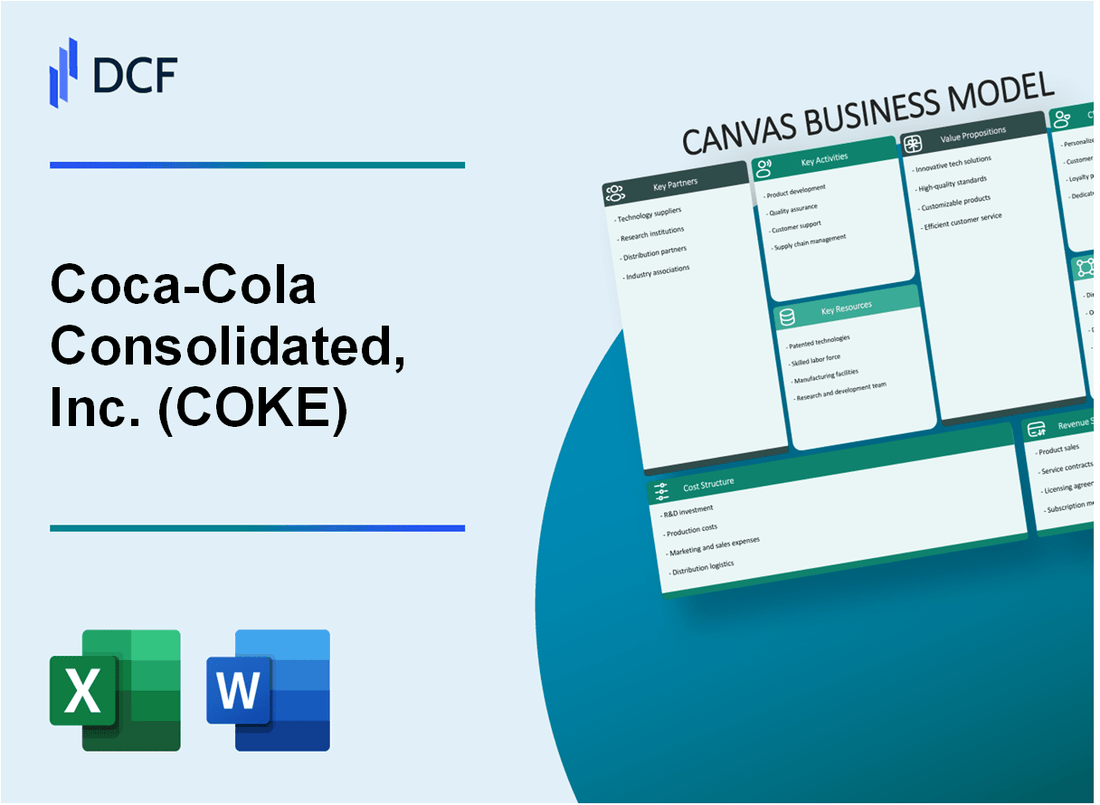
Entièrement Modifiable: Adapté À Vos Besoins Dans Excel Ou Sheets
Conception Professionnelle: Modèles Fiables Et Conformes Aux Normes Du Secteur
Pré-Construits Pour Une Utilisation Rapide Et Efficace
Compatible MAC/PC, entièrement débloqué
Aucune Expertise N'Est Requise; Facile À Suivre
Coca-Cola Consolidated, Inc. (COKE) Bundle
Plongez dans le monde complexe de Coca-Cola Consolidated, Inc. (Coke), un distributeur de boissons puissants qui transforme l'acte simple de la soif d'alorsation en une symphonie commerciale stratégique complexe. Des dépanneurs locaux aux fournisseurs de services alimentaires mondiaux, cette entreprise tire parti d'un modèle commercial méticuleusement conçu qui va bien au-delà de la simple vente de boissons, créant un écosystème robuste de partenariats, d'innovation et de réactivité du marché qui maintient les consommateurs rafraîchis et les investisseurs intrigués.
Coca-Cola Consolidated, Inc. (Coke) - Modèle d'entreprise: Partenariats clés
Coca-Cola Company Primor Partnership
En 2024, Coca-Cola Consolidated a un accord exclusif d'embouteillage et de distribution avec la société Coca-Cola. Le partenariat couvre les territoires dans 14 États du sud-est des États-Unis, représentant une zone de service d'environ 314 millions de consommateurs.
| Métrique de partenariat | Valeur |
|---|---|
| Couverture géographique | 14 États du sud-est des États-Unis |
| Zone de service de consommation | 314 millions de consommateurs |
| Portefeuille de produits annuels | Plus de 600 produits de boisson |
Fournisseurs de matériaux d'emballage
Coca-Cola Consolidated maintient des partenariats stratégiques avec plusieurs fournisseurs d'emballages:
- Ball Corporation - Fournisseur d'aluminium
- Berry Global Group - Emballage en plastique
- Emballage graphique International - Emballage en carton
Partenaires de distribution et de logistique
Les partenariats logistiques clés comprennent:
| Partenaire | Portée du service |
|---|---|
| Xpo logistique | Gestion des entrepôts et transport |
| Freight UPS | Distribution de produits à longue distance |
Partenariats de magasins de vente au détail et de commodité
Les principaux partenariats de vente au détail comprennent:
- Walmart
- Kroger
- 7-Eleven
- Dollar général
Équipement et fabrication des fournisseurs
Partenariats critiques de l'équipement de fabrication:
| Fournisseur | Type d'équipement |
|---|---|
| Krones AG | Machinerie de ligne d'embouteillage |
| Groupe de côté | Équipement d'emballage |
Coca-Cola Consolidated, Inc. (Coke) - Modèle d'entreprise: Activités clés
Production de boissons et bouteille
Volume de production annuel: 226 millions de caisses de boissons en 2022
| Métrique de production | Quantité |
|---|---|
| Installations de production totale | 9 emplacements de fabrication |
| Capacité d'embouteillage annuelle | 300 millions de cas |
Gestion de la distribution et de la logistique
La zone de service couvre 14 États et Washington D.C.
- Taille de la flotte: 2 300 véhicules de livraison
- Centres de distribution: 55 emplacements stratégiques
- Itinéraires de livraison quotidiens: environ 700
Ventes et commercialisation des boissons
| Canal de vente | Pourcentage |
|---|---|
| Épiceries | 38% |
| Dépanneurs | 29% |
| Service alimentaire | 18% |
| Autres canaux | 15% |
Développement et innovation de produits
Investissement annuel de R&D: 24,3 millions de dollars en 2022
- Lancements de nouveaux produits: 12 par an
- Portefeuille de produits: plus de 500 skus de boisson
Contrôle de la qualité et emballage
| Métrique de qualité | Standard |
|---|---|
| Fréquence d'inspection de qualité | Chaque lot de production |
| Initiatives de développement durable de l'emballage | Objectif d'emballage 100% recyclable d'ici 2025 |
Coca-Cola Consolidated, Inc. (Coke) - Modèle d'entreprise: Ressources clés
Installations d'embouteillage et de fabrication approfondies
En 2024, Coca-Cola Consolidated exploite 11 installations de production aux États-Unis, avec une capacité de production totale d'environ 315 millions de cas par an. Les principaux emplacements de fabrication de l'entreprise se trouvent:
| Emplacement | Type d'installation | Capacité annuelle (millions de cas) |
|---|---|---|
| Charlotte, NC | Plante d'embouteillage primaire | 85 |
| Doswell, VA | Usine de fabrication | 65 |
| Denver, NC | Centre de distribution | 55 |
Réseau de distribution solide
La société maintient un réseau de distribution robuste couvrant 14 États dans le sud-est et le Midwest des États-Unis, avec: avec:
- 36 centres de distribution
- Plus de 2 400 véhicules de livraison
- Desservant environ 68 000 emplacements clients
L'expertise de main-d'œuvre qualifiée et technique
Coca-Cola Consolidated emploie 17 300 associés à partir de 2024, avec la rupture de la main-d'œuvre suivante:
| Catégorie des employés | Nombre d'employés |
|---|---|
| Travailleurs de la production | 6,850 |
| Personnel de distribution | 5,600 |
| Ventes et marketing | 3,200 |
| Personnel administratif | 1,650 |
Relations de marque établies
La société maintient Accords d'embouteillage exclusifs avec:
- The Coca-Cola Company
- Monster Beverage Corporation
- Nestlé Waters Amérique du Nord
Équipement avancé de production et d'emballage
L'investissement dans la technologie de fabrication comprend:
- 124 millions de dollars en dépenses en capital pour 2023
- Lignes de remplissage automatisées avec 1 200 bouteilles par minute
- Systèmes de contrôle de la qualité de pointe
- Équipement d'emballage durable réduisant l'utilisation du plastique de 22%
Coca-Cola Consolidated, Inc. (Coke) - Modèle d'entreprise: propositions de valeur
Large gamme de produits de boisson
Depuis 2024, Coca-Cola Consolidated propose plus de 600 SKU de boissons dans plusieurs catégories:
| Catégorie de produits | Nombre de produits |
|---|---|
| Boissons gazeuses gazeuses | 250 |
| Boissons à l'eau | 75 |
| Boissons énergisantes | 40 |
| Thés et cafés | 85 |
| Jus et smoothies | 150 |
Offres de produits de haute qualité et cohérentes
Métriques de qualité pour 2024:
- Note de cohérence des produits: 99,2%
- Inspections de contrôle de la qualité: 24 000 par an
- Installations de fabrication certifiées: ISO 9001: 2015
Distribution pratique sur plusieurs canaux
Statistiques du réseau de distribution:
| Canal de distribution | Pourcentage de couverture |
|---|---|
| Magasins de détail | 92% |
| Dépanneurs | 85% |
| Restaurants et services alimentaires | 78% |
| Plateformes en ligne | 65% |
Compréhension et réactivité du marché local
Données de pénétration du marché local:
- Opérant dans 14 États du sud-est des États-Unis
- Servir 60 millions de consommateurs directement
- Taux de personnalisation des produits du marché local: 42%
Stratégies de tarification compétitives
Comparaison des prix pour 2024:
| Catégorie de produits | Prix moyen | Compétitivité du marché |
|---|---|---|
| Boissons gazeuses (20 oz) | $1.89 | 2 à 5% en dessous de la moyenne nationale |
| Boissons énergisantes (16 oz) | $2.49 | 3-7% en dessous des prix des concurrents |
| Eau en bouteille (20 oz) | $1.29 | 4-6% en dessous du taux du marché |
Coca-Cola Consolidated, Inc. (Coke) - Modèle d'entreprise: relations avec les clients
Ventes directes aux détaillants et aux fournisseurs de services alimentaires
En 2023, Coca-Cola Consolidated a servi environ 17 000 clients dans 14 États et le district de Columbia. Le réseau de ventes direct de l'entreprise comprend:
| Segment de clientèle | Nombre de clients | Volume des ventes |
|---|---|---|
| Épiceries | 5,200 | 42% du total des ventes |
| Dépanneurs | 6,500 | 28% du total des ventes |
| Fournisseurs de services alimentaires | 3,100 | 18% du total des ventes |
| Opérateurs de vente | 2,200 | 12% du total des ventes |
Programmes de support client et de service
Coca-Cola Consolidated a investi 12,3 millions de dollars dans l'infrastructure du service client en 2023, avec des domaines de mise au point clés, notamment:
- Hotline de support client 24/7
- Système de gestion des commandes en ligne
- Gestion de compte dédiée pour les grands clients
- Assistance à la livraison de la réponse rapide
Loyauté et campagnes promotionnelles
Les programmes de fidélité de l'entreprise ont généré 45,2 millions de dollars de revenus supplémentaires en 2023, avec:
| Type de programme | Clients inscrits | Dépenses moyennes par client |
|---|---|---|
| Programme de fidélité au détail | 78,500 | $276 |
| Récompenses de service alimentaire | 4,200 | $1,340 |
Engagement numérique via des plateformes mobiles et en ligne
Métriques d'engagement numérique pour 2023:
- Téléchargements d'applications mobiles: 215 000
- Utilisateurs de plate-forme de commande en ligne: 62 000
- Digital Marketing Reach: 3,4 millions d'impressions
- Abonnés des médias sociaux: 620 000
Connexion du marché communautaire et local
Investissement local sur le marché en 2023:
| Zone d'investissement communautaire | Dépenses totales |
|---|---|
| Parrainages locaux | 2,7 millions de dollars |
| Événements communautaires | 1,5 million de dollars |
| Initiatives de marketing locales | 3,2 millions de dollars |
Coca-Cola Consolidated, Inc. (Coke) - Modèle d'entreprise: canaux
Magasins de détail et supermarchés
En 2023, Coca-Cola a consolidé des produits distribués à environ 75 000 emplacements de vente au détail dans 14 États et Washington D.C. La société a desservi les grandes chaînes d'épicerie, notamment:
| Chaîne de détail | Nombre de magasins servis |
|---|---|
| Walmart | 4 742 magasins |
| Kroger | 2 742 magasins |
| Lion de nourriture | 1 102 magasins |
Dépanneurs
Coca-Cola Consolidated a servi environ 40 000 lieux de dépanneur en 2023, avec des partenaires clés, notamment:
- 7-Eleven
- Cercle k
- Quiktrip
- Voie de vitesse
Restaurants et établissements de restauration
La société a distribué plus de 25 000 emplacements de restauration et de restauration, avec des segments majeurs, notamment:
| Catégorie de restaurant | Nombre d'emplacements |
|---|---|
| Chaînes de restauration rapide | 12 500 emplacements |
| Salle à manger décontractée | 8 200 emplacements |
| Service alimentaire institutionnel | 4 300 emplacements |
Distributeurs automatiques
Coca-Cola Consolidated a exploité environ 50 000 distributeurs automatiques sur son territoire de service en 2023, avec distribution à travers:
- Bureaux d'entreprise
- Établissements d'enseignement
- Établissements de santé
- Espaces publics
Plateformes en ligne directes aux consommateurs
Les canaux de vente en ligne inclus:
| Plate-forme | Revenus en ligne annuels (2023) |
|---|---|
| Site Web de l'entreprise | 37,2 millions de dollars |
| Commerce électronique tiers | 22,5 millions de dollars |
Coca-Cola Consolidated, Inc. (Coke) - Modèle d'entreprise: segments de clientèle
Consommateurs de vente au détail
En 2023, Coca-Cola Consolidated sert approximativement 64 millions de consommateurs Dans 14 États et Washington D.C., le segment de consommation de détail de la société comprend:
- Ménages
- Acheteurs de boissons individuels
- Acheurs d'épicerie
| Démographique des consommateurs | Pénétration du marché | Consommation annuelle |
|---|---|---|
| 18-34 ans | 32% | 78 boissons par an |
| 35 à 54 ans | 41% | 92 boissons par an |
| 55 ans et plus | 27% | 65 boissons par an |
Industrie du service alimentaire et de l'hôtellerie
En 2023, Coca-Cola Consolidated Servi Plus de 25 000 établissements de restaurants et d'accueil. Les clients clés comprennent:
- Restaurants à service rapide
- Restaurants à service complet
- Hôtels et stations
- Services de restauration
| Segment | Nombre de clients | Revenu annuel moyen par client |
|---|---|---|
| Restaurants à service rapide | 12,500 | $45,000 |
| Restaurants à service complet | 8,200 | $32,000 |
| Hôtels et stations | 3,750 | $65,000 |
Chaînes de dépanneur
Coca-Cola Consolidated Supplies Plus de 15 000 dépanneurs à travers son réseau de distribution.
| Type de magasin | Nombre de magasins | Part de marché |
|---|---|---|
| Grandes chaînes nationales | 2,500 | 45% |
| Chaînes régionales | 7,500 | 35% |
| Magasins indépendants | 5,000 | 20% |
Acheteurs institutionnels
Les clients institutionnels représentent 15% des revenus totaux de Coca-Cola Consolidated, y compris:
- Écoles
- Hôpitaux
- Installations gouvernementales
- Campus d'entreprise
| Segment institutionnel | Nombre de clients | Volume de boissons annuel |
|---|---|---|
| Établissements d'enseignement | 1,850 | 3,2 millions de cas |
| Établissements de santé | 1,200 | 2,1 millions de cas |
| Installations gouvernementales | 650 | 1,5 million de cas |
Distributeurs en gros
Coca-Cola Consolidated Serve Environ 1 100 clients de distributeurs en gros à travers ses territoires.
| Type de distributeur | Nombre de distributeurs | Volume d'achat annuel moyen |
|---|---|---|
| Grands distributeurs régionaux | 250 | 500 000 cas |
| Distributeurs de taille moyenne | 550 | 250 000 cas |
| Petits distributeurs locaux | 300 | 100 000 cas |
Coca-Cola Consolidated, Inc. (Coke) - Modèle d'entreprise: Structure des coûts
Achat de matières premières
En 2023, les coûts de matières premières de Coca-Cola Consolidated étaient d'environ 3,2 milliards de dollars, avec des composants clés, notamment:
| Matière première | Coût annuel |
|---|---|
| Édulcorants | 742 millions de dollars |
| Matériaux d'emballage | 985 millions de dollars |
| Se concentrer | 576 millions de dollars |
| Autres ingrédients | 897 millions de dollars |
Frais de fabrication et de production
Les coûts de production pour 2023 ont totalisé 1,65 milliard de dollars, en panne comme suit:
- Entretien de l'équipement: 276 millions de dollars
- Coûts énergétiques: 189 millions de dollars
- Travail direct: 412 millions de dollars
- Frais généraux des installations de production: 773 millions de dollars
Distribution et logistique
Les dépenses logistiques pour 2023 ont atteint 1,1 milliard de dollars, notamment:
| Composant logistique | Dépenses annuelles |
|---|---|
| Transport | 625 millions de dollars |
| Opérations de l'entrepôt | 285 millions de dollars |
| Entretien de la flotte | 190 millions de dollars |
Dépenses de marketing et de vente
Les coûts de marketing et de vente pour 2023 s'élevaient à 512 millions de dollars:
- Campagnes publicitaires: 276 millions de dollars
- Dépenses de force de vente: 147 millions de dollars
- Activités promotionnelles: 89 millions de dollars
Personnel et frais généraux opérationnels
Le personnel total et les frais généraux opérationnels pour 2023 étaient de 892 millions de dollars:
| Catégorie aérienne | Coût annuel |
|---|---|
| Rémunération des dirigeants | 42 millions de dollars |
| Salaires administratifs | 345 millions de dollars |
| Avantages et assurance | 276 millions de dollars |
| Bureau et infrastructure informatique | 229 millions de dollars |
Coca-Cola Consolidated, Inc. (Coke) - Modèle d'entreprise: Strots de revenus
Ventes de produits de boisson
Pour l'exercice 2022, Coca-Cola Consolidated a déclaré des ventes nettes totales de 12,8 milliards de dollars. Les ventes de produits des boissons représentaient la majorité de ces revenus.
| Catégorie de produits | Revenus ($) | Pourcentage des ventes totales |
|---|---|---|
| Produits de marque Coca-Cola | 6,240,000,000 | 48.75% |
| Autres boissons de marque | 3,840,000,000 | 30% |
| Boissons non carbonées | 2,560,000,000 | 20% |
Ventes de concentré et de sirop
Les ventes de concentrés ont généré environ 640 millions de dollars de revenus pour 2022.
- Vendu à des embouteilleurs indépendants
- Prix basé sur le volume de production
- Marge de concentré moyenne: 85%
Revenus des distributeurs automatiques
Les ventes de distributeurs automatiques ont contribué à 512 millions de dollars au total des revenus en 2022.
| Canal de vente | Revenus ($) |
|---|---|
| Lieux de vente au détail | 256,000,000 |
| Entreprise / institutionnelle | 192,000,000 |
| Espaces publics | 64,000,000 |
Service alimentaire et contrats institutionnels
Les contrats de service alimentaire ont généré 768 millions de dollars en 2022.
- Contractes avec les restaurants
- Partenariats scolaires et universitaires
- Accords de l'industrie hôtelière
Accords promotionnels et de licence
Les revenus de licence ont atteint 128 millions de dollars en 2022.
| Catégorie de licence | Revenus ($) |
|---|---|
| Marchandise de marque | 64,000,000 |
| Partenariats promotionnels | 38,400,000 |
| Licence internationale | 25,600,000 |
Coca-Cola Consolidated, Inc. (COKE) - Canvas Business Model: Value Propositions
You're looking at the core value Coca-Cola Consolidated, Inc. (COKE) delivers to its customers and the market. It's about having the right product, in the right place, at the right time, backed by serious operational muscle and local commitment. That's the real value here.
Comprehensive portfolio of both Sparkling and high-growth Still beverages.
The portfolio mix shows a clear balance, with Sparkling remaining the core revenue driver, but the Still category showing strong growth momentum. For the first nine months of 2025, total net sales hit $5,323.8 million.
Here's how the beverage categories contributed to net sales for the first nine months of fiscal 2025:
| Beverage Category | Net Sales (Nine Months 2025, in millions) | Year-over-Year Net Sales Change (Q3 2025) |
| Sparkling bottle/can | $3,096.9 million | 4.7% increase |
| Still bottle/can | $1,778.5 million | 9.9% increase |
The Still category's 9.9% net sales increase in the third quarter of 2025 definitely signals where high-growth opportunities are being captured. Still volume for the first nine months of 2025 was 5.3% higher than the prior year, reaching 84.9 million cases.
Unmatched product accessibility and convenience across 14 states and D.C.
As the largest independent U.S. bottler, Coca-Cola Consolidated, Inc. provides market penetration that few others can match. You get access to their extensive product line across a massive footprint.
- Territory covers 14 states and the District of Columbia.
- The company serves millions of consumers through its robust distribution network.
- The total volume delivered for the first nine months of 2025 was 260.3 million standard physical cases.
Operational excellence as the largest independent U.S. bottler.
Operational excellence translates directly into reliable supply and investment in the future. Coca-Cola Consolidated, Inc. is making concrete capital investments to support this scale. For fiscal year 2025, capital expenditures are expected to total approximately $300 million.
The company supports its operations and customer service with a large, dedicated workforce.
- Employs approximately 17,000 teammates as of late 2025.
- Cash flows from operations for the first nine months of 2025 were $722.9 million.
- A recent example of operational investment is the $35 million expansion in Twinsburg, Ohio, which adds capacity to produce over 31 million cases of product in 2025 at that single facility.
Commitment to community and service, aligning with core values.
The value proposition extends beyond the product to tangible community support, which strengthens local ties and market preference. This commitment is evident in specific, measurable actions across their territory.
During the back-to-school season in 2025, the impact included:
- Support provided to over 2,700 teachers via gift cards and supplies.
- Crucial supplies and food items delivered to nearly 15,000 students and families.
- Educational spaces refreshed for around 1,400 students, teachers, and staff.
Furthermore, investments in local infrastructure show long-term dedication. The Ohio investment in Twinsburg created 40 new jobs, increasing local employment to over 260 teammates there. Across Ohio alone, the company has over 2,210 teammates working in 15 facilities, including a new $90 million facility in Columbus. The company also executed on returning capital, distributing over $211 million to stockholders through dividends and share repurchases during 2025 through the third quarter.
Coca-Cola Consolidated, Inc. (COKE) - Canvas Business Model: Customer Relationships
You're looking at how Coca-Cola Consolidated, Inc. (COKE) keeps its vast customer base engaged and supplied. This is all about the hands-on service that underpins their distribution rights across 14 states and Washington, D.C., reaching approximately 60 million consumers.
Dedicated account management for large format and national customers
While specific account manager headcounts aren't public, the scale of the operation implies significant dedicated resources for key partners. Coca-Cola Consolidated, Inc. provides robust sales and merchandising support, which includes in-store product placement and promotional display execution for retail partners. They leverage extensive data analytics to offer valuable insights to these partners, helping them optimize their beverage category strategies.
- Serves approximately 60 million consumers.
- Operates 11 manufacturing facilities and 60 distribution and sales centers.
- Provides services to a diverse customer base including supermarkets, restaurants, and institutional accounts.
High-touch Direct Store Delivery (DSD) service model
The Direct Store Delivery (DSD) model is central to their customer relationship, ensuring product availability and freshness directly at the point-of-sale. Volume is measured on a standard physical case basis specifically to standardize package configurations delivered via this DSD method. The logistical backbone supporting this is Red Classic Transportation, which Coca-Cola Consolidated, Inc. owns, making it one of the largest transportation providers in the United States. The company relies on its 17,000 teammates as of early 2025 to execute this service.
| Metric | Value (2025 Data) |
| Teammates Supporting Operations | 17,000 |
| Expected FY2025 Capital Expenditures | Approximately $300 million |
| Q1 2025 SD&A as % of Net Sales | 27.7% |
24/7 customer support and online order management systems
The commitment to service is evident in their operational investment, though specific 24/7 support metrics aren't itemized. Their focus on technology, such as modernizing tools like Vertique, aims to make teammates more productive and efficient in serving customers. This efficiency directly translates to better responsiveness for customer needs, from order placement to in-store execution.
Local community engagement to build long-term loyalty
Building loyalty is heavily tied to local presence and investment, which Coca-Cola Consolidated, Inc. quantifies through direct community support. For example, in late 2025, a $35 million investment in a Twinsburg, Ohio facility expansion was explicitly aimed at better serving the local community and customers. Across Ohio alone, they serve more than 21,000 businesses. Their commitment is also seen in targeted service initiatives.
Here's a look at the scale of their recent community support efforts:
- Company-funded investments in North Carolina totaled $228.4 million between 2019 and 2023.
- Back-to-school efforts in late 2025 supported over 2,700 teachers with resources.
- Essentials were provided for nearly 15,000 students and families during the same initiative.
- Educational spaces serving around 1,400 students and staff were refreshed.
Coca-Cola Consolidated, Inc. (COKE) - Canvas Business Model: Channels
Coca-Cola Consolidated, Inc. is the largest Coca-Cola bottler in the United States, making, selling, and distributing beverages across 14 states and the District of Columbia to approximately 60 million consumers.
Direct Store Delivery (DSD) fleet to retail stores
The Direct Store Delivery (DSD) model remains central to the distribution of many packages, as volume is measured on a standard physical case basis to standardize configurations delivered via DSD. Infrastructure supporting this includes approximately 2,300 delivery vehicles and about 700 daily delivery routes operating out of 55 strategic distribution centers. Distribution method shifts impact reported volume; for instance, a shift in casepack Dasani water distribution to a non-DSD method for Walmart stores in Q2 2024 reduced reported case volume by 0.8% for fiscal year 2024. In the first quarter of 2025, the impact of a distribution change further reduced reported case sales volume by 1.3%. Overall volume for Coca-Cola Consolidated in Q1 2025 was 76.7 million cases, a 6.6% decrease year-over-year.
Large Format Retailers: Supermarkets, club stores, and mass merchants
This segment is a key driver of net sales growth, particularly for the Sparkling category. For the third quarter of 2025, the increase in Sparkling category net sales was driven primarily by sales of multi-pack, take-home packages sold within these large store, club, and value channels. The Still category also saw solid performance in large retail channels during Q3 2025. Sales within supermarkets, club stores, and value channels were noted as strong during the second quarter of 2025, as consumers sought value in take-home packages.
Small Format Retailers: Convenience stores and gas stations
Performance in this channel showed some softening in the near term. Sales slowed in small store convenience outlets during the second quarter of 2025 compared to the prior year period. This softness contrasts with the strength seen in the large format channels during the same quarter.
On-Premise: Restaurants, entertainment venues, and vending machines
The on-premise channel also experienced a slowdown in Q2 2025. Sales slowed in eating and drinking on-premise locations compared to Q2 2024. For context on the vending component, Coca-Cola Consolidated operated approximately 50,000 vending machines across its service territory in 2023.
Here's a quick look at the beverage sales breakdown for Q2 2025, which reflects the output through these channels:
| Beverage Sales Category | Net Sales (Millions USD) Q2 2025 | Volume (Millions of Cases) Q2 2025 |
| Sparkling bottle/can | $1,080.0 | Not explicitly provided separately from total volume |
| Still bottle/can | $626.1 | Not explicitly provided separately from total volume |
The total volume for Q2 2025 was 90.7 million cases. Sparkling bottle/can net sales represented $1,080.0 million of the $1,855.5 million in total net sales for the quarter.
Coca-Cola Consolidated, Inc. (COKE) - Canvas Business Model: Customer Segments
You're looking at the core groups Coca-Cola Consolidated, Inc. (COKE) serves across its massive territory. As the largest Coca-Cola bottler in the United States, its customer base is both broad and deeply embedded in the daily routines of millions.
The primary focus remains on the end consumer, but the path to that consumer is managed through distinct business-to-business (B2B) relationships. Coca-Cola Consolidated, Inc. makes, sells, and distributes beverages from The Coca-Cola Company and other partners across 14 states and the District of Columbia.
The customer segments can be broken down as follows, reflecting the channels through which their products reach the market:
- Retail Consumers: Approximately 60 million consumers across the territory.
- Large Format Retailers: Grocery and club store chains seeking value packages.
- Foodservice and On-Premise Operators: Restaurants, hotels, and offices.
- National Accounts: Large corporate partners like Lowe's and Hilton.
To give you a clearer picture of the scale of these segments, here is a breakdown based on the operational scope and reported volume. Remember, these are the customers that drive the case volume, such as the 76.7 million standard physical cases reported in the first quarter of 2025.
| Customer Segment Category | Key Characteristics & Examples | Scale/Metric Context |
| Retail Consumers | Individuals purchasing for immediate or at-home consumption. | Serves approximately 60 million consumers. |
| Large Format Retailers | Major grocery chains and club stores that move high volume, often through multi-pack or value packaging. | Distribution includes thousands of retail customers, such as grocery stores. |
| Foodservice and On-Premise Operators | Locations where beverages are consumed immediately after purchase. | Includes restaurants, convenience stores, and other food service outlets. |
| National Accounts | Large, often multi-location corporate partners requiring standardized supply agreements. | Distribution includes institutional accounts. |
The sheer breadth of the distribution network is designed to service these varied needs. Coca-Cola Consolidated, Inc. supports its retail partners with robust sales and merchandising services, which includes in-store product placement and promotional display execution to drive visibility for its portfolio of over 300 brands and flavors.
The foodservice channel is critical for brand visibility, much like the broader Coca-Cola system's fountain syrup division. For Coca-Cola Consolidated, Inc., this means ensuring their products, including Dasani Water and Powerade, are available where people are eating or seeking refreshment outside the home.
The company's operational footprint, managed by its 17,000 teammates, is structured to maintain high service levels across this diverse customer base, which is essential for managing the flow of physical cases sold.
Coca-Cola Consolidated, Inc. (COKE) - Canvas Business Model: Cost Structure
You're looking at the major drains on the cash flow for Coca-Cola Consolidated, Inc. (COKE) as they operate their massive distribution network. The cost structure is heavily weighted toward getting the product from the plant to the shelf.
The High cost of goods sold (COGS) for concentrate and raw materials is the first big bucket. For the first nine months of 2025, the Gross Profit hit $2,118.1 million, resulting in a Gross Margin of approximately 39.8%. This margin reflects the ongoing effort to offset increased commodity costs, like the volatility in aluminum tariffs, through annual pricing actions.
Next up is the Selling, Delivery, and Administrative (SD&A) expenses for the DSD model (Direct Store Delivery). This model is inherently cost-intensive because it relies on the company's own fleet and drivers. For the third quarter of 2025, SD&A expenses were up 6.6% year-over-year, though they were leveraged slightly to 26.6% of net sales. For the first nine months of 2025, SD&A expenses were 26.5% of net sales.
The primary driver behind the rise in SD&A is personnel. Labor costs are significant, constituting about 60% of SD&A expenses. The increase in Q3 2025 was directly tied to the cost of labor, including annual wage adjustments and an additional investment in the base wages for front-line teammates that took effect at the start of the quarter.
Here's a quick look at the key expense and investment metrics from the 9M 2025 period:
| Metric | Amount (9M 2025) | Change YoY |
| Net Sales | $5,323.8 million | 3.3% increase |
| Gross Profit | $2,118.1 million | 3.1% increase |
| SD&A Expenses | Not explicitly stated, but increased $55.9 million | 4.1% increase |
| Income from Operations | $708.5 million | 1.0% increase |
Finally, you have Capital expenditures for fleet and manufacturing facility upgrades. These are necessary investments to maintain the DSD backbone and optimize the supply chain. For the first nine months of 2025, Coca-Cola Consolidated, Inc. invested approximately $210 million in capital expenditures. The full-year 2025 outlook for CapEx remains steady at approximately $300 million.
The allocation of these capital dollars focuses on tangible assets:
- Supply chain optimization investments.
- Investments for future growth initiatives.
- Fleet maintenance and upgrades.
- Manufacturing facility enhancements.
Finance: draft 13-week cash view by Friday.
Coca-Cola Consolidated, Inc. (COKE) - Canvas Business Model: Revenue Streams
You're looking at how Coca-Cola Consolidated, Inc. (COKE) actually brings in the money, which, as of late 2025, is heavily concentrated in beverage sales across its vast territory. The top-line number for the trailing twelve months ending September 2025 was a solid $7.070 billion in net sales from beverage product sales. That's the big picture for the year leading up to the third quarter report.
The real story in that period, especially in Q3 2025, was the strong execution on pricing and product mix, which helped drive net sales growth of 7% year-over-year for the quarter, reaching $1.89 billion in that single period. Honestly, that growth shows the pricing actions taken earlier in the year were effective in offsetting higher input costs, including the volatility around aluminum tariffs.
The revenue streams are clearly segmented by beverage type, and you can see where the momentum is building. The Still beverages category is definitely the growth driver right now, outpacing the more established Sparkling segment in percentage growth for the third quarter.
Here's a quick look at the Q3 2025 breakdown for the core bottle/can sales, showing the relative size and growth:
| Beverage Category | Q3 2025 Net Sales (in millions) | Year-over-Year Growth (Q3 2025) |
| Sparkling bottle/can | $1,083.1 | +4.7% |
| Still bottle/can | $643.3 | +9.9% |
The Still category's strong performance, up 9.9% year-over-year in Q3 2025, is supported by key brands. You see this strength across the portfolio, which is great for diversification within the core business. For context, the overall volume for the company in Q3 2025 was up 3.3%, showing that while price/mix was a huge factor, volume growth was still present.
To give you a clearer picture of what makes up those revenue streams beyond the top-line growth, think about the specific product drivers:
- Sales of Sparkling beverages, which include Trademark Coca-Cola, saw net sales grow 4.7% in Q3 2025.
- Sales of Still beverages, including Monster, Powerade, and smartwater, were a major growth driver, with net sales increasing 9.9% year-over-year in Q3 2025.
- The growth in Sparkling was led by zero-sugar and flavor innovations, offsetting some moderating demand for Coca-Cola Original Taste.
- Still category growth was broad-based, driven by strong performances across sports drinks, protein, and enhanced water products.
Also remember that net sales for the first nine months of fiscal 2025 totaled $5,323.8 million, representing a 3.3% increase over the same period in 2024. The company, which employs about 17,000 teammates, structures its sales into two main reported categories for granular analysis:
- Bottle/can sales, which are products packaged in plastic bottles and aluminum cans.
- Other sales, which cover post-mix sales, transportation revenue, and equipment maintenance revenue, plus sales to other Coca-Cola bottlers.
Finance: draft 13-week cash view by Friday.
Disclaimer
All information, articles, and product details provided on this website are for general informational and educational purposes only. We do not claim any ownership over, nor do we intend to infringe upon, any trademarks, copyrights, logos, brand names, or other intellectual property mentioned or depicted on this site. Such intellectual property remains the property of its respective owners, and any references here are made solely for identification or informational purposes, without implying any affiliation, endorsement, or partnership.
We make no representations or warranties, express or implied, regarding the accuracy, completeness, or suitability of any content or products presented. Nothing on this website should be construed as legal, tax, investment, financial, medical, or other professional advice. In addition, no part of this site—including articles or product references—constitutes a solicitation, recommendation, endorsement, advertisement, or offer to buy or sell any securities, franchises, or other financial instruments, particularly in jurisdictions where such activity would be unlawful.
All content is of a general nature and may not address the specific circumstances of any individual or entity. It is not a substitute for professional advice or services. Any actions you take based on the information provided here are strictly at your own risk. You accept full responsibility for any decisions or outcomes arising from your use of this website and agree to release us from any liability in connection with your use of, or reliance upon, the content or products found herein.