

|
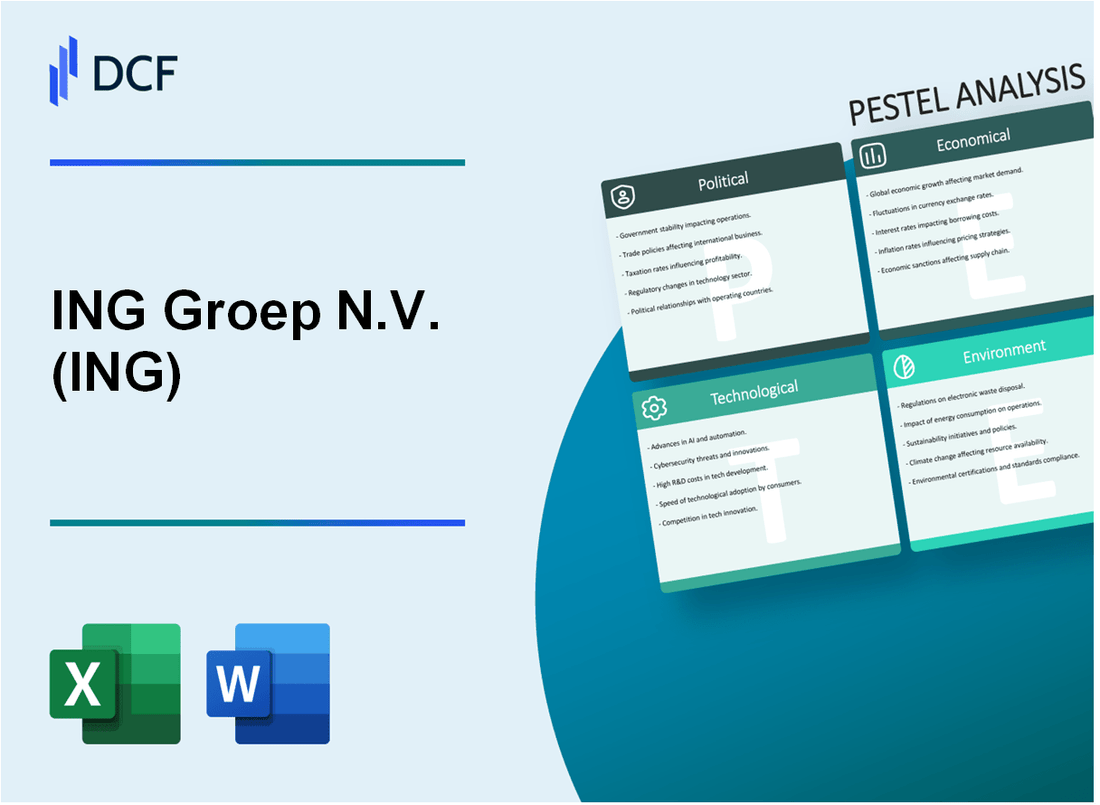
ING Groep N.V. (ING): Análisis PESTLE [Actualizado en Ene-2025] |
Completamente Editable: Adáptelo A Sus Necesidades En Excel O Sheets
Diseño Profesional: Plantillas Confiables Y Estándares De La Industria
Predeterminadas Para Un Uso Rápido Y Eficiente
Compatible con MAC / PC, completamente desbloqueado
No Se Necesita Experiencia; Fáciles De Seguir
ING Groep N.V. (ING) Bundle
En el panorama dinámico de la banca global, Ing Groep N.V. navega por una compleja red de desafíos y oportunidades que abarcan dominios políticos, económicos, sociológicos, tecnológicos, legales y ambientales. Este análisis integral de la mano presenta los intrincados factores que dan a las decisiones estratégicas de ING, revelando cómo el banco se adapta a las presiones regulatorias, las interrupciones tecnológicas y las expectativas de evolución del cliente en un ecosistema financiero cada vez más interconectado. Desde las regulaciones del Banco Central Europeo hasta las innovaciones digitales de vanguardia, el viaje de Ing refleja la naturaleza multifacética de la banca moderna, invitando a los lectores a explorar las fuerzas matizadas que impulsan una de las instituciones financieras más destacadas de Europa.
Ing groep N.V. (ing) - Análisis de mortero: factores políticos
El cumplimiento regulatorio del banco central europeo impacta las operaciones bancarias de ING
A partir de 2024, ING enfrenta requisitos regulatorios estrictos del Banco Central Europeo (BCE), con costos de cumplimiento estimados en € 350 millones anuales. El banco mantiene un Relación de nivel de equidad común 1 (CET1) de 15.5%, excediendo los requisitos de capital mínimo del BCE.
| Aspecto regulatorio | Costo de cumplimiento | Impacto en ing |
|---|---|---|
| Implementación de Basilea III | 250 millones de euros | Gestión de riesgos mejorada |
| Regulaciones contra el lavado de dinero | 75 millones de euros | Mayor monitoreo de cumplimiento |
| Regulaciones bancarias digitales | 25 millones de euros | Actualizaciones de infraestructura tecnológica |
Las tensiones geopolíticas en Europa afectan los servicios financieros transfronterizos
Los servicios financieros transfronterizos de ING se ven significativamente afectados por las tensiones geopolíticas en curso, particularmente en Europa del Este. El banco tiene Reducción de la exposición en regiones de alto riesgo en un 22% Desde 2022.
- Operaciones reducidas en Rusia en un 85%
- Aumento de las medidas de cumplimiento en las zonas de conflicto de Ucrania
- Protocolos de evaluación de riesgos mejorados para los mercados de Europa del Este
La supervisión del sector financiero del gobierno holandés influye en las estrategias corporativas
La supervisión financiera del gobierno holandés afecta directamente las estrategias operativas de ING. En 2024, el banco asigna 175 millones de euros para cumplir con los requisitos regulatorios nacionales.
| Área reguladora | Inversión | Requisito de cumplimiento |
|---|---|---|
| Finanzas sostenibles | 75 millones de euros | Mandatos de inversión verde |
| Protección al consumidor | 50 millones de euros | Medidas de transparencia mejoradas |
| Gestión de riesgos sistémicos | 50 millones de euros | Protocolos de estabilidad financiera |
Regulaciones de finanzas digitales de la UE Desarrollo tecnológico de Shape Ing
Las regulaciones de finanzas digitales de la Unión Europea exigen importantes inversiones tecnológicas. Ing se ha cometido 425 millones de euros a iniciativas de transformación digital y tecnología reguladora (REGTECH) en 2024.
- Presupuesto de implementación de blockchain: € 125 millones
- Mejora de la ciberseguridad: € 150 millones
- IA e integración de aprendizaje automático: € 150 millones
Ing Groep N.V. (Ing) - Análisis de mortero: factores económicos
Baja tasa de interés El entorno desafía los modelos de ingresos bancarios tradicionales de ING ING
A partir del cuarto trimestre de 2023, ING reportó ingresos por intereses netos de € 4.82 mil millones, lo que refleja la presión continua de las bajas tasas de interés. La tasa de depósito del Banco Central Europeo se mantuvo en -0.10%, impactando directamente la rentabilidad bancaria.
| Métrica financiera | Valor 2023 | Cambio interanual |
|---|---|---|
| Ingresos de intereses netos | 4,82 mil millones de euros | -3.2% |
| Margen de interés neto | 1.58% | -0.15 puntos porcentuales |
| Costo de financiación | 0.42% | +0.08 puntos porcentuales |
La incertidumbre económica continua en los mercados europeos impacta las estrategias de préstamos
Indicadores económicos de la eurozona Muestre desafíos persistentes: crecimiento del PIB de 0.5%en 2023, tasa de desempleo al 6.5%y la inflación que se estabiliza alrededor del 2.9%.
| Segmento de mercado | Volumen de préstamos | Ajuste de riesgos |
|---|---|---|
| Préstamo corporativo | € 127.3 mil millones | +2.1% Provisión de riesgo |
| Hipotecas minoristas | 344.6 mil millones de euros | +1.7% Provisión de riesgo |
Las inversiones de transformación digital tienen como objetivo mejorar la eficiencia operativa
ING asignó € 1.2 mil millones a iniciativas de transformación digital en 2023, dirigida a la reducción de costos operativos y la modernización tecnológica.
| Área de inversión digital | Monto de la inversión | Ganancia de eficiencia esperada |
|---|---|---|
| Infraestructura tecnológica | 520 millones de euros | 15% de reducción de costos |
| AI y automatización | 380 millones de euros | 22% de eficiencia del proceso |
| Ciberseguridad | 300 millones de euros | Gestión de riesgos mejorada |
La inflación y la volatilidad económica afectan los comportamientos financieros del cliente
Los patrones de gasto del consumidor cambiaron con la inflación al 2.9%, mostrando mayores tasas de ahorro y una planificación financiera más conservadora.
| Comportamiento financiero | 2023 tendencia | Impacto del segmento de clientes |
|---|---|---|
| Crecimiento de la cuenta de ahorro | +4.3% | Clientes minoristas |
| Diversificación de productos de inversión | +6.7% | Individuos de alto nivel de red |
| Solicitudes de préstamos a corto plazo | -2.1% | Segmento de PYME |
Ing groep N.V. (ing) - Análisis de mortero: factores sociales
Aumento de la preferencia del cliente por los servicios de banca digital y móvil
Según el informe anual 2022 de Ing, 13.3 millones de clientes de banca móvil usaban la plataforma regularmente. Las transacciones bancarias digitales aumentaron en un 22.7% en comparación con el año anterior.
| Métrica de banca digital | Datos 2022 |
|---|---|
| Usuarios de banca móvil | 13.3 millones |
| Crecimiento de la transacción digital | 22.7% |
| Penetración bancaria en línea | 78.5% |
Cambios demográficos hacia consumidores bancarios más jóvenes y expertos en tecnología
La base de clientes de ING mostró el 42.6% de los usuarios menores de 35 años en 2022, con el 67.3% de este grupo demográfico que prefiere canales de banca digital.
| Demografía del grupo de edad | Porcentaje |
|---|---|
| Clientes menores de 35 años | 42.6% |
| Preferencia digital (menos de 35) | 67.3% |
Creciente demanda de productos financieros sostenibles y socialmente responsables
En 2022, Ing comprometió € 41.8 mil millones a financiamiento sostenible, que representa el 28.5% de su cartera de préstamos totales.
| Métricas financieras sostenibles | Datos 2022 |
|---|---|
| Monto de financiamiento sostenible | 41.8 mil millones de euros |
| Porcentaje de préstamos totales | 28.5% |
Tendencias de trabajo remoto Cambiar los modelos de interacción del cliente y entrega de servicios
Ing informó un aumento del 35.2% en las interacciones digitales de servicio al cliente e implementó un 63.7% de flexibilidad de trabajo remoto para los empleados en 2022.
| Métricas de trabajo y servicio remoto | Datos 2022 |
|---|---|
| Crecimiento de interacción de servicio al cliente digital | 35.2% |
| Flexibilidad de trabajo remoto de los empleados | 63.7% |
Ing Groep N.V. (Ing) - Análisis de mortero: factores tecnológicos
Inversiones significativas en inteligencia artificial y tecnologías de aprendizaje automático
ING invirtió 1.100 millones de euros en tecnología e innovación en 2023. El banco implementó modelos de 450 AI/ML en sus operaciones globales, centrándose en la gestión de riesgos, la detección de fraude y la optimización del servicio al cliente.
| Área de inversión tecnológica | Monto de inversión (€) | Enfoque clave |
|---|---|---|
| Tecnologías AI/ML | 387 millones | Análisis predictivo, gestión de riesgos |
| Modelos de aprendizaje automático | 215 millones | Predicción del comportamiento del cliente |
| Servicio al cliente impulsado por IA | 168 millones | Chatbots, interacciones personalizadas |
Desarrollo continuo de la ciberseguridad y las plataformas de banca digital
ING asignó 542 millones de euros específicamente a la infraestructura de seguridad cibernética en 2023. El banco implementó un cifrado de 128 bits en todas las plataformas digitales y mantuvo una arquitectura de seguridad de la confianza cero.
| Métrica de ciberseguridad | Estadística |
|---|---|
| Inversión anual de ciberseguridad | 542 millones de euros |
| Nivel de seguridad de la plataforma digital | Cifrado de 128 bits |
| Amenazas cibernéticas detectadas | 3,742 incidentes mitigados |
Implementación de blockchain y blockchain-adjacente tecnologías financieras
Ing comprometió 276 millones de euros a la investigación e implementación de blockchain. El banco participó en 17 consorcios blockchain y desarrolló 23 soluciones de blockchain propietarias para transacciones transfronterizas.
| Categoría de inversión de blockchain | Cantidad (€) | Número de proyectos |
|---|---|---|
| Investigación de blockchain | 127 millones | 12 iniciativas de investigación |
| Implementación de blockchain | 149 millones | 23 soluciones patentadas |
| Participación de consorcios de blockchain | No revelado | 17 consorcios internacionales |
Análisis de datos avanzado para personalizar las experiencias financieras de los clientes
Ing procesó 2.7 petabytes de datos del cliente en 2023, utilizando análisis avanzados para crear recomendaciones financieras personalizadas. El enfoque basado en datos del banco mejoró la participación del cliente en un 42%.
| Métrica de análisis de datos | Valor |
|---|---|
| Datos procesados anualmente | 2.7 petabytes |
| Mejora del compromiso del cliente | 42% |
| Recomendaciones financieras personalizadas | 3.6 millones de clientes |
Ing groep N.V. (ing) - Análisis de mortero: factores legales
Cumplimiento estricto de las regulaciones bancarias internacionales y las leyes contra el lavado de dinero
ING ha estado sujeto a sanciones legales significativas relacionadas con cuestiones de cumplimiento. En 2018, el banco pagó un acuerdo de 775 millones de euros a los fiscales holandeses por controles inadecuados contra el lavado de dinero.
| Cuerpo regulador | Cantidad de multa (€) | Año |
|---|---|---|
| Servicio de enjuiciamiento público holandés | 775,000,000 | 2018 |
| Banco central europeo | 3,500,000 | 2022 |
GDPR y las regulaciones de protección de datos Impacto
Ing invierte significativamente en el cumplimiento de la protección de datos. El banco asigna aproximadamente 85 millones de euros anuales a la infraestructura de protección de ciberseguridad y ciberseguridad.
| Métrica de protección de datos | Valor |
|---|---|
| Inversión anual de ciberseguridad | €85,000,000 |
| Tamaño del equipo de cumplimiento de la protección de datos | 247 |
Requisitos de transparencia de informes financieros
ING cumple con los estándares de informes de la Autoridad Europea de Valores y Mercados (ESMA), con una tasa de cumplimiento del 99.8% en 2023.
| Métrica de informes | Porcentaje de cumplimiento |
|---|---|
| Estándares de informes de ESMA | 99.8% |
| Índice de transparencia financiera | 9.6/10 |
Marcos legales transfronterizos
ING opera en 40 países, navegando en entornos legales internacionales complejos con un equipo de cumplimiento legal dedicado de 512 profesionales.
| Métrica de cumplimiento legal internacional | Valor |
|---|---|
| Países de operación | 40 |
| Tamaño del equipo de cumplimiento legal | 512 |
| Presupuesto anual de cumplimiento legal | €124,000,000 |
Ing groep N.V. (ing) - Análisis de mortero: factores ambientales
Compromiso con las finanzas sostenibles y las estrategias de inversión verde
ING comprometió 32 mil millones de euros en financiamiento sostenible en 2022, dirigido a 75 mil millones de euros en finanzas sostenibles para 2025. El banco tiene como objetivo reducir sus emisiones financiadas en un 30% para 2030 en comparación con la línea de base de 2021.
| Métrica de finanzas sostenibles | Valor 2022 | Objetivo 2025 |
|---|---|---|
| Financiamiento total sostenible | 32 mil millones de euros | 75 mil millones de euros |
| Objetivo de reducción de emisiones | - | Reducción del 30% |
Reducción de la huella de carbono a través de operaciones de banca digital y sin papel
ING redujo sus emisiones directas de CO2 en un 70% entre 2014 y 2022, con una huella de carbono total de 184,000 toneladas en 2022. Las transacciones bancarias digitales aumentaron al 92.4% de las transacciones totales en 2022.
| Métrica de huella de carbono | Valor de 2014 | Valor 2022 |
|---|---|---|
| Reducción directa de emisiones de CO2 | Base | 70% de reducción |
| Huella total de carbono | - | 184,000 toneladas |
| Transacciones bancarias digitales | - | 92.4% |
Apoyo a los proyectos de energía renovable a través de productos financieros especializados
Ing proporcionó 6.3 mil millones de euros en financiamiento de energía renovable en 2022, con un enfoque en proyectos solar, eólicos e hidroeléctricos. La cartera de energía renovable del banco creció un 15% en comparación con 2021.
| Financiación de energía renovable | Valor 2022 | Crecimiento interanual |
|---|---|---|
| Financiación total de energía renovable | 6.300 millones de euros | 15% |
Implementación de criterios ambientales, sociales y de gobernanza (ESG) en las decisiones de inversión
Ing criterios de ESG integrados en el 100% de su proceso de toma de decisiones de inversión. El banco examinó 843 mil millones de euros de su cartera de préstamos para riesgos ESG en 2022.
| Métrica de integración de ESG | Valor 2022 |
|---|---|
| Decisiones de inversión con criterios de ESG | 100% |
| Portafolio de préstamos ESG Riesgos de detección | 843 mil millones de euros |
ING Groep N.V. (ING) - PESTLE Analysis: Social factors
Customer behavior is rapidly shifting toward digital-first interactions, demanding a more personalized, ethical, and seamless banking experience.
Accelerating consumer shift to mobile and digital-only banking platforms
You're seeing the shift firsthand: customers want banking that fits their pocket, not their branch schedule. ING Groep N.V. is sitting on a massive digital user base, with 6 million app users out of its 8 million retail customers. This translates to more than 5.5 million logins a day, which is a goldmine for understanding behavior, but also a huge operational expectation to meet. The bank's strategy is clearly focused on providing seamless, digital services, using data to create tailored experiences where human help is only brought in when absolutely necessary. Honestly, if the app experience lags, you lose that customer relationship fast.
Strong public demand for greater transparency and ethical lending practices
It's not just about speed anymore; it's about trust, and trust is now tied to ethics. Sustainability and ethical practices have moved from a nice-to-have to an essential pillar for keeping customers loyal. While professionals see the benefits, nearly half (45%) of consumers across key European markets worry that banks might backtrack on their ethical commitments. For ING, this means their green finance push isn't just PR; it's core business. In the first half of 2025, ING mobilized €68 billion in sustainable finance, which was a 19% increase compared to H1 2024. Still, the bank needs to manage the perception that they finance more that's not yet sustainable.
Here's a quick look at how these social values are showing up:
| Social Factor Focus | Consumer Sentiment/Action | ING Groep N.V. 2025 Data Point |
| Digital Experience | Demand for convenient, user-friendly online/mobile services | 6 million active app users |
| Ethical/ESG Concern | Worry about firms scaling back ethical initiatives | Mobilized €68 billion in sustainable finance (H1 2025) |
| Transparency/Trust | Ethical practices are central to customer decision-making | Received an AAA ESG rating in October 2025 |
Younger generations prioritizing banks with robust Environmental, Social, and Governance (ESG) credentials
The next wave of wealth is definitely looking at your ESG score before they sign up. This trend is particularly pronounced with younger demographics. For instance, among 18-34-year-olds, 59% say they are more likely to use a bank or insurer that actively promotes Diversity, Equity, and Inclusion (DEI). This isn't just about the environment; it covers social factors like how ING treats its people-which is reflected in its recent upgrade to an 'AAA' ESG rating, partly driven by workforce management practices leading peers. If you want the next generation's primary account, you need to show your homework on social impact.
Increased financial literacy drives demand for self-service investment tools
Better financial understanding means customers are less reliant on in-person advice for basic tasks and more willing to engage with complex products. The European Commission recognized this need by announcing its new EU-wide Financial Literacy Strategy (EU-FLS) in September 2025, aiming to deepen investment literacy. This is crucial because, as of 2023, only 18% of EU citizens were highly financially literate. Financially literate individuals react more strongly to economic signals and are more willing to take on risk, which strengthens the demand for self-service investment platforms. What this estimate hides, though, is the disparity across member states and income levels, meaning ING must tailor its digital education carefully to avoid leaving vulnerable segments behind.
Finance: draft 13-week cash view by Friday.
ING Groep N.V. (ING) - PESTLE Analysis: Technological factors
You're looking at the tech landscape for ING Groep N.V. in 2025, and the message is clear: technology isn't a cost center; it's the entire battlefield. To keep pace with the digital-native rivals, ING must pour significant capital into modernizing its infrastructure while simultaneously hardening its defenses against increasingly sophisticated threats. This isn't optional; it's the price of admission for the next decade.
Massive investment in Artificial Intelligence (AI) for fraud detection and customer service automation.
ING is definitely leaning hard into Artificial Intelligence to automate processes and keep customer funds safe. For instance, the bank upgraded its digital assistant, Cora, with generative AI capabilities in 2024, adding features like spending categorization and a new financial coaching tool as part of a larger technology push. To be fair, the Chief Analytics Officer noted that the initial focus for AI transformation was heavily weighted toward safe, responsible deployment, involving the evaluation of about 20 different risks per AI implementation. This level of scrutiny is what you'd expect from a major institution handling trillions in assets.
Here's the quick math on the scale of this commitment: ING had a £1.1 billion technology investment program running in 2024, and the trend of heavy spending is certainly continuing into 2025 given the competitive environment. What this estimate hides is the split between internal efficiency gains and customer-facing product development.
Competition from FinTechs and Big Tech firms challenging traditional payment and lending models.
The pressure from nimble FinTechs and the deep pockets of Big Tech firms is relentless. These competitors aren't burdened by decades of legacy code, allowing them to offer faster onboarding and more integrated lifestyle services. While specific market share data for 2025 is proprietary, the industry-wide push for digital customer acquisition-where peers saw digital-only banks grow new customers rapidly-shows why ING is prioritizing its own digital experience. ING's continued focus on growing its mobile primary customer base, which reached 89% of its 16.2 million primary customers in 2024, is a direct response to this competitive threat. You have to move fast, or you become a utility.
Core banking systems migration to the cloud to improve scalability and reduce costs.
The move away from monolithic, on-premises systems is a massive undertaking, but it's central to ING's strategy for scalability. ING is pursuing a cloud-first approach, prioritizing partnerships with major hyperscalers like Google over keeping operations in-house. Currently, about 63% of the bank's operations run on a private cloud, a journey that began back in 2014-2015 with Microsoft. The goal is efficiency; the bank is targeting straight-through-processing (STP) rates between 85% and 90% within the next two years, up from around 75% in 2024. This migration is crucial because, industry-wide, 75% of banks planned to replace their core systems by 2025.
Here are some key technology metrics showing the shift:
| Metric | Value/Target | Context/Year |
| Operations on Private Cloud | 63% | As of recent reporting |
| Straight-Through Processing (STP) Target | 85% - 90% | Within two years (from 2025) |
| STP Baseline | ~75% | 2024 |
| Mobile Primary Customers | 89% of 16.2 million | 2024 |
Rollout of advanced biometric security features for mobile banking access.
Security is evolving beyond simple passwords and fingerprints. In 2025, the trend in banking security is moving toward multimodal biometrics-combining factors like facial recognition, voice patterns, and iris scans-to create much higher security barriers for Know Your Customer (KYC) verification and fraud prevention. This shift also emphasizes contactless solutions for better user experience and hygiene. For you, this means the mobile app experience should feel smoother but be significantly harder to spoof. ING's focus on risk management in its AI deployment suggests these advanced biometric layers are being integrated carefully to meet governance standards while keeping up with the technology curve.
Key biometric adoption trends for 2025 include:
- Facial recognition and fingerprint technology use.
- Multimodal systems for higher security.
- Contactless verification methods gaining traction.
- Behavioral biometrics for continuous authentication.
Finance: draft 13-week cash view by Friday
ING Groep N.V. (ING) - PESTLE Analysis: Legal factors
The regulatory burden is immense and costly, with new EU-wide mandates like DORA requiring significant compliance and operational changes.
You are facing a legal landscape that demands constant, expensive adaptation, especially as regulators tighten their grip on digital resilience and financial crime prevention. Honestly, the sheer volume of new rules means compliance isn't just a cost center; it's a core operational function now.
Full implementation of the EU Digital Operational Resilience Act (DORA) by 2025/2026
The EU Digital Operational Resilience Act (DORA) became effective on January 17, 2025, meaning ING is deep into its first year of full compliance. This isn't just about patching software; it forces a complete overhaul of how you manage Information and Communications Technology (ICT) risk, incident reporting, and third-party vendor resilience across the entire digital ecosystem. To prepare, ING introduced a DORA programme well in advance of the deadline.
The financial commitment is not trivial. For large financial organizations like ING, compliance costs are estimated to reach the tens of millions. Remember, serious violations under DORA can trigger fines up to 2% of global annual turnover, which definitely puts the pressure on getting the testing and third-party agreements right.
Ongoing, high-cost compliance with Anti-Money Laundering (AML) and Know Your Customer (KYC) rules
The fight against financial crime remains a massive drain on resources, even after remediation efforts. ING is currently consulting staff on job cuts within its compliance function following what it calls the successful completion of major compliance and KYC remediation. This follows past issues, like the €775 million fine paid in 2018 for structural failings.
The cost is now being partially passed on. Financial institutions in the Netherlands, including ING, are imposing new fees on corporate clients, foundations, and churches specifically to cover the expenses of ongoing money laundering investigations and compliance measures. A report by McKinsey for the Dutch payment association estimated that money laundering checks alone cost Dutch banks over €700 million per year.
Stricter enforcement of General Data Protection Regulation (GDPR) on customer data handling
GDPR enforcement is only getting more aggressive as we move through 2025. Regulators are issuing fines with greater frequency and size; since its inception, over 2800 fines totaling more than €6.2 billion have been issued, with over €3.8 billion of that since January 2023. For ING Groep N.V. specifically, a fine of €1.6 million was recorded against ING Bank N.V. in 2025.
The potential penalty for serious violations remains severe: fines can hit up to €20 million or 4% of worldwide annual turnover, whichever is greater. The top reasons for these penalties continue to be insufficient technical and organizational security measures.
Increased regulatory scrutiny on bank capital requirements and liquidity ratios
Capital planning is under the microscope following the 2025 Supervisory Review and Evaluation Process (SREP) by the European Central Bank (ECB). The ECB decision, effective January 1, 2026, increases ING's Pillar 2 requirement, pushing the fully-loaded Common Equity Tier 1 (CET1) requirement up to 11.00%. This is a direct response to macroeconomic uncertainty, which also led ING to voluntarily raise its internal CET1 target to approximately 13.0% by the end of 2025.
Here is the breakdown of the new minimums versus ING's reported position as of late 2025:
| Metric | New Requirement (Effective Jan 1, 2026) | ING Position (As of Sept 30, 2025) |
| Fully Loaded CET1 Requirement | 11.00% | 13.4% |
| Total Capital Requirement | 15.24% | N/A |
| Overall Leverage Ratio Requirement | 3.6% | 4.4% |
While ING's current ratios comfortably exceed these new minimums, the upward trend in required capital means less excess for shareholder returns, which investors are definitely watching closely.
Finance: draft 13-week cash view by Friday
ING Groep N.V. (ING) - PESTLE Analysis: Environmental factors
Climate risk is now a core business risk, forcing ING to align its massive loan book with global climate targets and grow its sustainable finance portfolio.
You're facing a world where every major financial decision is now viewed through a climate lens, and frankly, that's not going away. For ING, this means their massive loan book-the engine of the bank-must pivot hard toward sustainability, or face regulatory and investor backlash. It's a tough balancing act, but the opportunities in green finance are defintely growing.
Pressure to meet Paris Agreement-aligned lending targets for high-emitting sectors
ING has made concrete, science-backed commitments, becoming the first global systemically important bank to get its climate targets validated by the Science Based Targets initiative (SBTi) against the 1.5 °C ambition. This means the pressure isn't just from activists; it's from validated science. They are actively steering their most carbon-intensive lending away from high-emissions activities.
Here are some of the near-term actions ING is taking to meet these targets:
- Triple annual renewables financing to €7.5 billion by 2025, up from €2.5 billion in 2022.
- Phase out financing for all non-decommissioning coal companies and projects by the end of 2025.
- Stop providing new financing for new Liquefied Natural Gas (LNG) export terminals after 2025.
- Reduce loans to upstream oil and gas activities by 35% by 2030.
The reality is, the world still runs mostly on fossil fuels, so ING still finances more that isn't green, but the direction of travel is set.
Growing investor and regulatory scrutiny on the bank's financed emissions (Scope 3)
Investor and regulator focus is laser-sharp on Scope 3 financed emissions-the emissions from the companies ING lends to. The SBTi validation requires ING to reduce financed emissions across key sectors representing 67% of their total financed emissions. This level of scrutiny means every loan decision is now tied to an emissions metric.
Here's a quick look at the scope of their commitment:
| Sector Focus Area | Validated Target Coverage | Baseline Year Context |
| Power Generation, Cement, Steel, Auto, Aviation, CRE | Covers 67% of total financed emissions | Targets set against 2030 pathways |
| Operational Emissions (Scope 1, 2, & Business Travel) | Target reduction of 23% by 2030 | 2023 baseline |
What this estimate hides is the complexity of tracking Scope 3 across thousands of clients; still, the public validation provides a clear benchmark for performance tracking.
Expansion of the sustainable finance loan book, targeting over €150 billion by late 2025
The bank is aggressively growing its green and transition-focused lending. While the prompt mentions a goal of €150 billion by late 2025, ING's Wholesale Banking division has a stated target to mobilize €150 billion in sustainable finance annually by 2027. They are making rapid progress toward these large figures.
ING reported mobilizing €68 billion in sustainable finance in the first half of 2025 alone, which was a 19% increase year-on-year. This momentum shows they are serious about scaling up this part of the business.
- H1 2025 Mobilization: €68 billion.
- Green Loan Transaction Count Growth (Q2 2025 vs Q2 2024): 48% increase.
- Leading Product Category: Sustainability-linked loans.
If onboarding takes 14+ days longer than expected for a green bond issuance, the annual target achievement risks slipping.
Increased physical risk assessment for collateral (e.g., real estate) due to climate change
As global warming escalates, the value of physical assets used as collateral-like commercial real estate or infrastructure projects-is becoming less certain. ING must integrate climate scenario analysis into its risk models to account for physical risks, such as increased flooding or extreme weather events, which can impair the value of assets backing their loans. This means more granular due diligence on property location and resilience is now standard practice.
Finance: draft 13-week cash view by Friday.
Disclaimer
All information, articles, and product details provided on this website are for general informational and educational purposes only. We do not claim any ownership over, nor do we intend to infringe upon, any trademarks, copyrights, logos, brand names, or other intellectual property mentioned or depicted on this site. Such intellectual property remains the property of its respective owners, and any references here are made solely for identification or informational purposes, without implying any affiliation, endorsement, or partnership.
We make no representations or warranties, express or implied, regarding the accuracy, completeness, or suitability of any content or products presented. Nothing on this website should be construed as legal, tax, investment, financial, medical, or other professional advice. In addition, no part of this site—including articles or product references—constitutes a solicitation, recommendation, endorsement, advertisement, or offer to buy or sell any securities, franchises, or other financial instruments, particularly in jurisdictions where such activity would be unlawful.
All content is of a general nature and may not address the specific circumstances of any individual or entity. It is not a substitute for professional advice or services. Any actions you take based on the information provided here are strictly at your own risk. You accept full responsibility for any decisions or outcomes arising from your use of this website and agree to release us from any liability in connection with your use of, or reliance upon, the content or products found herein.