

|
The Hershey Company (HSY): 5 FORCES Analysis [Nov-2025 Updated] |
Fully Editable: Tailor To Your Needs In Excel Or Sheets
Professional Design: Trusted, Industry-Standard Templates
Investor-Approved Valuation Models
MAC/PC Compatible, Fully Unlocked
No Expertise Is Needed; Easy To Follow
The Hershey Company (HSY) Bundle
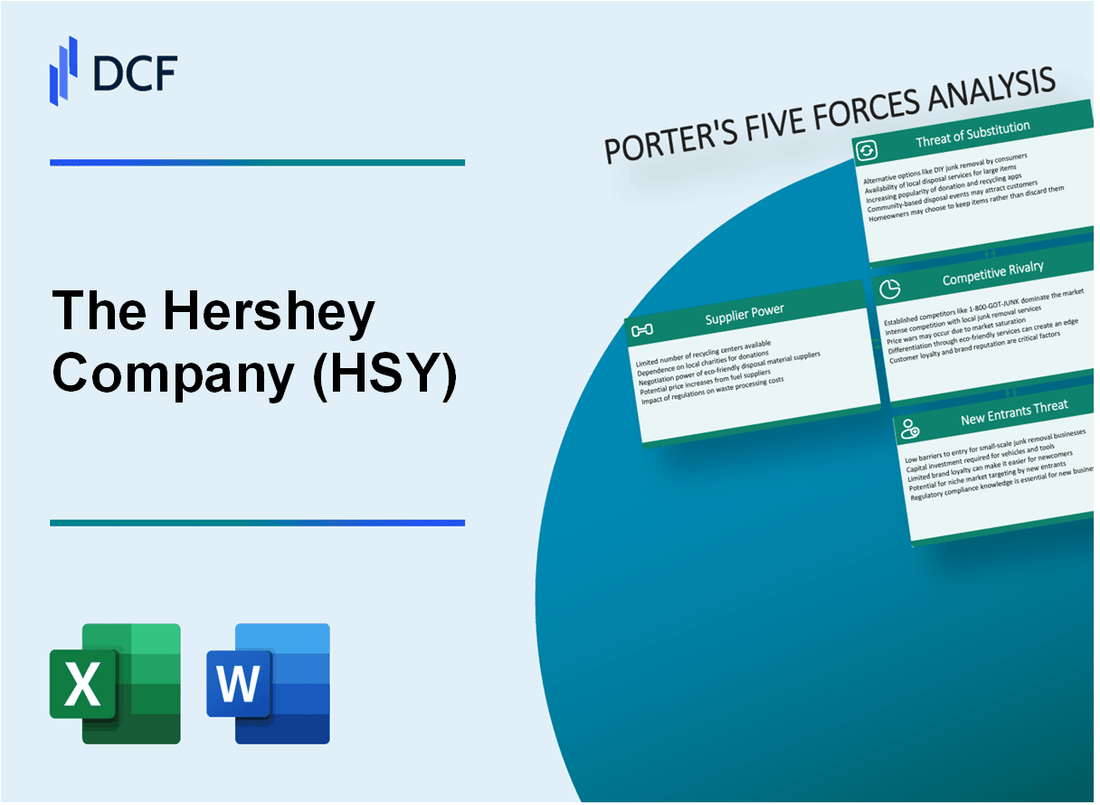
You're looking for a clear, unvarnished view of The Hershey Company's competitive moat as we hit late 2025, and honestly, the landscape is definitely high-stakes. After a tough H1 where commodity shocks-like the extreme cocoa price volatility-eroded gross margins by 970 basis points in Q2, the pressure isn't letting up. We see major retailers flexing their muscle against The Hershey Company's 24% US market share, while healthier substitutes chip away at growth in a mature market projected to only grow at 2.76% through 2033. Before diving into the full five-force breakdown below, know this: navigating supplier concentration and customer price sensitivity while defending against rivals like Mars and Ferrero is the defining challenge for The Hershey Company right now.
The Hershey Company (HSY) - Porter's Five Forces: Bargaining power of suppliers
You're looking at the raw material landscape for The Hershey Company, and honestly, the supplier power here is intense, driven almost entirely by cocoa.
Cocoa price volatility is extreme, with significant inflation expected in 2025. We saw spot prices hit a staggering peak of $10,750 per tonne in early 2025, which was fueled by a 478,000-tonne global deficit. While analysts project a stabilization around $6,000 per tonne by the 2025-2026 period, that is still historically elevated compared to prior years. This input cost pressure directly hit the bottom line; higher commodity and manufacturing costs drove a gross margin decrease of 970 basis points in Q2 2025, with the reported gross margin falling to 30.5% from 40.2% year-over-year.
Here's a quick look at how the commodity market has been swinging, showing why suppliers hold sway:
| Metric | Value/Date | Context |
| Peak Cocoa Price (Early 2025) | $10,750 USD/MT | Reflects extreme supply shock |
| Projected Stabilization Price (2025-2026) | $6,000 USD/MT | Analyst projection for cost normalization |
| Q2 2025 Reported Gross Margin | 30.5% | Impacted by commodity inflation |
| Côte d'Ivoire Farm-Gate Price (2025-2026) | 2,800 CFA francs/kg | A 56% increase from the prior season |
| Current Cocoa Price (Nov 27, 2025) | 5,068.38 USD/MT | Reflects recent market softening |
The supply concentration risk is a major factor in this power dynamic. Côte d'Ivoire and Ghana supply approximately 60% of global cocoa, creating high concentration risk. To capture more value, both nations have actively restricted supply; for instance, Côte d'Ivoire has sold less than 400,000 tons forward for the 2025-2026 season, a sharp drop from the 1.45 million tons sold at this time last year. Ghana followed suit, selling only about 100,000 tons against a usual 500,000 tons.
Switching costs are high for specialized ingredients like high-quality cocoa beans. You can't just swap out the core ingredient in a Reese's Peanut Butter Cup without fundamentally altering the product consumers expect. The Hershey Company acknowledges this, stating they are 'pretty precious about the brands and what they stand for with consumers,' even as they explore alternatives where possible. This commitment to core taste profiles means they must absorb much of the input cost volatility or pass it on via pricing, which has already led to a 970 basis points margin contraction in Q2 2025. To mitigate this long-term exposure, The Hershey Company has committed $500 million to its Cocoa For Good initiative to improve farmer yields and stabilize sourcing.
The leverage suppliers hold manifests in several ways:
- Extreme price spikes, like the $10,750 high in early 2025.
- Geographic concentration in West Africa, with producers actively limiting forward sales.
- The necessity of maintaining premium taste profiles, which limits substitution options.
- Significant farm-gate price hikes, such as the 56% increase in Côte d'Ivoire for the next season.
The Hershey Company (HSY) - Porter's Five Forces: Bargaining power of customers
You're looking at how much sway the end-buyer has over The Hershey Company's pricing and terms. Honestly, this force presents a dual reality for HSY, balancing the immense power of a few key buyers against the sheer volume of individual transactions.
The concentration among major retail partners is a significant factor. Mass merchandisers like Walmart and Target command substantial shelf space and volume, which translates directly into leverage for negotiating trade terms and discounts. For instance, Walmart's Q3 2025 global e-commerce sales grew 27% year-over-year, showing their massive scale in the modern retail environment. Target reported third-quarter 2025 net sales of $25.3 billion, underscoring the financial weight these buyers carry when discussing margins with The Hershey Company. Globally, hypermarkets/supermarkets accounted for a 47% revenue share in the confectionery market in 2024, solidifying their gatekeeper status. Here's a quick look at the scale of some of these key buyers and market segments:
| Metric | Value/Amount | Context/Source Year |
|---|---|---|
| North America Confectionery Net Price Realization (NPR) | 7% | Q3 2025 |
| North America Confectionery Volume Decline | Approx. 1% | Q3 2025 |
| Target Q3 2025 Net Sales | $25.3 billion | Q3 2025 |
| Private Label Chocolate Share (Regional Range) | 25% to 40% | General Range |
| Private Label Chocolate Annual Growth Rate | Approx. 4-6% | General Range |
Still, customer price sensitivity acts as a constant check on The Hershey Company's ability to pass on costs. You saw this dynamic play out in Q3 2025, where the North America Confectionery segment achieved a net price realization of approximately 7%, but this was partially offset by price elasticity, evidenced by a volume decline of approximately 1%. This shows that while The Hershey Company can raise prices, the end consumer pushes back, limiting the full benefit of those price increases.
The threat from private label alternatives is definitely growing, offering a lower-cost proposition directly to the consumer. This forces The Hershey Company to defend its premium positioning. In the chocolate candy category specifically, private label products have penetrated to almost 5% share in some analyses. Furthermore, major retailers are aggressively building their own value brands; for example, one retailer's plan involves driving more than $15 billion in sales growth by 2030 through expansion of its store brands in food and beverage categories.
On the other side of the coin, the sheer number of individual consumers dilutes the power of any single person. The Hershey Company's target market is broad, encompassing families, children, and adults. In 2024, younger demographics accounted for 45% of its target market, showing a wide base of potential purchasers. The US convenience confectionery market alone was valued at $17.1 billion in 2025, demonstrating the massive volume of individual transactions that make up the total sales base. This high volume of individual transactions means that, on a per-customer basis, bargaining power is minimal.
- The Hershey Company markets to grocery stores, mass merchandisers, and convenience stores.
- Chocolate Confectionery held a 52% value share in the US convenience market in 2025.
- The company's International segment saw net price realization of approximately 7% in Q3 2025.
- The global private label chocolate market is valued at approximately $15 billion USD annually.
The Hershey Company (HSY) - Porter's Five Forces: Competitive rivalry
You're analyzing the competitive landscape for The Hershey Company, and honestly, the rivalry force here is a heavyweight bout. It's not just about who has the best chocolate bar; it's about market maturity, global scale, and external shocks like commodity costs.
Rivalry is intense due to large, global players like Mars, Ferrero, and Mondelez International. These aren't small regional players; they operate on a massive scale, which means they can absorb short-term margin hits or aggressively price to gain share. The top two companies, The Hershey Company and Mars, Incorporated, together account for over 60% of the US market, showing a clear duopolistic dominance that still leaves intense competition for the remaining share and for category leadership.
The US confectionery market is mature, with a projected slow CAGR of 2.76% from 2025 to 2033, intensifying the fight for share. When growth is slow, every percentage point of market share gained by one player is often a direct loss for another. The US confectionery market was valued at over $83.54 billion in 2024.
The Hershey Company maintains a leading position with approximately 24% of the US confectionery market share. This leadership position means The Hershey Company is the primary target for rivals like Mars and Mondelez International, who are also major players in the US chocolate segment, which accounts for nearly 47% of the US confectionery market by value.
Competitors are increasing pricing pressure, particularly in international markets like Mexico and Brazil. This pressure is heavily influenced by external commodity and trade dynamics. For instance, there are reports of a potential 'Sugar War' where Brazil and Mexico-key sugar suppliers to the US-are considering cutting off exports, which analysts warn would cause US domestic sugar prices to skyrocket, directly impacting the production costs for The Hershey Company and Mars. Furthermore, trade policy risks, such as proposed 50% tariffs on Brazil, are noted as potential roadblocks for competitors like Ferrero, indicating a volatile international pricing environment that forces strategic reactions across the board. The surge in cocoa prices, which reached record highs above 10,000 US dollars per metric ton in 2024, is a universal cost pressure that forces all major players, including Mondelez and Ferrero, to adjust procurement and pricing structures.
The intensity of rivalry is further illustrated by the scale of the key competitors:
| Competitor | Reported Revenue/Scale Context (Latest Available) |
| Mondelez International, Inc. | Projected global net revenues of almost $36 billion in 2024. |
| Ferrero | Reported sales of $20.4 billion in the year through August 2024. |
| The Hershey Company (HSY) | Generated over $11.2 billion in annual revenues. |
| US Chocolate Market Value (2024) | US$ 35.25 billion. |
You need to watch how The Hershey Company manages input cost inflation against the slow market growth. Here's the quick math: a 2.76% market growth rate means any significant cost increase must be passed on, but competitors are ready to fight for every consumer dollar.
Key competitive dynamics include:
- Dominance by The Hershey Company and Mars, accounting for over 60% of the US market.
- Chocolate segment holds nearly 47% of US market value.
- International business growth is a key battleground, with Mexico showing double-digit volume growth for The Hershey Company in Q4 2024.
- High commodity costs, like cocoa prices surging in 2024, pressure margins for all players.
- Geopolitical trade risks involving Brazil and Mexico threaten raw material supply stability.
Finance: draft 13-week cash view by Friday.
The Hershey Company (HSY) - Porter's Five Forces: Threat of substitutes
The threat of substitutes remains a significant dynamic for The Hershey Company, as consumer preferences pivot toward options perceived as healthier or more functional. You see this pressure coming from several angles, not just direct candy competitors.
Consumer shift toward healthier alternatives like protein bars and organic snacks is a key threat. For instance, a February 2025 survey of 2,000 U.S. consumers showed 57% actively seek healthier snack options. This aligns with the broader trend where nearly 50% of US consumers preferred snacks with functional ingredients in 2024, fueling growth in high-protein innovations.
The functional confectionery segment itself represents an area where substitutes are evolving within the broader sweet treat category. While the prompt suggested a $3.1 billion valuation in 2024 with a 4.8% CAGR, verifiable global data shows a different scale. The global functional confectionery market was valued at USD 2.55 billion in 2024, with projections showing a CAGR of 9.10% from 2025 to 2032, indicating rapid growth in these alternative formats.
To counter the pull from the broader, faster-growing snack food market, The Hershey Company relies on its strategic acquisitions. The performance of these brands in early 2025 demonstrates their role in mitigating this substitution risk:
- SkinnyPop ready-to-eat popcorn takeaway increased 6.4% in the 12 weeks ending March 30, 2025.
- Dot's Homestyle Pretzels retail sales increased 20.7% for the same 12-week period.
- In the third quarter of 2025, volume growth across Dot's, SkinnyPop, and Pirate's Booty was approximately 11%.
- Dot's retail sales grew 7% year-over-year in Q3 2025, while SkinnyPop grew 7%.
It is important to map the relative growth rates between the overall snack market and The Hershey Company's core confectionery business to understand the pressure. Here's a quick look at the market context as of late 2025:
| Market Segment | 2025 Projected Growth Rate | 2024 Value (Global/US Context) |
| US Snack Food Market (Overall) | Around 2.18% CAGR (next five years) | $172.5 billion (US value in past year) |
| Confectionery Segment (Global) | 5.6% (Projected volume growth in 2025) | $17.93 billion (Chocolate revenue, Global 2025 est.) |
| Functional Confectionery (Global) | 9.10% CAGR (2025-2032) | USD 2.55 billion (Global value in 2024) |
Finally, the emergence of GLP-1 weight loss drugs presents a unique, though currently muted, substitution threat, particularly for chocolate, which is often consumed to satisfy cravings. The Hershey Company has publicly stated its observation on this front. The CEO cited seeing a mild year-on-year impact as a result of GLP-1 drugs following the Q3 2024 earnings call, suggesting the effect on overall category consumption is gradual and not yet material enough to drastically alter purchasing patterns across the entire consumer base.
The Hershey Company (HSY) - Porter's Five Forces: Threat of new entrants
You're looking at the barriers to entry in the confectionery space, and for The Hershey Company, those barriers are substantial, built up over decades of massive investment and brand building. Honestly, starting a new national chocolate competitor today would require a capital outlay that scares off most players right out of the gate.
High capital investment is required for manufacturing and establishing a national distribution network. The scale of The Hershey Company's recent commitment shows you the baseline cost. They recently opened a new 250,000-square-foot chocolate processing facility in Hershey, Pennsylvania, which was the first new one in over 30 years at their headquarters. This single project was part of a multi-year, $1 billion investment in their supply chain network. For the latest twelve months ending September 28, 2025, The Hershey Company reported capital expenditures of $451.1 million. For the full fiscal year 2025 projection, capital investments are expected to be approximately $425 million.
Here's a quick look at that recent capital deployment:
| Metric | Amount/Value | Period/Context |
|---|---|---|
| Latest Twelve Months CapEx (ending 9/28/2025) | $451.1 million | Trailing Twelve Months |
| Projected Full-Year 2025 Capital Investment | Approximately $425 million | Full-Year Outlook |
| Total Supply Chain Investment | $1 billion | Multi-year strategy culminating in new plant |
| New Facility Size | 250,000-square-foot | New Chocolate Processing Facility |
What this estimate hides is the cost of securing the necessary raw material supply contracts and the logistics infrastructure to service the entire country. That distribution network is already deeply entrenched, using indirect channels through wholesalers, retailers, mass merchandisers, chain drug stores, and vending channels.
Hershey's strong brand equity (Reese's, Kit Kat U.S.) creates significant consumer loyalty barriers. Brand strength translates directly into consumer pull, making it hard for a new product to even get noticed, let alone purchased consistently. In the 12 weeks ending September 28, 2025, consumption growth for the core Reese's franchise was up 7%, and the main Hershey brand was up 11%. The company markets its products under more than 80 brand names. This established loyalty means a new entrant must spend heavily just to achieve trial.
New entrants must compete for limited prime shelf space in consolidated retail channels. You know how grocery and convenience stores are-they don't have infinite room. The Hershey Company has established relationships across these channels, including chain grocery stores, mass merchandisers, chain drug stores, and convenience stores. Securing that prime eye-level shelf space requires leverage that only massive, consistent sales volume and established trade spending can provide.
Smaller, innovative brands are successfully entering niche markets like plant-based and functional confectionery. To be fair, this is where the threat is most acute, as The Hershey Company is actively investing in capacity to meet evolving trends. While the capital barrier is high for a full-scale competitor, smaller, agile players can target specific, high-margin segments, forcing The Hershey Company to respond with its own innovation or acquisitions, like the recent purchase of the Sour Strips brand.
The company exports its products in approximately 80 countries worldwide, showing a global distribution footprint that further complicates entry into any single market segment.
Finance: Review the Q4 2025 trade spend budget against the 2024 actuals to quantify shelf-space investment by Friday.
Disclaimer
All information, articles, and product details provided on this website are for general informational and educational purposes only. We do not claim any ownership over, nor do we intend to infringe upon, any trademarks, copyrights, logos, brand names, or other intellectual property mentioned or depicted on this site. Such intellectual property remains the property of its respective owners, and any references here are made solely for identification or informational purposes, without implying any affiliation, endorsement, or partnership.
We make no representations or warranties, express or implied, regarding the accuracy, completeness, or suitability of any content or products presented. Nothing on this website should be construed as legal, tax, investment, financial, medical, or other professional advice. In addition, no part of this site—including articles or product references—constitutes a solicitation, recommendation, endorsement, advertisement, or offer to buy or sell any securities, franchises, or other financial instruments, particularly in jurisdictions where such activity would be unlawful.
All content is of a general nature and may not address the specific circumstances of any individual or entity. It is not a substitute for professional advice or services. Any actions you take based on the information provided here are strictly at your own risk. You accept full responsibility for any decisions or outcomes arising from your use of this website and agree to release us from any liability in connection with your use of, or reliance upon, the content or products found herein.