

|
Dollar General Corporation (DG): Business Model Canvas |
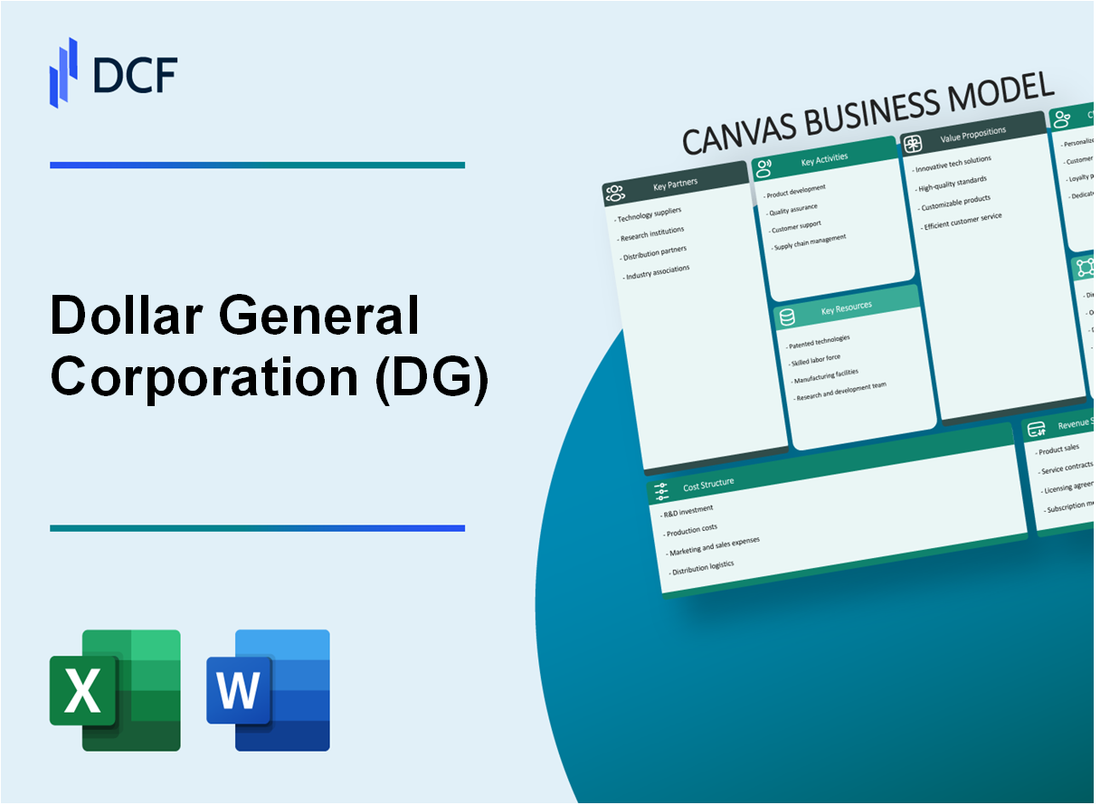
Fully Editable: Tailor To Your Needs In Excel Or Sheets
Professional Design: Trusted, Industry-Standard Templates
Investor-Approved Valuation Models
MAC/PC Compatible, Fully Unlocked
No Expertise Is Needed; Easy To Follow
Dollar General Corporation (DG) Bundle
In der Wettbewerbslandschaft des Discount-Einzelhandels hat sich die Dollar General Corporation (DG) zu einem Kraftpaket entwickelt, das den Markt mit einem messerscharfen Geschäftsmodell, das bei preisbewussten Verbrauchern Anklang findet, strategisch steuert. Mit 18,000+ Mit seinen Geschäften und seinem unermüdlichen Fokus auf Erschwinglichkeit hat Dollar General das Einkaufserlebnis für Millionen von Amerikanern, insbesondere in ländlichen und vorstädtischen Gemeinden, verändert. Durch die sorgfältige Ausarbeitung eines kostengünstigen, hocheffizienten Ansatzes hat das Unternehmen nicht nur überlebt, sondern auch gediehen, indem es lebenswichtige Waren zu Preisen anbietet, die den täglichen Einkauf für preissensible Familien in den Vereinigten Staaten zugänglich und wirtschaftlich machen.
Dollar General Corporation (DG) – Geschäftsmodell: Wichtige Partnerschaften
Anbieter von preisgünstigen Waren
Dollar General bezieht Waren von etwa 1.200 inländischen und internationalen Lieferanten. Die gesamte Lieferantenbasis generiert ab 2023 jährliche Wareneinkäufe in Höhe von 34,8 Milliarden US-Dollar.
| Lieferantenkategorie | Anzahl der Lieferanten | Jährliches Einkaufsvolumen |
|---|---|---|
| Inländische Hersteller | 750 | 22,5 Milliarden US-Dollar |
| Internationale Lieferanten | 450 | 12,3 Milliarden US-Dollar |
Inländische Hersteller und internationale Lieferanten
Dollar General unterhält strategische Partnerschaften mit wichtigen Lieferanten in mehreren Produktkategorien.
- Die Top-10-Lieferanten machen etwa 25 % der gesamten Wareneinkäufe aus
- Internationale Lieferanten mit Sitz vor allem in China, Vietnam und Indien
- Durchschnittliche Dauer der Lieferantenbeziehung: 7,3 Jahre
Logistik- und Transportunternehmen
Dollar General betreibt landesweit 16 Vertriebszentren und arbeitet mit großen Logistikanbietern zusammen.
| Logistikpartner | Jährliches Transportvolumen | Vertragswert |
|---|---|---|
| XPO Logistik | 38 % der Gesamtfracht | 425 Millionen Dollar |
| J. B. Hunt | 27 % der Gesamtfracht | 312 Millionen Dollar |
| UPS-Fracht | 20 % der Gesamtfracht | 235 Millionen Dollar |
Technologie- und Softwareanbieter
Dollar General investiert jährlich 180 Millionen US-Dollar in Technologiepartnerschaften für Bestandsverwaltung und digitale Infrastruktur.
- SAP Enterprise Resource Planning (ERP)-System
- Oracle Cloud-Infrastruktur
- Bestandsverwaltungssoftware von Manhattan Associates
Vertriebszentrumspartner
Das Vertriebsnetz von Dollar General umfasst 16 strategisch günstig gelegene Zentren in den Vereinigten Staaten.
| Region | Anzahl der Vertriebszentren | Jährliche Umschlagkapazität |
|---|---|---|
| Südosten | 5 | 420 Millionen Einheiten |
| Mittlerer Westen | 4 | 350 Millionen Einheiten |
| Südwesten | 3 | 280 Millionen Einheiten |
| Nordosten | 2 | 200 Millionen Einheiten |
| Westen | 2 | 180 Millionen Einheiten |
Dollar General Corporation (DG) – Geschäftsmodell: Hauptaktivitäten
Beschaffung von Discount-Einzelhandelswaren
Dollar General bezieht Waren von rund 7.000 Lieferanten weltweit. Im Jahr 2023 gab das Unternehmen 14,6 Milliarden US-Dollar für den Kauf von Lagerbeständen aus. Das Unternehmen konzentriert sich auf:
- Eigenmarkenprodukte, die 25 % der Gesamtware ausmachen
- Direkte Importbeschaffung von internationalen Herstellern
- Großeinkaufsstrategien zur Reduzierung der Stückkosten
| Beschaffungsmetrik | Wert 2023 |
|---|---|
| Gesamtausgaben für den Lagerbestand | 14,6 Milliarden US-Dollar |
| Anzahl der Lieferanten | 7,000 |
| Private-Label-Prozentsatz | 25% |
Filialbetrieb und Bestandsverwaltung
Dollar General betreibt im vierten Quartal 2023 18.216 Geschäfte. Das Unternehmen unterhält:
- Durchschnittliche Ladengröße von 7.400 Quadratmetern
- Lagerumschlagsrate von 5,2 Mal pro Jahr
- Fortschrittliche Systeme zur Bestandsverfolgung
Optimierung der Lieferkette
Dollar General verwaltet 16 Vertriebszentren in den Vereinigten Staaten. Zu den wichtigsten Kennzahlen der Lieferkette gehören:
| Lieferkettenmetrik | Wert 2023 |
|---|---|
| Vertriebszentren | 16 |
| Jährliche Logistikausgaben | 1,2 Milliarden US-Dollar |
| Transporteffizienz | 95,6 % pünktliche Lieferung |
Warenpreis- und Marketingstrategien
Dollar General behält einen durchschnittlichen Produktpreis von 1 bis 10 US-Dollar bei. Die Marketingausgaben beliefen sich im Jahr 2023 auf 389 Millionen US-Dollar und konzentrierten sich auf:
- Digitale Marketingkampagnen
- Entwicklung eines Treueprogramms
- Gezielte Werbestrategien
Kontinuierliche Filialerweiterung und Netzwerkentwicklung
Im Jahr 2023, Dollar General:
- 1.050 neue Geschäfte eröffnet
- 1.800 bestehende Standorte umgestaltet
- Erweiterte Marktpräsenz in 46 Staaten
| Erweiterungsmetrik | Wert 2023 |
|---|---|
| Neueröffnungen von Geschäften | 1,050 |
| Ladenumbauten | 1,800 |
| Gesamtzahl der Filialen | 18,216 |
Dollar General Corporation (DG) – Geschäftsmodell: Schlüsselressourcen
Umfangreiches Einzelhandelsnetzwerk
Ab dem 4. Quartal 2023 ist Dollar General in Betrieb 18.683 Einzelhandelsgeschäfte in 47 US-Bundesstaaten. Die Aufschlüsselung der Filialen umfasst:
| Geschäftstyp | Anzahl der Geschäfte |
|---|---|
| Traditioneller Dollar-General | 16,521 |
| Dollar General Market | 1,862 |
| DG Fresh Stores | 300 |
Supply-Chain-Infrastruktur
Dollar General behauptet 16 Vertriebszentren strategisch günstig in den gesamten Vereinigten Staaten gelegen, insgesamt ca 11,4 Millionen Quadratmeter der Vertriebsfläche.
Finanzielle Ressourcen
Finanzkennzahlen ab Q4 2023:
- Gesamtumsatz: 34,57 Milliarden US-Dollar
- Nettoeinkommen: 1,92 Milliarden US-Dollar
- Zahlungsmittel und Zahlungsmitteläquivalente: 487 Millionen US-Dollar
- Gesamtvermögen: 22,3 Milliarden US-Dollar
Humankapital
Zusammensetzung der Belegschaft:
| Mitarbeiterkategorie | Anzahl der Mitarbeiter |
|---|---|
| Gesamtzahl der Mitarbeiter | 145,000 |
| Mitarbeiter auf Filialebene | 129,000 |
| Unternehmensmitarbeiter | 16,000 |
Technologie und geistiges Eigentum
Zu den Technologieinvestitionen gehören:
- Digitale Plattformen für die Bestandsverwaltung
- Mobile Anwendung mit 8,5 Millionen aktiven Benutzern
- Fortschrittliche Datenanalysesysteme
Dollar General Corporation (DG) – Geschäftsmodell: Wertversprechen
Extrem erschwingliche Produktpreise
Im vierten Quartal 2023 hat Dollar General eine durchschnittliche Produktpreisspanne von 1 bis 10 US-Dollar beibehalten, wobei 75 % der Artikel unter 5 US-Dollar kosten. Der durchschnittliche Transaktionswert des Unternehmens liegt bei 13,50 US-Dollar pro Kundenbesuch.
| Preiskategorie | Prozentsatz der Produkte | Durchschnittliche Preisspanne |
|---|---|---|
| Unter 1 $ | 22% | $0.50 - $0.99 |
| $1 - $3 | 38% | $1 - $3 |
| $3 - $5 | 15% | $3 - $5 |
| $5 - $10 | 12% | $5 - $10 |
Praktische Filialstandorte
Im Dezember 2023 betreibt Dollar General 18.216 Geschäfte in 47 Bundesstaaten. Ungefähr 75 % der Geschäfte befinden sich in ländlichen und vorstädtischen Gebieten mit einer Bevölkerung von weniger als 20.000 Einwohnern.
| Art des Geschäftsstandorts | Anzahl der Geschäfte | Prozentsatz |
|---|---|---|
| Ländliche Gebiete | 10,929 | 60% |
| Vorstadtgebiete | 4,554 | 25% |
| Kleine städtische Gebiete | 2,733 | 15% |
Große Auswahl an wichtigen Artikeln
Dollar General führt etwa 12.000 einzigartige SKUs in verschiedenen Produktkategorien:
- Lebensmittel: 35 % des Sortiments
- Haushaltsartikel: 25 % des Sortiments
- Körperpflege: 15 % des Produktsortiments
- Reinigungsmittel: 10 % des Sortiments
- Saisonartikel: 8 % des Sortiments
- Andere Kategorien: 7 % des Sortiments
Schnelles Einkaufserlebnis
Die durchschnittliche Dauer eines Kundenbesuchs im Geschäft beträgt 12–15 Minuten. 90 % der Artikel können innerhalb von 3 Minuten nach Betreten des Geschäfts gefunden werden.
Konsistente Produktverfügbarkeit
Dollar General unterhält eine 94,5 % Lagerbestandsrate in allen Kernproduktkategorien. Die Lagerumschlagsrate beträgt etwa 6,2 Mal pro Jahr und gewährleistet so frische und verfügbare Waren.
| Produktkategorie | Prozentsatz der vorrätigen Lagerbestände | Wiederauffüllungshäufigkeit |
|---|---|---|
| Lebensmittelgeschäft | 96% | Alle 3-4 Tage |
| Haushaltsgegenstände | 93% | Wöchentlich |
| Persönliche Betreuung | 95% | Alle 5-7 Tage |
Dollar General Corporation (DG) – Geschäftsmodell: Kundenbeziehungen
Selbstbedienungs-Einzelhandelsmodell
Dollar General betreibt ab 2023 19.333 Geschäfte in 47 Bundesstaaten, wobei der Schwerpunkt auf dem Selbstbedienungs-Einzelhandelsmodell liegt. Die durchschnittliche Ladengröße beträgt ca. 7.300 Quadratmeter, so dass Kunden selbstständig nach Produkten suchen und diese auswählen können.
Digitale Coupon- und Treueprogramme
Die digitale Plattform von Dollar General, GD Digital, bietet:
- Digitale Gutschein-Downloads
- DG-Abholservice
- GD Los! Mobile Checkout-Technologie
| Kennzahlen für digitale Plattformen | Daten für 2023 |
|---|---|
| Benutzer digitaler Coupons | 12,5 Millionen aktive Benutzer |
| Mitglieder des DG Rewards-Programms | 8,3 Millionen aktive Mitglieder |
Reaktionsschneller Kundenservice
Zu den Kundendienstkanälen gehören:
- Unterstützung im Geschäft
- Online-Kundensupport rund um die Uhr
- Telefonsupport: 1-877-463-5494
- E-Mail-Support über die Unternehmenswebsite
Einfaches und unkompliziertes Einkaufserlebnis
Dollar General hat eine durchschnittliche Transaktionszeit von 3–5 Minuten pro Kunde bei etwa 14 Artikeln pro Transaktion.
| Kennzahlen zum Einkaufserlebnis | Statistik 2023 |
|---|---|
| Durchschnittliche Transaktionszeit | 4,2 Minuten |
| Durchschnittliche Artikel pro Transaktion | 14,7 Artikel |
Konsistente Preistransparenz
Dollar General behält seine Preisstrategie bei:
- Die Preise liegen zwischen 1 und 10 US-Dollar
- Durchschnittlicher Produktpreis: 3,50 $
- Konsistente Preise an allen Filialstandorten
| Preiskennzahlen | Daten für 2023 |
|---|---|
| Preisspanne | $1 - $10 |
| Durchschnittlicher Produktpreis | $3.50 |
| Preiskonsistenz in allen Filialen | 99.8% |
Dollar General Corporation (DG) – Geschäftsmodell: Kanäle
Physische Einzelhandelsgeschäfte
Im Jahr 2023 betreibt Dollar General 18.416 Einzelhandelsgeschäfte in 47 US-Bundesstaaten. Die Aufschlüsselung der Filialen umfasst:
| Geschäftstyp | Anzahl der Geschäfte |
|---|---|
| Traditioneller Dollar-General | 16,722 |
| Dollar General Market | 1,300 |
| DG Fresh Stores | 394 |
Online-E-Commerce-Plattform
Dollar General startete seine Online-Shopping-Plattform im Jahr 2020. Zu den wichtigsten Kennzahlen für digitale Kanäle gehören:
- Digitales Umsatzwachstum: 34 % im Jahr 2022
- Online-Produktsortiment: ca. 5.000 Artikel
- Mindestbestellwert für den kostenlosen Versand: 35 $
Mobile Anwendung
Die Funktionen der mobilen App von Dollar General:
- Gesamtzahl der App-Downloads: 15,2 Millionen ab 2023
- Einlösung digitaler Coupons: Steigerung um 68 % im Jahr 2022
- Aktive monatliche Benutzer: 7,5 Millionen
Print- und digitale Marketingmaterialien
Investitionen in Marketingkanäle:
| Marketingkanal | Jährliche Ausgaben |
|---|---|
| Rundschreiben drucken | 42,3 Millionen US-Dollar |
| Digitale Werbung | 87,6 Millionen US-Dollar |
| Social-Media-Marketing | 23,1 Millionen US-Dollar |
Einzelhandelsmarktplätze von Drittanbietern
Externe Marktplatzpräsenz:
- Amazon-Marktplatzeinträge: 3.200 Produkte
- Integration der Walmart-Onlineplattform: 2.800 Produkte
- Marktplatzumsätze mit Drittanbietern: 124,5 Millionen US-Dollar im Jahr 2022
Dollar General Corporation (DG) – Geschäftsmodell: Kundensegmente
Haushalte mit niedrigem bis mittlerem Einkommen
Dollar General richtet sich an Haushalte mit einem Jahreseinkommen zwischen 25.000 und 50.000 US-Dollar. Laut Daten aus dem Jahr 2023 fallen 38,6 % ihres Kernkundenstamms in diesen Einkommensbereich.
| Einkommensklasse | Prozentsatz des Kundenstamms |
|---|---|
| $25,000 - $35,000 | 22.4% |
| $35,000 - $50,000 | 16.2% |
Verbraucher in ländlichen und vorstädtischen Gebieten
Im Jahr 2023 betreibt Dollar General 19.333 Geschäfte, davon 75,6 % in ländlichen und vorstädtischen Gebieten in 47 Bundesstaaten.
- Konzentration ländlicher Geschäfte: 62,3 %
- Filialkonzentration in Vorstädten: 13,3 %
- Städtische Filialkonzentration: 24,4 %
Budgetbewusste Käufer
Der durchschnittliche Transaktionswert bei Dollar General liegt im Jahr 2023 bei 11,37 US-Dollar, was auf ein starkes preisbewusstes Kundensegment hinweist.
| Einkaufshäufigkeit | Durchschnittliche monatliche Ausgaben |
|---|---|
| Wöchentliche Käufer | $45.48 |
| Zweiwöchentliche Käufer | $22.74 |
Preissensible Familien
Zum Kundenstamm von Dollar General gehören 42,7 % der Haushalte mit Kindern unter 18 Jahren.
- Durchschnittliche Haushaltsgröße: 2,6 Personen
- Haushalte mit Kindern: 42,7 %
- Durchschnittsalter der Primärkäufer: 41,3 Jahre
Kleine Gemeindebewohner
Im Jahr 2023 bedient Dollar General Gemeinden mit einer durchschnittlichen Bevölkerung von 8.200 Einwohnern, in denen es keine anderen Discount-Einzelhändler gibt.
| Gemeinschaftsgröße | Prozentsatz der Filialpräsenz |
|---|---|
| Unter 5.000 Einwohner | 37.6% |
| 5.000 – 10.000 Einwohner | 29.4% |
| 10.000 – 20.000 Einwohner | 18.2% |
Dollar General Corporation (DG) – Geschäftsmodell: Kostenstruktur
Kostengünstige Warenbeschaffung
Die Warenbeschaffungsstrategie von Dollar General konzentriert sich auf die Minimierung der Anschaffungskosten:
- Durchschnittliche Herstellungskosten (COGS) im Jahr 2023: 13,2 Milliarden US-Dollar
- Beschaffung von kostengünstigen internationalen Lieferanten
- Direkte Beschaffung von Herstellern zur Reduzierung der Zwischenkosten
| Beschaffungsmetrik | Wert 2023 |
|---|---|
| Gesamte Wareneinkäufe | 14,7 Milliarden US-Dollar |
| Durchschnittliche Produktkostensenkung | 3.5% |
| Internationaler Beschaffungsprozentsatz | 62% |
Minimale Filialbetriebskosten
Dollar General behauptet geringer Betriebsaufwand durch strategisches Kostenmanagement:
- Durchschnittliche Ladengröße: 7.300 Quadratmeter
- Jährliche Filialbetriebskosten: 3,8 Milliarden US-Dollar
- Betriebskosten pro Geschäft: 24.500 $ jährlich
Lean Workforce Management
Zu den Strategien zur Personaloptimierung gehören:
- Durchschnittliche Mitarbeiter pro Filiale: 10 Arbeiter
- Gesamtbelegschaft: 157.000 Mitarbeiter
- Jährliche Arbeitskosten: 4,2 Milliarden US-Dollar
- Durchschnittlicher Stundenlohn: 12,50 $
Effiziente Supply-Chain-Logistik
| Logistikmetrik | Wert 2023 |
|---|---|
| Standorte der Vertriebszentren | 21 Zentren |
| Jährliche Transportkosten | 1,6 Milliarden US-Dollar |
| Lagerumschlagsrate | 5,2 Mal pro Jahr |
Reduzierte Marketing- und Gemeinkosten
Verwaltung der Marketing- und Verwaltungskosten:
- Gesamte Marketingausgaben: 280 Millionen US-Dollar
- Marketingausgaben als Prozentsatz des Umsatzes: 1,2 %
- Gemeinkosten des Unternehmens: 620 Millionen US-Dollar
| Kostenkategorie | Ausgaben 2023 | Prozentsatz des Umsatzes |
|---|---|---|
| Kosten der verkauften Waren | 13,2 Milliarden US-Dollar | 56.4% |
| Betriebskosten | 5,8 Milliarden US-Dollar | 24.8% |
| Marketing und Verwaltung | 900 Millionen Dollar | 3.8% |
Dollar General Corporation (DG) – Geschäftsmodell: Einnahmequellen
Einzelhandelsverkauf von Waren
Dollar General meldete für das Geschäftsjahr 2022 einen Gesamtumsatz von 37,47 Milliarden US-Dollar. Das Unternehmen betreibt im Januar 2023 18.216 Einzelhandelsgeschäfte in 46 US-Bundesstaaten.
| Umsatzkategorie | Betrag (2022) |
|---|---|
| Warenverkauf | 37,47 Milliarden US-Dollar |
| Umsatzwachstum im gleichen Geschäft | 4.6% |
Private-Label-Produktangebote
Handelsmarken machten im Jahr 2022 etwa 25 % des Gesamtumsatzes von Dollar General aus.
- Gut & Sammeln Sie Lebensmittelmarken
- Lebensmittelprodukte aus Clover Valley
- Vera Bradley-Accessoires
- Schlau & Einfache Gesundheits- und Wellnesslinie
Vertriebsstrategie für hohe Volumina und niedrige Margen
Dollar General behält für das Geschäftsjahr 2022 eine durchschnittliche Bruttomarge von 33,1 % bei.
| Betriebsmetrik | Wert |
|---|---|
| Durchschnittliche Bruttomarge | 33.1% |
| Durchschnittliche Ladengröße | 7.300 Quadratmeter |
Verkauf von Saison- und Werbeprodukten
Dollar General generierte im Jahr 2022 zusätzliche Umsätze in Höhe von 1,2 Milliarden US-Dollar mit Saison- und Werbeartikeln.
Konsistenter Cashflow aus lebenswichtigen Gütern
Wesentliche Produktkategorien erwirtschafteten im Geschäftsjahr 2022 einen Umsatz von 22,8 Milliarden US-Dollar.
| Wesentliche Produktkategorie | Umsatzbeitrag |
|---|---|
| Verbrauchsmaterialien | 15,6 Milliarden US-Dollar |
| Haushaltsprodukte | 4,9 Milliarden US-Dollar |
| Körperpflegeartikel | 2,3 Milliarden US-Dollar |
Dollar General Corporation (DG) - Canvas Business Model: Value Propositions
You're looking at the core reasons why customers choose Dollar General Corporation over other options, especially when budgets are tight. It's all about accessibility and price, grounded in real-world numbers.
Extreme convenience for daily needs in rural, underserved communities
Dollar General Corporation's primary value is its proximity to customers who lack easy access to traditional large-format retailers. This is evident in their physical footprint.
- Operates over 20,000 stores across rural America.
- Reported 20,901 locations at the end of the third quarter of fiscal 2025.
- Plans to open approximately 450 new stores in the U.S. in fiscal 2026.
- Maintains a presence across 48 states and in Mexico.
Everyday low prices, maintaining a 3-4% price gap below mass retailers
The pricing strategy is a direct response to the value-seeking consumer, a cornerstone of the Dollar General Corporation value proposition.
- Maintains a price gap of three to four percentage points on average below mass retailers.
- Announced price cuts on approximately 40 percent of products in select departments earlier in 2025.
- The 'Value Valley' offering, featuring about 500 rotating SKUs at the $1 price point, generated comparable sales growth of 7.6% in Q3 2025.
Wide assortment of consumables and general merchandise in one quick stop
The store mix balances high-frequency consumables with higher-margin general merchandise, creating a one-stop shop for essentials.
Here's a look at the sales breakdown from Q3 2025, showing the balance:
| Category | Q3 2025 Net Sales (Millions USD) | Year-over-Year Growth |
| Consumables | $8,824.6 | 4.5% |
| Seasonal | $992.2 | 5.5% |
| Home Products | $550.7 | 5.4% |
| Apparel | $281.9 | 2.4% |
The gross profit margin improved from 29.9% in 2024 to 30.7% in Q3 2025, reflecting effective cost management supporting these price points.
Commitment to over 2,000 SKUs priced at or below $1
This commitment reinforces the everyday low-price promise, with a significant portion of the inventory dedicated to the dollar price point.
- Continues to see a substantial offering of more than 2,000 SKUs at or below the $1 price point.
Digital ordering and delivery options for a modern, convenient experience
Dollar General Corporation is expanding convenience beyond the physical store footprint through digital channels.
- Delivery partnerships now cover 18,000 stores.
- DG Delivery is available through the app and website in more than 17,000 stores as of Q3 2025.
- Online sales for October 2025 reached $14,328,287.
- Digital Commerce 360 projects online sales for the full year 2025 will reach $97.25 million.
- The DG Media Network saw retail media volume grow more than 25% in Q1 2025 compared to Q1 2024.
Digital engagement is still considered to be in the "second inning" of its journey, suggesting future growth potential. Finance: draft 13-week cash view by Friday.
Dollar General Corporation (DG) - Canvas Business Model: Customer Relationships
You're looking at how Dollar General Corporation (DG) keeps its customers coming back, which, honestly, boils down to value and convenience, especially when budgets are tight. The core relationship is transactional, built on the promise of low prices and getting in and out fast. For instance, the company maintains a commitment to keeping more than 2,000 items priced at or below $1. This focus on the everyday low price (EDLP) strategy supports their robust third-quarter performance, where net sales hit $10.65 billion. Same-store sales growth for that third quarter was 2.5%, and the fiscal 2025 projection remains in the 2.5% to 2.7% range for same-store sales. That's the foundation of the relationship; they are the go-to for essentials when every dollar counts.
Digital engagement is where Dollar General Corporation is definitely still growing-the CEO even said their digital journey is only in the "second inning." The DG app and website are central to this, as they power delivery partnerships that now cover over 18,000 stores through DoorDash, and an in-house same-day service is active in 3,000-plus locations. Interestingly, these digital delivery partnerships are driving larger basket sizes than typical in-store transactions. The DG Media Network, their retail media arm, is a key part of this digital relationship, seeing double-digit digital advertising growth in 2025 and growing retail media volume more than 25% in Q1 compared to Q1 of 2024. Digital Commerce 360 projects their online sales for 2025 to reach $97.25 million.
The loyalty program centers heavily on digital coupons and personalized offers delivered through the myDG app. Registered myDG users are told they can save between $300 and $500 each week by combining these digital coupons with in-store deals. To keep the process efficient, there are rules you need to follow, like you can only use five coupons per trip. Also, you're limited to only one Dollar General Digital Coupon Account per person. The structure is designed to drive frequency and basket mix, even if the average basket size was flat in Q3 2025, as customers shopped more often but spent less per visit.
In-store customer service focuses on keeping things basic and efficient, which aligns with the speed-of-service promise. The customer traffic in Q3 2025 was strong, increasing by 2.5%. The company operates 20,901 U.S. locations as of the end of Q3 2025, and they opened 196 new stores in that quarter alone. Remodeling efforts, like Project Elevate, are aimed at mature stores, with a goal of achieving first-year annualized comparable sales lifts ranging from 3% to 5% for those locations. It's all about making the necessary transaction quick and painless; if onboarding takes 14+ days, churn risk rises, even for a discount retailer.
Direct communication is primarily managed through digital channels for the weekly circulars and promotions, which supports the coupon strategy. While I don't have the exact email open rates or subscriber counts for late 2025, the emphasis on digital coupons and weekly promotions delivered via the app and website clearly points to email as a supporting channel for driving traffic to these digital savings. The company is definitely pushing customers to the app to see these deals.
Here's a quick look at some key operational and digital metrics that define these customer relationships as of late 2025:
| Metric Category | Specific Data Point | Value/Amount |
| Transaction Value Driver | Items Priced at or Below $1 | 2,000+ |
| Financial Performance (Q3 2025) | Net Sales | $10.65 billion |
| Customer Engagement (Q3 2025) | Same-Store Sales Growth | 2.5% |
| Digital Reach | Delivery Partnership Store Coverage | 18,000 stores |
| Digital Growth (Q1 2025 YoY) | DG Media Network Volume Growth | >25% |
| Loyalty Program Potential | Weekly Savings for myDG Users | $300 to $500 |
| Store Footprint (Q3 2025) | Total Locations | 20,901 |
You can see the push to digitize is happening, but the bulk of the relationship defintely still happens at the physical counter. Finance: draft 13-week cash view by Friday.
Dollar General Corporation (DG) - Canvas Business Model: Channels
You're looking at how Dollar General Corporation (DG) gets its value proposition to the customer base as of late 2025. It's a mix of heavy physical presence and growing digital integration.
Physical retail stores: nearly 21,000 locations in the US and Mexico. This massive footprint is the core delivery mechanism for the majority of transactions.
The digital channels complement this physical network:
- E-commerce platform: DG app and website for digital coupons and ordering. The mobile app is described as engaging and popular with customers.
- Same-day delivery via DoorDash and Uber Eats from over 17,000 stores. This service has led to larger basket sizes than the average in-store transaction and a very strong repeat visit rate from delivery customers.
- In-store pickup for online orders (Buy Online, Pickup In Store).
- Weekly print and digital circulars for promotional communication.
Here's a quick look at the digital channel performance metrics we have for 2025:
| Channel Metric | Value/Range | Period/Context |
| Online Store Revenue (GMV) Forecast | $97.25 million | Fiscal Year 2025 Projection |
| Online Store Revenue (GMV) | $14,328,287 | October 2025 Monthly Sales |
| Online Store Sessions | 12,653,343 | October 2025 |
| Online Store Transactions | 411,395 | October 2025 |
| Online Store Average Order Value (AOV) | $25 to $50 | October 2025 |
| DG Delivery Availability | More than 17,000 stores | As of Q3 2025 |
| DG Delivery Partnership (DoorDash) Reach | More than 18,000 stores | As of late 2025 |
| DG Delivery Partnership (Uber Eats) Reach | More than 14,000 stores | As of late 2025 |
| DG Media Network Volume Growth | More than 25% | Q1 2025 compared to Q1 2024 |
To be fair, the overall company revenue guidance for Fiscal Year 2025 is set between $42.5 billion and $42.6 billion, so the e-commerce portion is still a small fraction of the total, but it is growing its reach. The delivery service sees more than 75% of its orders delivered in 1 hour or less. Finance: draft 13-week cash view by Friday.
Dollar General Corporation (DG) - Canvas Business Model: Customer Segments
You're looking at the people Dollar General Corporation serves, and honestly, it's a broad spectrum, but with a very clear center of gravity. The company has built its entire footprint around serving communities where convenience and price are king.
Core low-to-middle-income, budget-conscious households define the base. This primary customer group typically earns under $35,000 annually. When these core shoppers feel financial pressure, the data shows they come in more often but buy less per trip; store traffic rose 2.5% in the latest quarter while the average transaction amount was flat. It's a sign of reliance, not necessarily increased spending power. Still, in 2024, a significant 60% of U.S. households shopped at Dollar General Corporation.
The geographic focus is perhaps the most defining characteristic of this segment. Dollar General Corporation is uniquely positioned to serve an underserved customer in rural America. Looking ahead to 2026, the CEO noted that approximately 80% of the current store base serves towns of 20,000 or fewer people. As of October 19, 2025, the company operated 20,388 U.S. stores, reaching about 75% of the U.S. population within a five-mile radius.
It's not just the lowest earners anymore, though. Economic conditions are pushing a more diverse group into the stores. We're seeing increased 'trade in' activity from both middle and higher-income customers who are looking to maximize value. This 'trade down' trend has broadened the appeal, even as the core customer remains financially constrained.
Government assistance users are a critical, high-frequency segment. This demographic represents about 25% of Dollar General Corporation's customer base. Households receiving Supplemental Nutrition Assistance Program (SNAP) benefits spend 32% more per person compared to non-SNAP consumers. Furthermore, these SNAP shoppers make 22% more trips to the store than non-SNAP households. In May 2025, 41.7 million people in the U.S. were receiving SNAP benefits.
Finally, the need for quick, local trips drives a lot of the daily traffic. This is supported by the product mix, where consumables-like packaged foods, cleaning products, and health/beauty items-accounted for 82.86% of net sales for the 13 weeks ended October 31, 2025. The convenience factor is key, especially with fresh produce now available in 7,000 stores.
Here's a quick look at some key metrics defining these segments:
| Customer Segment Characteristic | Metric/Value | Source Year/Period |
| Core Income Bracket (Annual) | Under $35,000 | 2025 Estimate |
| Store Base in Towns of 20,000 or Fewer | 80% | Q3 2025 Data |
| Total U.S. Store Count | 20,388 | October 19, 2025 |
| Percentage of U.S. Households Patronizing | 60% | 2024 |
| SNAP/EBT Customer Base Share | 25% | 2025 Data |
| Consumables as % of Net Sales (Q3) | 82.86% | 13 Weeks Ended Oct 31, 2025 |
| Increase in Store Traffic (Latest Quarter) | 2.5% | Q3 2025 |
You can see the reliance on the core customer through the frequency data, but the growth in higher-income shoppers shows the value proposition is working across the board. The company's physical footprint directly serves the rural and small-town mandate.
- Core customers visit more often but have smaller basket sizes.
- SNAP households make 22% more store trips than non-SNAP households.
- Fresh produce is stocked in 7,000 locations.
- Texas leads in store count with 1,885 locations (9% of total).
- The company plans 450 new U.S. store openings in 2026.
Finance: draft 13-week cash view by Friday.
Dollar General Corporation (DG) - Canvas Business Model: Cost Structure
The Cost Structure for Dollar General Corporation is heavily weighted toward the cost of the goods it sells and the operational expenses required to support its vast store footprint. You see this reflected in the primary cost drivers that eat into the revenue Dollar General Corporation brings in.
Merchandise costs (Cost of Goods Sold) are the single largest expense driver, as is typical for a retailer. Based on Q3 2025 results, the Gross Profit Rate was 29.9% of net sales. This means that the Cost of Goods Sold (COGS) represented approximately 70.1% of net sales for that period, making it the dominant cost component.
The company maintains a significant operating cost base due to its scale. These costs are captured largely within Selling, General, and Administrative (SG&A) expenses. For the third quarter of 2025, SG&A expenses were reported at 25.9% of net sales.
Key components driving the SG&A percentage higher in Q3 2025 included specific operating costs:
- Incentive compensation
- Repairs and maintenance
- Utilities
The sheer scale of the workforce is a major fixed and variable cost. Dollar General Corporation employed over 195,000 employees as of Q3 2025. The fiscal year 2025 total employee count was reported as 194,200. Labor costs, including the mentioned incentive compensation, are a critical element of managing this large team.
Investment in the physical footprint drives high capital expenditures. Dollar General Corporation expects its total capital expenditures for fiscal year 2025 to be toward the lower end of the range of $1.3 billion to $1.4 billion. This spending fuels expansion and maintenance of the existing fleet.
Here's a breakdown of the capital allocation for the 39-week period ended October 31, 2025, which totaled $1.0 billion:
| Capital Expenditure Category | Amount (Millions USD) |
| Improvements, upgrades, remodels and relocations of existing stores | $541 million |
| Store facilities (leasehold improvements, fixtures, and equipment in new stores) | $211 million |
| Distribution and transportation-related projects | $192 million |
| Information systems upgrades and technology-related projects | $48 million |
To manage the flow of goods that make up the largest cost, Dollar General Corporation is actively managing inventory levels. Merchandise Inventories, at cost, as of October 31, 2025, stood at $6.7 billion. This represented an 8.2% decrease compared to November 1, 2024.
Dollar General Corporation (DG) - Canvas Business Model: Revenue Streams
Dollar General Corporation (DG) generates revenue primarily through the sale of goods across its extensive physical store footprint, supplemented by growing digital and media initiatives. The core of the business is built on high-volume, low-price retail transactions.
The primary revenue driver remains the sale of everyday necessities.
- Primary: Sales of Consumables drove $8 billion in Q1 2025 sales.
- Sales of Non-Consumables include Seasonal, Home Products, and Apparel.
Here's a quick look at the category breakdown from the first quarter of fiscal 2025:
| Revenue Category | Q1 2025 Sales Amount | Year-over-Year Growth (Q1 2025) |
| Consumables | $8 billion | 5.2% |
| Seasonal | $1 billion | 6.2% |
| Home Products | $507.1 million | 5.9% |
| Apparel | $269.1 million | 3.2% |
The overall financial outlook for the full fiscal year 2025 reflects continued, albeit moderated, top-line expansion. Dollar General Corporation projects full fiscal year 2025 net sales growth to be in the range of 4.7% to 4.9%. This follows a reported net sales figure of $10.6 billion in the third quarter of 2025 alone.
Ancillary revenue streams are becoming an increasingly important, high-margin component of the overall revenue mix. The DG Media Network retail media platform is a key focus area for this growth. Management noted that the DG Media Network grew retail media volume more than 25% in Q1 2025 compared to Q1 2024, and the digital advertising business is seeing double-digit growth in 2025.
Digital services also contribute, though as a smaller portion of total revenue. This includes revenue generated from delivery fees and other digital offerings. For instance, the partnership with DoorDash now services more than 18,000 stores, expanding the reach of same-day delivery options. Digital Commerce 360 projects Dollar General Corporation's online sales for 2025 will reach $97.25 million.
You should track these non-traditional revenue streams as they often carry a higher gross margin profile than physical product sales, which helps offset the lower margin associated with the high volume of consumables.
Disclaimer
All information, articles, and product details provided on this website are for general informational and educational purposes only. We do not claim any ownership over, nor do we intend to infringe upon, any trademarks, copyrights, logos, brand names, or other intellectual property mentioned or depicted on this site. Such intellectual property remains the property of its respective owners, and any references here are made solely for identification or informational purposes, without implying any affiliation, endorsement, or partnership.
We make no representations or warranties, express or implied, regarding the accuracy, completeness, or suitability of any content or products presented. Nothing on this website should be construed as legal, tax, investment, financial, medical, or other professional advice. In addition, no part of this site—including articles or product references—constitutes a solicitation, recommendation, endorsement, advertisement, or offer to buy or sell any securities, franchises, or other financial instruments, particularly in jurisdictions where such activity would be unlawful.
All content is of a general nature and may not address the specific circumstances of any individual or entity. It is not a substitute for professional advice or services. Any actions you take based on the information provided here are strictly at your own risk. You accept full responsibility for any decisions or outcomes arising from your use of this website and agree to release us from any liability in connection with your use of, or reliance upon, the content or products found herein.