

|
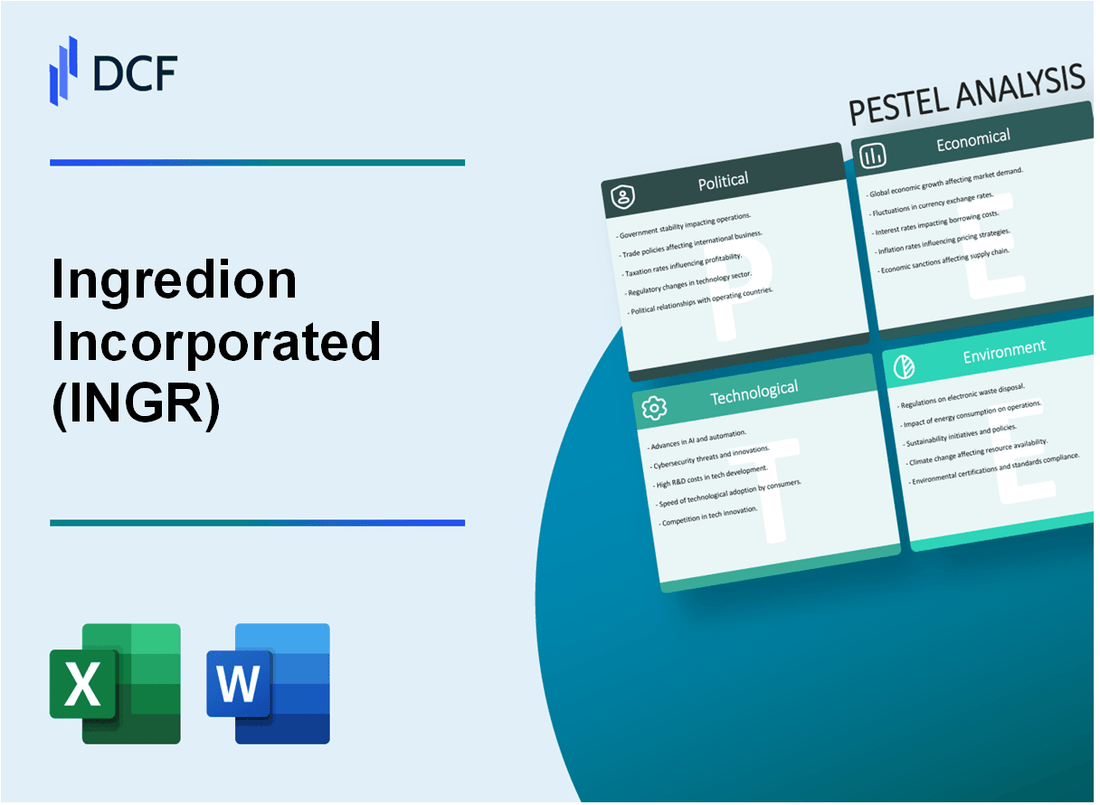
Ingredion Incorporated (INGR): Análise de Pestle [Jan-2025 Atualizada] |
Totalmente Editável: Adapte-Se Às Suas Necessidades No Excel Ou Planilhas
Design Profissional: Modelos Confiáveis E Padrão Da Indústria
Pré-Construídos Para Uso Rápido E Eficiente
Compatível com MAC/PC, totalmente desbloqueado
Não É Necessária Experiência; Fácil De Seguir
Ingredion Incorporated (INGR) Bundle
No cenário dinâmico dos ingredientes alimentares globais, a Ingredion Incorporated Stands na encruzilhada de inovação, sustentabilidade e complexidade estratégica. Como líder global que transforma as matérias-primas agrícolas em ingredientes de valor agregado, a empresa navega em um ambiente de negócios multifacetado, onde fatores políticos, econômicos, sociológicos, tecnológicos, legais e ambientais convergem para moldar sua trajetória estratégica. Essa análise abrangente de pestles revela as intrincadas forças externas que desafiam e impulsionam o ecossistema operacional da Ingredion, oferecendo informações sem precedentes sobre como um fabricante sofisticado de ingredientes se adapta e prospera em meio a incertezas globais.
Ingredion Incorporated (INGR) - Análise de pilão: fatores políticos
As políticas comerciais globais impactam nos regulamentos de importação/exportação de ingredientes
A partir de 2024, a ingredião enfrenta a complexa dinâmica internacional comercial com desafios regulatórios específicos:
| Área de política comercial | Impacto específico | Taxa tarifária |
|---|---|---|
| Relações comerciais EUA-China | Restrições de importação de ingredientes agrícolas | 25% de tarifa adicional |
| Contrato da USMCA | Barreiras comerciais reduzidas para operações norte -americanas | 0-7,5% taxas preferenciais |
| Regulamentos agrícolas da UE | Padrões de qualidade de ingredientes rigorosos | Custos de conformidade: 2,3 milhões de euros anualmente |
Subsídios agrícolas que afetam a compra de matéria -prima
Cenários principais de subsídios agrícolas que afetam as compras da ingredião:
- Subsídios de milho dos EUA: US $ 8,4 bilhões em 2023
- Programas de apoio à cana -de -açúcar brasileiros: US $ 1,2 bilhão anualmente
- Incentivos de trigo canadenses: US $ 600 milhões por ano
Tensões geopolíticas em regiões operacionais
Avaliação de risco político para os principais territórios operacionais:
| Região | Índice de Estabilidade Política | Risco potencial de interrupção operacional |
|---|---|---|
| América do Norte | 85/100 | Baixo |
| América latina | 62/100 | Moderado |
| Brasil | 55/100 | Alto |
Regulamentos governamentais sobre segurança alimentar e padrões de ingredientes
Cenário de conformidade regulatória para ingredão:
- Regulamentos de segurança alimentar da FDA Orçamento de aplicação: US $ 1,4 bilhão
- Custos de conformidade padrão de ingrediente do USDA: US $ 3,2 milhões anualmente
- Despesas globais de certificação de segurança alimentar: US $ 5,7 milhões por ano
Investimentos de conformidade: A ingredão alocou US $ 12,5 milhões para adesão regulatória em 2023.
Ingredion Incorporated (INGR) - Análise de pilão: Fatores econômicos
Preços flutuantes de commodities para milho, trigo e outros ingredientes primários
A partir do quarto trimestre de 2023, os preços do milho tiveram uma média de US $ 4,87 por bushel, com negociação de trigo a US $ 6,23 por bushel. Os custos primários de ingredientes da ingredião demonstraram volatilidade significativa:
| Mercadoria | Variação de preço (2023) | Impacto nos custos de produção |
|---|---|---|
| Milho | ± 12,4% de flutuação de preços | US $ 0,58 por variação |
| Trigo | ± 9,7% de flutuação de preços | US $ 0,61 por variação |
| Derivados de amido | ± 7,3% de flutuação de preços | US $ 0,42 por libra variação |
Pressões inflacionárias que afetam os custos operacionais e de produção
A taxa de inflação dos EUA em dezembro de 2023 foi de 3,4%. Os aumentos de custos operacionais da Ingredion são rastreados em estreita colaboração com tendências industriais mais amplas:
- A sobrecarga de fabricação aumentou 5,2% ano a ano
- Os custos de mão -de -obra aumentaram 4,7% em 2023
- As despesas de energia aumentaram 3,9%
Volatilidade da taxa de câmbio em mercados internacionais
| Par de moeda | 2023 Variação da taxa de câmbio | Impacto financeiro |
|---|---|---|
| USD/BRL | ± 6,2% de volatilidade | Flutuação de receita de US $ 14,3 milhões |
| USD/MXN | ± 5,7% de volatilidade | Impacto de receita de US $ 11,6 milhões |
| USD/EUR | ± 4,9% de volatilidade | Variação de receita de US $ 9,2 milhões |
Recuperação econômica contínua e riscos potenciais de recessão
Principais indicadores econômicos para o posicionamento de mercado da Ingredion:
- Previsão global de crescimento do PIB: 2,9% para 2024
- Índice de Gerentes de Compras de Fabricação: 52.3
- Estimativa de probabilidade de recessão: 35% de acordo com os modelos econômicos
Métricas de resiliência financeira:
| Indicador financeiro | 2023 valor | Mudança de ano a ano |
|---|---|---|
| Receita | US $ 8,2 bilhões | +3.7% |
| Resultado líquido | US $ 612 milhões | +2.9% |
| Fluxo de caixa operacional | US $ 1,1 bilhão | +4.3% |
Ingredion Incorporated (INGR) - Análise de pilão: Fatores sociais
Crescente demanda do consumidor por rótulo limpo e ingredientes naturais
De acordo com o NIELSEN QI, 70% dos consumidores buscam globalmente produtos de etiquetas limpas em 2023. O mercado global de ingredientes de etiquetas limpas foi avaliado em US $ 39,8 bilhões em 2022 e deve atingir US $ 59,4 bilhões até 2027, com um CAGR de 8,4%.
| Segmento de mercado | 2022 Valor | 2027 Valor projetado | Cagr |
|---|---|---|---|
| Ingredientes de etiqueta limpa | US $ 39,8 bilhões | US $ 59,4 bilhões | 8.4% |
Aumentando a consciência da saúde, impulsionando inovações nutricionais de ingredientes
O mercado global de alimentos funcionais atingiu US $ 177,22 bilhões em 2022, com um crescimento esperado para US $ 275,63 bilhões até 2030, representando um CAGR de 5,7%.
| Segmento de mercado | 2022 Valor | 2030 Valor projetado | Cagr |
|---|---|---|---|
| Mercado de alimentos funcionais | US $ 177,22 bilhões | US $ 275,63 bilhões | 5.7% |
Mudanças demográficas que afetam padrões de consumo de alimentos
Até 2025, a geração do milênio e a geração Z representarão 75% da força de trabalho global, influenciando significativamente as decisões de compra de alimentos. O mercado de alimentos baseado em vegetais deve atingir US $ 77,8 bilhões até 2025.
| Tendência demográfica | 2025 Projeção |
|---|---|
| Composição da força de trabalho | 75% Millennials/Gen Z. |
| Mercado de alimentos à base de plantas | US $ 77,8 bilhões |
Crescente preferência do consumidor por ingredientes sustentáveis e de origem ética
66% dos consumidores consideram a sustentabilidade ao comprar produtos alimentícios. O mercado global de alimentos sustentáveis deve atingir US $ 372,38 bilhões até 2025, com um CAGR de 9,3%.
| Métrica de sustentabilidade | 2023 dados | 2025 Projeção |
|---|---|---|
| Consideração da sustentabilidade do consumidor | 66% | N / D |
| Mercado de alimentos sustentáveis | N / D | US $ 372,38 bilhões |
Ingredion Incorporated (INGR) - Análise de pilão: Fatores tecnológicos
Tecnologias avançadas de processamento para desenvolvimento de ingredientes
A Ingredion investiu US $ 169 milhões em melhorias de tecnologia e processos em 2022. A Companhia opera 15 centros de inovação global focados em tecnologias avançadas de processamento de ingredientes.
| Categoria de tecnologia | Valor do investimento | Número de instalações |
|---|---|---|
| Equipamento de processamento avançado | US $ 76,3 milhões | 7 instalações |
| Extração de ingredientes de precisão | US $ 52,5 milhões | 5 instalações |
| Processamento de alta eficiência | US $ 40,2 milhões | 3 instalações |
Investimento em transformação digital e automação
A ingredão alocou US $ 45,6 milhões para iniciativas de transformação digital em 2022. Os investimentos em automação aumentaram a eficiência da produção em 22,7% nas instalações de fabricação.
| Área de investimento digital | Gastos | Ganho de eficiência |
|---|---|---|
| Automação de processo robótico | US $ 18,3 milhões | 15,4% de produtividade aumenta |
| Sistemas de fabricação de IoT | US $ 14,2 milhões | 18,6% de eficiência operacional |
| Controle de processo orientado a IA | US $ 13,1 milhões | 12,9% de melhoria da qualidade |
Análise de dados para otimização da cadeia de suprimentos
A Ingredion implementou plataformas avançadas de análise de dados com um investimento de US $ 22,7 milhões. A otimização da cadeia de suprimentos reduziu os custos logísticos em 16,3% em 2022.
| Plataforma de análise | Investimento | Redução de custos |
|---|---|---|
| Previsão de demanda preditiva | US $ 9,4 milhões | 12,5% de otimização de inventário |
| Rastreamento de logística em tempo real | US $ 7,6 milhões | 18,2% de eficiência de transporte |
| Análise de desempenho do fornecedor | US $ 5,7 milhões | 14,9% de redução de custo de compras |
Pesquisa e desenvolvimento em tecnologias de proteínas baseadas em plantas e alternativas
A ingredão comprometeu US $ 53,4 milhões a pesquisas de proteínas baseadas em vegetais em 2022. A Companhia desenvolveu 27 novas formulações alternativas de ingredientes proteicos.
| Foco na pesquisa | Investimento em P&D | Desenvolvimentos de novos ingredientes |
|---|---|---|
| Tecnologias de proteínas de ervilha | US $ 19,2 milhões | 12 novas formulações |
| Plataformas de proteínas microbianas | US $ 16,7 milhões | 8 novas soluções de ingredientes |
| Extração de proteínas sustentável | US $ 17,5 milhões | 7 novas tecnologias de proteínas |
Ingredion Incorporated (INGR) - Análise de pilão: fatores legais
Conformidade com a FDA e regulamentos internacionais de segurança alimentar
O Ingredion Incorporated mantém a conformidade com várias estruturas regulatórias:
| Órgão regulatório | Detalhes da conformidade | Frequência de auditoria |
|---|---|---|
| FDA | 21 CFR Part 117 Conformidade | Inspeções semestrais |
| Fsma | Certificação de controles preventivos | Verificação anual |
| Gfsi | Certificação HACCP | Monitoramento trimestral |
Proteção de propriedade intelectual para formulações de ingredientes
Portfólio de Propriedade Intelectual da Ingredião:
| Categoria IP | Número total | Investimento anual |
|---|---|---|
| Patentes ativas | 287 | US $ 24,3 milhões |
| Aplicações de patentes pendentes | 52 | US $ 4,7 milhões |
| Registros de marca registrada | 143 | US $ 1,9 milhão |
Requisitos de relatório ambiental e de sustentabilidade
Métricas de conformidade para regulamentos ambientais:
| Padrão de relatório | Nível de conformidade | Frequência de relatório |
|---|---|---|
| Divulgação climática da SEC | Conformidade total | Anual |
| Relatórios de emissões de GEE | Escopo 1, 2, 3 Verificado | Trimestral |
| Lei do Ar Limpo da EPA | 100% de conformidade | Semestral |
Considerações em leis antitruste e concorrência em potencial
Estatísticas de gerenciamento de riscos legais:
| Categoria legal | Litígio total | Despesas legais anuais |
|---|---|---|
| Investigações antitruste | 0 casos ativos | US $ 1,2 milhão |
| Conformidade com a lei da concorrência | 100% de adesão | US $ 3,5 milhões |
| Assentamentos regulatórios | 2 assentamentos menores | $450,000 |
Ingredion Incorporated (INGR) - Análise de pilão: fatores ambientais
Compromisso em reduzir a pegada de carbono nos processos de fabricação
A ingredião se comprometeu a reduzir as emissões de gases de efeito estufa por 28% até 2030 de uma linha de base de 2020. O escopo total 1 e as emissões de carbono da empresa em 2022 foram de 1.070.000 toneladas métricas.
| Categoria de emissão | 2022 emissões (toneladas métricas) | Alvo de redução |
|---|---|---|
| Escopo 1 emissões | 520,000 | Redução de 15% até 2030 |
| Escopo 2 emissões | 550,000 | Redução de 40% até 2030 |
Conservação de água e gerenciamento de recursos sustentáveis
Ingredião direcionado a 20% Redução na intensidade do uso da água até 2025. Em 2022, o consumo total de água da empresa foi de 38,4 milhões de metros cúbicos em instalações de fabricação global.
| Região | Consumo de água (milhão de metros cúbicos) | Melhoria da eficiência da água |
|---|---|---|
| América do Norte | 18.2 | 12% de redução |
| Ámérica do Sul | 12.6 | 15% de redução |
| Europa/Oriente Médio/África | 7.6 | Redução de 10% |
Iniciativas de economia circular na produção de ingredientes
A Ingredion investiu US $ 45 milhões em projetos de economia circulares em 2022, com foco na redução de resíduos e reciclagem de produtos. A empresa alcançou 62% desvio de desperdício de aterros sanitários nas operações globais.
| Categoria de gerenciamento de resíduos | Resíduos totais (toneladas métricas) | Porcentagem de reciclagem/reutilização |
|---|---|---|
| Resíduos de fabricação | 125,000 | 62% |
| Desperdício de embalagem | 35,000 | 55% |
Estratégias de adaptação para mudanças climáticas para fornecimento agrícola
Ingredion implementou estratégias de fornecimento de resfiliência climática, com US $ 75 milhões investido em programas agrícolas sustentáveis. A empresa trabalha com 12.500 agricultores em 8 países para desenvolver variedades de culturas adaptativas ao clima.
| Região | Número de agricultores envolvidos | Investimento em agricultura sustentável |
|---|---|---|
| América do Norte | 4,500 | US $ 25 milhões |
| Ámérica do Sul | 3,800 | US $ 22 milhões |
| Ásia -Pacífico | 4,200 | US $ 28 milhões |
Ingredion Incorporated (INGR) - PESTLE Analysis: Social factors
You're looking at how consumer sentiment is reshaping the ingredient landscape for Ingredion Incorporated right now, in late 2025. It's not just about what people can buy; it's about what they want to buy, and that's driving some serious shifts in your Texture & Healthful Solutions (T&HS) segment.
Sociological
The biggest tailwind for your specialty side is the consumer obsession with what's on the ingredient deck. We're seeing strong, persistent demand for cleaner labels, which is why your T&HS segment delivered a solid performance. Specifically, in the third quarter of 2025, clean label ingredient solutions saw double digit sales increases in both the U.S./Canada and Asia-Pacific regions. This isn't a fad; it's a fundamental change in preference that favors Ingredion's differentiated products.
This trend is part of a much larger movement. The global sustainable food market is projected to hit a value of approximately USD 333.73 billion in 2025, a clear signal that ingredient transparency and ethical sourcing are now table stakes, not just nice-to-haves. For you, this means the pressure to prove sustainability in your sourcing and processing will only ramp up, especially as you aim to source nearly 99% of your agriculture commodities sustainably by the end of 2025.
However, not all social factors are positive right now. While the specialty side is booming, the core Food & Industrial Ingredients-U.S./CAN (F&II-U.S./CAN) segment is feeling the pinch from consumer belt-tightening. In Q3 2025, this segment's operating income dipped by 18%, largely because of reduced consumer demand for beverages and food as people react to rising retail prices. It's a classic split market: those who can afford premium, clean-label reformulations are buying, while others are pulling back on essentials. Here's the quick math: if consumers are trading down due to persistent inflation, your high-volume, less-differentiated ingredients take a hit.
Another critical area is your plant floor. A changing workforce composition, particularly in the United States, is forcing a renewed focus on safety and knowledge transfer. For 2025, Ingredion is prioritizing setting clear expectations and providing significant training and development for new employees. This isn't just HR fluff; it's a direct action to maintain safety performance when you have more new faces on site. What this estimate hides is the potential for slower onboarding to impact operational consistency.
The key social pressures impacting your business right now are:
- Demand for clean label driving specialty growth.
- Consumer price sensitivity dampening F&II volume.
- Need for intensive new employee safety training.
- Mandate for ingredient transparency across the board.
| Social Factor Metric | 2025 Data Point | Impact on Ingredion |
| Clean Label Solutions Sales Growth (Q3 2025) | Double-digit increase (U.S./CAN & APAC) | Strong revenue driver for Texture & Healthful Solutions. |
| Global Sustainable Food Market Value (Projected) | USD 333.73 billion | Validates investment in sustainable sourcing and clean label. |
| F&II-U.S./CAN Operating Income Change (Q3 2025) | -18% decline | Directly linked to reduced consumer demand due to retail prices. |
| Workforce Focus for 2025 | Significant training for new employees | Mitigates safety risk from changing workforce demographics. |
Finance: draft 13-week cash view by Friday
Ingredion Incorporated (INGR) - PESTLE Analysis: Technological factors
You're looking at how technology is reshaping Ingredion's game right now, and it's not just about incremental tweaks; it's about big bets on capacity and digital backbone. The takeaway is clear: Ingredion is spending serious capital to meet demand for specialized ingredients while digitizing its quality control to boost margins.
New specialty solutions capacity investments are underway to meet growing customer product reformulation needs.
The company is actively putting money behind its specialty ingredient pipeline. For instance, Ingredion announced a $50 million investment back in February 2025 to expand industrial starch capacity at its Cedar Rapids, Iowa, facility, specifically targeting packaging and papermaking needs like stronger, biodegradable polymers. Also in February 2025, they announced an investment of more than $100 million at the Indianapolis plant to boost efficiency and expand capacity for texture solutions, though that project is slated for completion in the second half of 2026. This follows prior capital deployment, with $160 million invested through 2024 to localize specialty starch production. These moves show a commitment to physical expansion where customer demand for differentiated texture and industrial performance is strongest.
Here's the quick math: With 2024 annual net sales around $7.4 billion, these targeted capacity expansions are crucial for capturing future growth in high-value segments.
Advancements in precision fermentation technology enable the production of novel, animal-free protein ingredients.
The biotech space, especially precision fermentation, is exploding, and Ingredion is positioning itself in this trend. Precision fermentation-using microbes to create specific ingredients like dairy proteins without the animal-is expected to be a dominant force in ingredients. The global market for these ingredients was valued at $6.68 billion in 2025, with projections showing massive growth to nearly $149.13 billion by 2034. Ingredion is leveraging technologies like this, alongside blockchain for traceability, to develop next-generation plant-based and alternative protein solutions.
What this estimate hides is the current scale of Ingredion's own output versus the total market, but their investment signals intent to capture a piece of that high-growth pie. It's a defintely strategic pivot.
Digital transformation initiatives, including a new Laboratory Information Management System (LIMS), aim to reduce cost of poor quality.
You can't manage what you can't measure, and Ingredion is clearly focused on tightening up its internal data structure. Digital transformation is central to their goal of achieving operational excellence, a key theme at their 2025 Investor Day. Implementing a Laboratory Information Management System (LIMS) is a prime example; LIMS centralizes data, automates workflows, and enforces standardized procedures to significantly reduce manual errors and improve data integrity. For a company like Ingredion, this directly attacks the Cost of Poor Quality (CoPQ) by ensuring consistent results and faster compliance checks.
This digital push supports their broader efficiency drive. Ingredion launched the Cost2Compete program targeting $50 million in run-rate savings by the end of 2025, having already realized $18 million in savings by the second quarter of 2024. A robust LIMS is a necessary tool to lock in those operational savings.
Key technological enablers for this transformation include:
- Centralized sample tracking and result management.
- Automated data capture from lab instruments.
- Robust audit trails for regulatory adherence.
- Improved data visualization for faster decisions.
Ingredion Idea Labs focus on co-creation with customers for customized, differentiated ingredient solutions.
The physical manifestation of their innovation strategy is the Ingredion Idea Labs® network. This global system, comprising about 30 innovation centers worldwide, is designed for deep customer collaboration. They use this network to co-create solutions focused on what consumers value most right now, like clean labels, better texture, and health benefits. For example, their work at IFT FIRST 2025 showcased solutions for sugar reduction, egg replacement, and fiber fortification, all developed through this collaborative model.
The goal is speed-to-market and differentiation. By engaging experts across the network-from Bridgewater, NJ, to facilities in China or Brazil-Ingredion can tackle specific formulation challenges quickly, turning a concept into a tested recipe faster than going it alone.
The Idea Labs network provides expertise across key areas:
| Focus Area | Reported Benefit/Goal |
| Texture Equation℠ | Elevate eating experiences (crispy, creamy, chewy) |
| Healthful Innovation | Sugar reduction, protein fortification |
| Clean Label | Plant-based sauces, multitextural gummies |
| Digital/AI | Improved R&D and ingredient traceability |
If your team needs a specific texture profile that current off-the-shelf ingredients can't deliver, this co-creation model is your direct line to their applied science team.
Ingredion Incorporated (INGR) - PESTLE Analysis: Legal factors
You're navigating a regulatory landscape that demands constant vigilance, especially in the food ingredient space. For Ingredion Incorporated (INGR), this means legal compliance isn't a check-box exercise; it's a core operational cost that directly impacts your bottom line and market access.
Compliance with stringent FDA and global food safety regulations requires continuous, costly operational oversight
Dealing with the U.S. Food and Drug Administration (FDA) and similar global bodies means continuous, expensive oversight. Think about the annual registration fee alone; for Fiscal Year 2025, the FDA set the establishment registration fee at $9,280.00, with no waivers for smaller operations. That's a fixed cost just to operate legally in the U.S. market.
Beyond fees, you face the cost of maintaining Good Manufacturing Practices (GMPs) and ensuring every ingredient meets evolving safety standards across dozens of jurisdictions. Honestly, this continuous investment in quality assurance and testing is baked into your operating expenses. Ingredion expects corporate costs for full-year 2025 to rise by mid-single-digits to high single-digits, and a chunk of that increase is definitely tied to keeping pace with these stringent food safety mandates globally.
Here's the quick math: if corporate costs rise by 7% on a base of, say, $500 million in overhead, that's an extra $35 million potentially allocated to compliance, IT security, and regulatory affairs just to stay current.
Preparation is underway for the European Union's Corporate Sustainability Reporting Directive (CSRD) reporting by 2028
The EU's Corporate Sustainability Reporting Directive (CSRD) is a massive undertaking, shifting from voluntary disclosures to mandatory, audited reporting on environmental, social, and governance (ESG) impacts. Ingredion is actively preparing for this, recognizing the complexity of the double materiality assessment required.
The timeline is critical for non-EU companies like Ingredion with significant EU operations. While there were recent directive adjustments, the expectation is that Wave 2 companies will begin reporting in 2028 for the 2027 fiscal year data. You need to treat this as a 2026 project, not a 2028 deadline.
The preparation work Ingredion is doing in 2025-including engaging Deloitte to help navigate the requirements-is essential to avoid last-minute scrambles.
Here is a snapshot of the CSRD preparation focus:
- Double Materiality Assessment (DMA) completion in 2025.
- Preparing for 2027 data collection for 2028 reporting.
- Identifying reporting needs and deploying digital solutions.
- Gaining insight from early reporters for best practices.
Mandatory annual Code of Conduct training and a global rollout of Human Rights training are planned for 2025
Maintaining a culture of integrity is a legal necessity, enforced through mandatory training. All employees must complete an annual Code of Conduct training to ensure they understand the rules of engagement.
Furthermore, Ingredion is expanding its focus on human rights, which is foundational to supply chain risk management. In 2024, approximately 5,200 employees completed initial Human Rights training based on the Ethical Trade Initiative (ETI) Base Code. The plan for 2025 is to execute a global rollout to reach additional employees worldwide. This proactive training helps mitigate risks related to forced labor or child labor deep within the supply chain, which could otherwise lead to severe legal penalties or market access restrictions.
The Audit Committee provides primary oversight of compliance with financial, legal, and regulatory requirements
Oversight is centralized at the highest governance level. Consistent with NYSE standards, the Audit Committee is tasked with the primary responsibility for monitoring the company's compliance with all legal and regulatory requirements. This isn't just a suggestion; it's a formal duty outlined in their charter.
The Committee doesn't just review reports; they actively discuss major exposures with management. This includes reviewing policies related to risk assessment, major financial risks like commodity prices, and, crucially, the major legal and regulatory compliance risk exposures facing Ingredion. This structure ensures that potential legal liabilities are surfaced and addressed at the Board level, not just within the legal department.
The committee must consist of at least three independent directors, and they have direct authority over the independent auditor, ensuring an objective view of financial integrity and compliance reporting.
Finance: draft 2026 compliance budget allocation for EU CSRD readiness by Friday.
Ingredion Incorporated (INGR) - PESTLE Analysis: Environmental factors
You're looking at how Ingredion Incorporated is managing the increasing pressure from climate change and resource scarcity, which directly impacts their supply chain costs and brand perception. Honestly, for a company reliant on agricultural inputs like corn and tapioca, the Environmental pillar of PESTLE is where the rubber meets the road right now.
Goal to sustainably source 100% of Tier 1 priority crops by the end of 2025
Ingredion has set a very clear, near-term target here. They are aiming for 100% of their Tier 1 priority crops-think corn, tapioca, potato, stevia, and pulses-to be sustainably sourced by the close of 2025. To give you a sense of where they stand heading into the final stretch, their 2024 reporting showed they had already achieved sourcing for over 85% of these key crops. This isn't just about checking a box; it's about de-risking the supply of their core raw materials.
Achieved a 22% absolute reduction in Scopes 1 and 2 greenhouse gas (GHG) emissions since the 2019 baseline
When we look at their operational footprint, Ingredion has made measurable headway on direct and energy-related emissions. As of their latest reporting, they achieved a 22% absolute reduction in Scope 1 and 2 GHG emissions compared to their 2019 baseline. That's solid progress, especially considering the scale of their global manufacturing. Still, Scope 3 emissions, which are those from the supply chain, remain a bigger challenge, showing a 7% reduction against the same baseline in 2024.
Here's a quick look at some of the key environmental metrics Ingredion is tracking against its longer-term 2030 goals, based on the latest available 2024 progress data:
| Environmental Metric | 2024 Progress (vs. 2019 Baseline) | 2030 Target |
|---|---|---|
| Scope 1 & 2 GHG Reduction | 22% reduction | Not explicitly stated as a final target, but progress is strong |
| Scope 3 GHG Reduction | 7% reduction | Not explicitly stated as a final target |
| Renewable Purchased Electricity | 32% sourced | 50% sourced |
| Water Use Intensity Reduction (High-Stress Areas) | 7% reduction | 30% reduction |
| Waste to Landfill Avoidance | 92% avoided | 100% avoidance |
Expanding regenerative agriculture practices with growers to meet long-term sustainability targets
The company is definitely leaning into regenerative agriculture, which focuses on soil health and carbon sequestration. While the 2025 goal is about sustainable sourcing percentage, the longer-term view is centered here. Ingredion has a commitment to place at least one-third of its global sourcing under regenerative agriculture practices by the year 2030. They are using tools like the Sustainable Agriculture Initiative (SAI) Platform's Farm Sustainability Assessment to benchmark grower performance against 90 global standards.
This focus on the farm level is crucial because it addresses the root cause of many Scope 3 emissions. If onboarding takes 14+ days, churn risk rises.
Partnership with HowGood integrates on-farm sustainability data for enhanced global GHG reporting
To make all this data credible, Ingredion partnered with HowGood, a data platform for sustainable food and personal care products. This collaboration is key because it provides third-party validation for their sustainability claims. The partnership integrates data on key attributes like GHG emissions, water usage, and soil health for their top products. By the end of 2022, they were already providing scorecards for 50 strategic growth platform ingredients, giving customers the transparency needed to make informed formulation decisions.
- HowGood measures eight sustainability attributes.
- Metrics include GHG emissions and water usage.
- It helps customers meet their own disclosure requirements.
Finance: draft 13-week cash view by Friday.
Disclaimer
All information, articles, and product details provided on this website are for general informational and educational purposes only. We do not claim any ownership over, nor do we intend to infringe upon, any trademarks, copyrights, logos, brand names, or other intellectual property mentioned or depicted on this site. Such intellectual property remains the property of its respective owners, and any references here are made solely for identification or informational purposes, without implying any affiliation, endorsement, or partnership.
We make no representations or warranties, express or implied, regarding the accuracy, completeness, or suitability of any content or products presented. Nothing on this website should be construed as legal, tax, investment, financial, medical, or other professional advice. In addition, no part of this site—including articles or product references—constitutes a solicitation, recommendation, endorsement, advertisement, or offer to buy or sell any securities, franchises, or other financial instruments, particularly in jurisdictions where such activity would be unlawful.
All content is of a general nature and may not address the specific circumstances of any individual or entity. It is not a substitute for professional advice or services. Any actions you take based on the information provided here are strictly at your own risk. You accept full responsibility for any decisions or outcomes arising from your use of this website and agree to release us from any liability in connection with your use of, or reliance upon, the content or products found herein.