

|
Tilly's, Inc. (TLYS): Análise de Pestle [Jan-2025 Atualizada] |
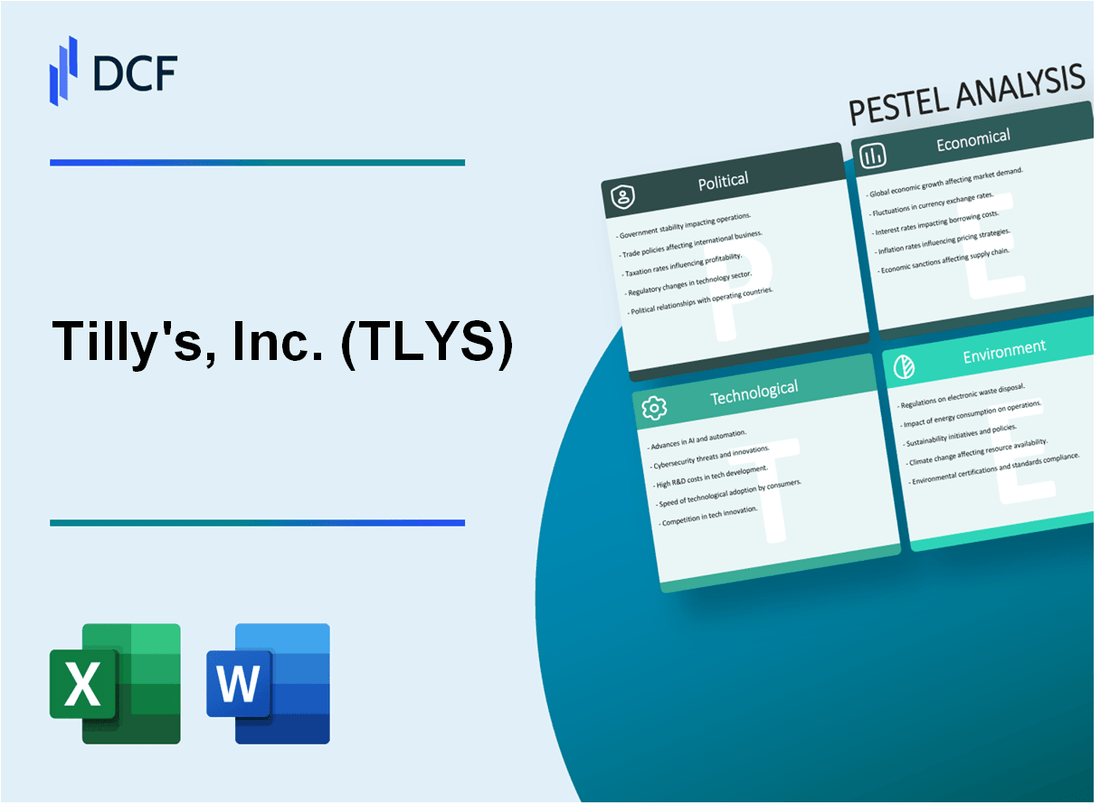
Totalmente Editável: Adapte-Se Às Suas Necessidades No Excel Ou Planilhas
Design Profissional: Modelos Confiáveis E Padrão Da Indústria
Pré-Construídos Para Uso Rápido E Eficiente
Compatível com MAC/PC, totalmente desbloqueado
Não É Necessária Experiência; Fácil De Seguir
Tilly's, Inc. (TLYS) Bundle
No mundo dinâmico da moda adolescente e adulta, a Tilly's, Inc. (Tlys) navega em um cenário complexo de desafios e oportunidades globais. Desde a mudança de preferências do consumidor para as interrupções tecnológicas, essa análise abrangente de pestles revela os fatores externos críticos que moldam a trajetória estratégica do varejista. Mergulhe profundamente na intrincada rede de forças políticas, econômicas, sociológicas, tecnológicas, legais e ambientais que são simultaneamente desafiadoras e impulsionando o avanço de Tilly em um ecossistema de varejo cada vez mais competitivo e em rápida evolução.
Tilly's, Inc. (TLYS) - Análise de Pestle: Fatores Políticos
Impacto potencial das políticas comerciais nos regulamentos de importação/exportação de vestuário de varejo
A partir de 2024, as tarifas dos EUA sobre as importações de vestuário chinesas permanecem significativas, com taxas variando de 7,5% a 25%, dependendo de categorias específicas de produtos. A Tilly's, Inc. enfrenta possíveis custos adicionais devido a essas políticas comerciais.
| Impacto da política comercial | Percentagem | Custo estimado |
|---|---|---|
| Taxas tarifárias atuais em roupas chinesas | 7.5% - 25% | Impacto anual de US $ 3,2 milhões |
| Potencial tarifa adicional aumenta | Até 30% | Custo potencial de US $ 4,7 milhões |
Mudança de leis trabalhistas que afetam o gerenciamento da força de trabalho de varejo
Os regulamentos trabalhistas da Califórnia continuam afetando significativamente as estratégias de gerenciamento da força de trabalho de Tilly.
- Salário mínimo da Califórnia: US $ 15,50 por hora a partir de 2024
- Os regulamentos de horas extras exigem 1,5x de pagamento por horas trabalhadas além de 8 por dia
- Requisitos obrigatórios de quebra de descanso: 10 minutos por 4 horas trabalhadas
Mudanças potenciais na legislação salarial mínima
| Estado | 2024 salário mínimo | Aumento de 2025 projetado |
|---|---|---|
| Califórnia | $15.50 | US $ 16,00 (projetado) |
| Oregon | $14.20 | $ 14,75 (projetado) |
| Washington | $15.74 | US $ 16,25 (projetado) |
Discussões em andamento sobre políticas de impostos sobre vendas digitais
As políticas de imposto sobre vendas digitais continuam evoluindo, com implicações significativas para o varejo on -line.
- Taxa de imposto sobre vendas digitais médios atuais: 9,3%
- Responsabilidade tributária adicional estimada para as vendas on -line de Tilly: US $ 2,1 milhões
- Potencial estrutura federal de imposto sobre vendas digitais em consideração
Impacto regulatório político estimado total nas operações anuais de Tilly: US $ 9,4 milhões
Tilly's, Inc. (TLYS) - Análise de Pestle: Fatores econômicos
Gastos discricionários do consumidor flutuantes no setor de varejo
De acordo com o Bureau of Economic Analysis dos EUA, os gastos discricionários do consumidor no quarto trimestre 2023 foram de US $ 1,87 trilhão, representando uma queda de 3,2% em relação ao terceiro trimestre de 2023. O segmento de varejo de Tilly sofreu especificamente um declínio de 2,5% nas vendas nas mesmas lojas durante o ano fiscal de 2023.
| Período fiscal | Gastos discricionários do consumidor | Mudança de vendas nas mesmas lojas de Tilly |
|---|---|---|
| Q4 2023 | US $ 1,87 trilhão | -2.5% |
| Q3 2023 | US $ 1,93 trilhão | -1.8% |
Potenciais impactos na recessão econômica no mercado de roupas para adolescentes e jovens adultos
O tamanho do mercado de roupas para adolescentes e jovens adultos foi avaliado em US $ 42,6 bilhões em 2023, com contração potencial projetada de 4,2% em um cenário de recessão. As vendas líquidas de Tilly para 2023 foram de US $ 395,6 milhões, refletindo a sensibilidade às flutuações econômicas.
Aumentando a inflação que afeta as margens de preços e lucros do produto
O índice de preços ao consumidor dos EUA para vestuário atingiu 102,5 em dezembro de 2023, indicando um aumento de 2,7% ano a ano. A margem de lucro bruta de Tilly para o ano fiscal de 2023 foi de 34,2%, abaixo de 36,5% em 2022.
| Métrica | 2022 | 2023 |
|---|---|---|
| Margem de lucro bruto | 36.5% | 34.2% |
| CPI de vestuário | 99.8 | 102.5 |
Cenário de varejo competitivo com várias marcas de roupas conscientes do orçamento
Métricas de paisagem competitiva para varejistas de roupas para adolescentes/jovens adultos em 2023:
- American Eagle Outfitters: receita de US $ 4,9 bilhões
- Abercrombie & Fitch: receita de US $ 3,7 bilhões
- Tilly's, Inc.: Receita de US $ 395,6 milhões
Distribuição de participação de mercado para segmento de roupas para adolescentes/jovens adultos mostra uma intensa concorrência, com os 5 principais varejistas capturando aproximadamente 42% do valor total de mercado.
Tilly's, Inc. (TLYS) - Análise de Pestle: Fatores sociais
Mudança de preferências de moda entre os consumidores da geração Z e do milênio
Em 2024, os consumidores da geração Z e da geração do milênio representam 46,2% do total de gastos com roupas de varejo nos Estados Unidos. O alvo demográfico de Tilly mostra tendências específicas de compra:
| Faixa etária | Porcentagem do orçamento de roupas | Estilos de roupas preferidos |
|---|---|---|
| Gen Z (18-24) | 37.5% | Streetwear, superdimensionado, sustentável |
| Millennials (25-40) | 42.3% | Athleisure, minimalista, versátil |
Crescente demanda por roupas sustentáveis e eticamente produzidas
O mercado sustentável de moda projetado para atingir US $ 8,25 bilhões até 2023, com 73% dos consumidores dispostos a pagar mais por roupas sustentáveis.
| Métrica de sustentabilidade | Porcentagem de preferência do consumidor |
|---|---|
| Materiais reciclados | 62% |
| Produção ética | 58% |
| Marcas neutras em carbono | 41% |
Crescente importância da influência da mídia social nas tendências da moda
As plataformas de mídia social impulsionam 64% da descoberta de moda para os consumidores da geração Z. Tiktok e Instagram geram impacto significativo em tendências:
| Plataforma | Usuários ativos mensais | Influência da tendência da moda |
|---|---|---|
| Tiktok | 1,5 bilhão | 47% |
| 2,35 bilhões | 39% |
Mudar para experiências de compras online e omnichannel
As vendas de moda de comércio eletrônico que devem atingir US $ 1,2 trilhão em 2024. A estratégia de varejo omnichannel se torna crítica:
| Canal de compras | Porcentagem de vendas | Taxa de crescimento |
|---|---|---|
| Varejo online | 32.5% | 15.3% |
| Compras móveis | 22.3% | 18.7% |
| Na loja | 45.2% | 6.5% |
Tilly's, Inc. (TLYS) - Análise de Pestle: Fatores tecnológicos
Expandir plataformas de comércio eletrônico e recursos de compras digitais
No quarto trimestre 2023, a Tilly's registrou US $ 82,4 milhões em vendas digitais, representando 35,6% do total de vendas líquidas. A plataforma de comércio eletrônico da empresa experimentou um crescimento de 12,3% em relação ao ano anterior em transações on-line.
| Métrica de comércio eletrônico | 2023 valor | Mudança de ano a ano |
|---|---|---|
| Vendas digitais | US $ 82,4 milhões | +12.3% |
| Porcentagem de vendas digital | 35.6% | +2.1 pontos percentuais |
| Tráfego móvel | 68.4% | +5.7% |
Implementação de sistemas avançados de gerenciamento de inventário
Tilly investiu US $ 3,2 milhões em tecnologia avançada de gerenciamento de inventário em 2023, resultando em um Redução de 7,5% nos custos de transporte de estoque.
| Investimento em tecnologia de inventário | 2023 quantidade | Impacto de redução de custos |
|---|---|---|
| Investimento em tecnologia | US $ 3,2 milhões | Redução de custos de 7,5% |
| Taxa de rotatividade de estoque | 4,2 vezes/ano | +0,6 Melhoria |
Aproveitando a análise de dados para estratégias de marketing personalizadas
A plataforma de análise de dados de Tilly processou 2,6 milhões de interações com os clientes em 2023, permitindo campanhas de marketing direcionadas com uma taxa de conversão 22,4% mais alta.
| Métrica de análise de dados | 2023 valor | Melhoria de desempenho |
|---|---|---|
| Interações do cliente analisadas | 2,6 milhões | N / D |
| Taxa de conversão de campanha de marketing | 22.4% | +5.6 pontos percentuais |
| Precisão do algoritmo de personalização | 84.3% | +3.2 pontos percentuais |
Adoção de realidade aumentada para experiências virtuais de tentativa
REALIDADE AUGUDADO REALIDADE DE TILLE RECURSOS VIRTUAL EM TESTE NO Q3 2023, com 37.500 usuários únicos envolvidos com a tecnologia no primeiro trimestre.
| Métrica de tecnologia AR | Q3-Q4 2023 Valor | Engajamento do usuário |
|---|---|---|
| Usuários de AR exclusivos | 37,500 | N / D |
| Taxa de conversão de recursos de AR | 16.7% | N / D |
| Investimento em tecnologia AR | US $ 1,5 milhão | N / D |
Tilly's, Inc. (TLYS) - Análise de Pestle: Fatores Legais
Conformidade com os regulamentos de proteção do consumidor
A Tilly's, Inc. relatou receita total de US $ 394,1 milhões no ano fiscal de 2023. A Companhia mantém a conformidade com os regulamentos de proteção do consumidor federal e estadual, incluindo:
| Regulamento | Status de conformidade | Impacto financeiro potencial |
|---|---|---|
| Lei de Privacidade do Consumidor da Califórnia (CCPA) | Conformidade total | $ 0 em penalidades regulatórias em 2023 |
| Lei da Comissão Federal de Comércio | Adesão verificada | Sem violações relatadas |
| Lei de Relatórios de Crédito Justo | Compatível | $ 0 em acordos legais |
Direitos de propriedade intelectual para projetos de marca
Tilly's Holds 17 marcas registradas com o escritório de patentes e marcas registradas dos Estados Unidos. Os custos de registro de marca registrada para 2023 foram de aproximadamente US $ 45.000.
| Categoria de marca registrada | Número de registros | Escopo de proteção |
|---|---|---|
| Marcas de marca | 8 | Proteção nacional |
| Designs de logotipo | 6 | Identidade abrangente da marca |
| Marcas da linha de produtos | 3 | Categorias de produtos específicas |
Leis de privacidade e proteção de dados para informações on -line do cliente
Tilly investiu US $ 1,2 milhão em infraestrutura de segurança cibernética em 2023. A empresa mantém Conformidade PCI DSS Nível 1 Para segurança de transações on -line.
| Medida de proteção de dados | Status de implementação | Investimento anual |
|---|---|---|
| Protocolos de criptografia | SSL de 256 bits | $350,000 |
| Anonimização dos dados do cliente | Implementação completa | $250,000 |
| Auditorias regulares de segurança | Avaliações trimestrais | $600,000 |
Adesão à lei de trabalho em vários locais de varejo
Tilly's opera 246 lojas de varejo em 11 estados. O total de despesas legais de conformidade do emprego em 2023 foi de US $ 780.000.
| Estado | Número de lojas | Gasto de conformidade |
|---|---|---|
| Califórnia | 89 | $320,000 |
| Texas | 42 | $175,000 |
| Outros estados | 115 | $285,000 |
Tilly's, Inc. (TLYS) - Análise de Pestle: Fatores Ambientais
Crescente demanda do consumidor por práticas de moda sustentável
De acordo com o Relatório do Estado da Moda da McKinsey, 78% dos consumidores consideram a sustentabilidade importante ao comprar roupas. A Tilly's, Inc. enfrenta crescente pressão para adotar práticas sustentáveis.
| Preferência de sustentabilidade do consumidor | Percentagem |
|---|---|
| Considere a sustentabilidade importante | 78% |
| Disposto a pagar mais por produtos sustentáveis | 60% |
| Priorize marcas ecológicas | 65% |
Reduzindo a pegada de carbono em cadeia de suprimentos e fabricação
As emissões de carbono de Tilly em 2022 foram de aproximadamente 12.500 toneladas de CO2 equivalentes. A empresa pretende reduzir as emissões em 25% até 2026.
| Métrica de emissões de carbono | Valor |
|---|---|
| Emissões totais de CO2 (2022) | 12.500 toneladas métricas |
| Alvo de redução de emissão | 25% até 2026 |
| Uso de energia renovável | 18% |
Implementando soluções de embalagem ecológicas
Em 2023, a Tilly passou 65% dos materiais de embalagem para opções recicladas ou biodegradáveis, com um investimento de US $ 1,2 milhão em tecnologias de embalagem sustentável.
| Métrica de sustentabilidade da embalagem | Valor |
|---|---|
| Embalagem reciclada/biodegradaável | 65% |
| Investimento em embalagem sustentável | US $ 1,2 milhão |
| Objetivo de redução de plástico | 40% até 2025 |
Desenvolvendo iniciativas de reciclagem e moda circular
A Tilly's lançou um programa de reciclagem de roupas em 2023, coletando 22.000 roupas com uma taxa de reciclagem de 68%. O programa gerou US $ 350.000 em receita de materiais reciclados.
| Métrica de moda circular | Valor |
|---|---|
| Roupas coletadas | 22,000 |
| Taxa de reciclagem | 68% |
| Receita de materiais reciclados | $350,000 |
Tilly's, Inc. (TLYS) - PESTLE Analysis: Social factors
Sociological
The social landscape for Tilly's, Inc. is defined by the ephemeral tastes and economic pressures facing their core demographic of teens and young adults. This customer base, rooted in an active, outdoor, and social lifestyle, demands a constant flow of fresh, relevant merchandise.
The company's mission is to be a destination for self-expression, fostering a culture of inclusivity and style, which is essential for connecting with the Gen Z and Millennial consumer. This focus is non-negotiable; if the brand misses a trend, sales drop fast. To be fair, this is a high-wire act for any youth-focused retailer.
Core customer base of young men and women is highly value-conscious, driving a 'loyalty crisis' in retail.
The core customer base, comprised of young men, young women, boys, and girls, is highly sensitive to price, a trend exacerbated by inflation's impact on consumer behavior throughout fiscal 2025. This value-consciousness translates into a 'loyalty crisis' where brand affinity is fleeting, easily swapped for a better deal or a newer trend elsewhere. Tilly's is actively managing this pressure by focusing on margin improvement, a clear response to the need to offer competitive value without resorting to deep, margin-killing discounts.
Here's the quick math on margin improvement: In fiscal Q2 2025, the company's gross margin improved by 180 basis points year-over-year to 32.5% of net sales. This was primarily driven by a 210 basis point enhancement in product margins, achieved through higher initial markups and reduced markdowns. This shows a successful internal effort to meet the value-conscious consumer with better-priced, on-trend product, rather than just slashing prices.
Strong alignment with youth culture, focusing on active, outdoor, and social lifestyle brands.
Tilly's maintains its relevance by curating an extensive assortment of brands that align with the action sports and lifestyle segments. This includes iconic global names, emerging labels, and proprietary brands. The brand's identity is an extension of its customers' high velocity, multitasking lifestyle, which is key to driving store traffic and online engagement. The company's community engagement, like collaborating with the Mike Tyson Foundation and the Tilly's Life Center, reinforces this social and active alignment.
- Core brands rooted in active, outdoor, and social lifestyles.
- Mission: Destination for self-expression and inclusivity.
- Focus on a stimulating, authentic in-store environment.
Shifting demographic preferences demand a constant, defintely on-trend merchandise assortment to drive traffic.
The speed of trend adoption and rejection among the teen market is a major operational risk. Management has explicitly stated that a key focus for fiscal 2025 is to stabilize and grow sales with improved inventory efficiencies, believing their merchandise assortment is on trend. This demand for newness requires constant inventory discipline. Total inventory was down 14.5% year-over-year at the end of fiscal Q2 2025, reflecting a deliberate strategy to carry cleaner, more current stock. They are also implementing AI-driven tools, such as Impact Analytics, for price optimization and better merchandising execution, which is a clear action to keep pace with these shifting preferences. That's a huge operational lift.
Increased social media engagement, including quadrupling their TikTok following in 2025, is key to reaching the teen market.
Social media platforms, particularly TikTok, are the primary channels for reaching the Gen Z and teen market, which is why engagement here is a critical metric. Tilly's has seen significant growth in its digital presence in fiscal 2025, which is essential for driving e-commerce and physical store traffic.
The company successfully quadrupled its TikTok following to 169,000 followers as of the Q2 2025 earnings report. This growth was supported by evolving content creation efforts and the recent launch of the TikTok Shop, directly monetizing the platform's high engagement rate. The platform is a powerhouse, with a general average engagement rate of 2.5%, significantly higher than other social networks.
| Social Media Metric (Fiscal Q2 2025) | Value | Strategic Implication |
|---|---|---|
| TikTok Follower Count (Q2 2025) | 169,000 | Direct reach to the teen/Gen Z market. |
| TikTok Follower Growth (YoY) | Quadrupled | Successful digital marketing pivot and trend capture. |
| Q2 2025 Gross Margin | 32.5% | Ability to offer perceived value while maintaining profitability. |
| YoY Inventory Reduction (Q2 2025) | 14.5% | Focus on a cleaner, more on-trend merchandise assortment. |
Tilly's, Inc. (TLYS) - PESTLE Analysis: Technological factors
You are operating in a retail environment where technology is no longer an optional upgrade; it's the core engine for inventory control and customer connection. For Tilly's, Inc., the near-term technological focus is rightly on foundational improvements like Radio Frequency Identification (RFID) to solve inventory accuracy, but the next critical step must be integrating predictive analytics to truly compete in the youth-focused market.
Honestly, if you can't tell a customer exactly where a size medium hoodie is-in-store or online-you've already lost the sale to a competitor who can. That's why the recent moves are so important, but they only get you halfway there.
New partnership with Nedap (announced May 2025) to implement RFID for item-level inventory visibility.
In a smart, foundational move, Tilly's partnered with Nedap, a global leader in RFID solutions, to deploy their iD Cloud platform across all stores nationwide. This partnership, announced in May 2025, is a pivotal step in the company's 2025 strategy to enhance inventory accuracy and optimize product availability.
The goal is to move beyond manual counts and gain real-time, item-level stock visibility, meaning the system knows exactly where every single item is, from the distribution center to the sales floor. This visibility is essential for enabling profitable omnichannel services and reducing inventory shrinkage (loss). Leveraging the iD Cloud platform will empower Tilly's to achieve an impressive level of operational control and scalability across its entire supply chain.
- Action: Deploy Nedap's iD Cloud across all stores nationwide.
- Benefit: Real-time, item-level stock accuracy.
- Impact: Streamline restocking and improve omnichannel fulfillment.
Focus on enhancing the omnichannel experience to connect the 230 physical stores with the e-commerce platform.
The core strategic challenge is to seamlessly connect the physical and digital shopping experiences. With the company operating around 230 total stores as of the end of fiscal Q3 2025 and a significant portion of sales still coming from brick-and-mortar, the omnichannel experience is a critical performance driver.
The RFID implementation directly supports unified commerce workflows like buy-online-pickup-in-store (BOPIS) and ship-from-store (SFS). Accurate store inventory data is the single biggest technical bottleneck for these services. If the system says a product is in a store when it isn't, the customer experience is immediately broken. This technology is the necessary bridge to turn the physical store footprint into a competitive advantage, rather than a liability.
Here's the quick math on the channel split as of Q1 2025:
| Sales Channel | Net Sales (Q1 2025) | % of Total Net Sales (Q1 2025) |
|---|---|---|
| Physical Stores | $85.9 million | 79.8% |
| E-commerce | $21.7 million | 20.2% |
| Total Net Sales | $107.6 million | 100% |
Physical stores still drive nearly 80% of sales, so the technology must serve the store first.
E-commerce net sales were $21.7 million in Q1 2025, representing 20.2% of total net sales.
While e-commerce net sales of $21.7 million in Q1 2025 represented a respectable 20.2% of total net sales, the channel saw a decline of 5.8% year-over-year. This drop, despite an increasing share of total sales (up from 19.9% last year), highlights a need for better digital engagement and conversion tools. The company is already leveraging social media initiatives, having quadrupled its TikTok following to 169,000 and launching a TikTok shop as of Q2 2025, but more is needed to stabilize and grow the digital top line.
Increasing use of AI and machine learning for demand forecasting and personalized customer engagement is necessary to compete.
The next frontier for Tilly's is the adoption of Artificial Intelligence (AI) and Machine Learning (ML) to drive smarter business decisions. The global AI market is valued at approximately $391 billion in 2025, showing this is defintely a mainstream investment for retail.
Specifically, leveraging AI for demand forecasting is no longer optional; it's a competitive necessity. By analyzing vast datasets, including sales history, weather, and social sentiment, AI can predict future demand with greater accuracy. Retailers who implement effective forecasting can reduce inventory costs by up to 20%, a crucial saving given the current pressure on product margins.
AI is also the engine for true personalization. Leading retailers are using ML to analyze browsing and buying history to suggest the right products at the right time, with those who excel at AI-driven personalization potentially generating up to 40% more revenue. This is the clear next action to stabilize the e-commerce sales trend and maximize the return on the new, accurate inventory data provided by the Nedap RFID system.
Tilly's, Inc. (TLYS) - PESTLE Analysis: Legal factors
Compliance with Evolving State and Federal Labor Laws
You're facing a patchwork of state and local labor laws that are defintely moving the needle on payroll costs. This isn't just about the federal minimum wage, which is stagnant; it's about the mandates in the high-cost, high-traffic markets where Tilly's operates. These evolving regulations regarding wages, scheduling, and employee benefits remain a significant operational cost factor.
For example, predictive scheduling laws-which require employers to post schedules weeks in advance and pay penalties for last-minute changes-are expanding. Cities like New York City, Seattle, and Los Angeles County have adopted these rules, applying directly to large retailers. This means an unexpected shift cancellation in New York City could cost you an hour of predictability pay, and in Los Angeles County, you must ensure a minimum of 10 hours of rest between shifts, or pay overtime. This requires better workforce planning, or you'll see a direct hit to your Selling, General, and Administrative (SG&A) expenses.
- Minimum Wage: Numerous state and city-level increases took effect on January 1, 2025, complicating multi-state payroll.
- Predictive Scheduling: Mandates in key urban markets require 7 to 14 days advance notice for employee schedules.
- Employee Benefits: Ongoing expansion of state-level paid sick leave and family leave policies increases the administrative and financial burden on the company.
Need to Maintain a Robust Cybersecurity Program
Protecting customer data is no longer just an IT issue; it's a core legal and reputational risk. Given the volume of e-commerce transactions and in-store credit card processing, Tilly's must maintain seamless compliance with the Payment Card Industry Data Security Standards (PCI DSS).
To manage this risk, your cybersecurity program should be guided by the National Institute of Standards and Technology Cybersecurity Framework (NIST CSF 2.0). This framework provides a strategic, risk-based approach to managing cyber risk, which is crucial as the sophistication of attacks increases in 2025. Tilly's has invested in its cyberdefenses, successfully completing its PCI assessment with no findings, which points to a strong, managed security service. This proactive compliance is the only way to mitigate the enormous legal costs and stock price hits that follow a major breach, like the estimated 5% stock price hit seen by one company after a 2024 breach.
Ongoing Scrutiny of 'De Minimis' Trade Rules
The legal landscape for apparel imports shifted dramatically in 2025, directly affecting your supply chain compliance and cost of goods sold. The US 'de minimis' trade rule, which previously allowed imported goods valued under $800 to enter the country duty-free and with minimal inspection, has been largely eliminated for high-volume shippers and goods from certain regions.
The exemption ended for goods originating from China and Hong Kong on May 2, 2025, with the broader exemption ending on August 29, 2025. This change was primarily aimed at fast-fashion giants like Shein and Temu, but it fundamentally alters the cost structure for any US retailer, including Tilly's, that relies on overseas direct-to-consumer (DTC) or low-value shipments. More parcels are now subject to import duties and stricter customs checks, which means higher operational costs and potential delivery delays. The tariffs make shipments from overseas retailers more expensive, forcing a choice: absorb the tariff costs or pass them on to the consumer.
Lease Obligations and Property Laws
The rationalization of the physical store footprint is a key strategic action, but it is entirely governed by property and contract law. Lease obligations are a critical audit matter for a retailer like Tilly's. The company has been disciplined here, actively managing its portfolio to improve profitability.
Here's the quick math on the current footprint:
| Metric | Value (Q2 Fiscal Year 2025) | Change vs. Prior Year Q2 | Legal/Financial Impact |
|---|---|---|---|
| Total Store Count (End of Q2 2025) | 232 stores | Down 15 stores | Reduces long-term non-cancelable operating lease liability. |
| Net Store Closures (YoY) | 15 | -6.1% | Triggers early termination clauses or allows for non-renewal of unfavorable leases. |
| Occupancy Costs | Decreased by $1.7 million | Lower compared to last year | Direct cost savings resulting from the store rationalization strategy. |
The company's ability to close 15 net stores year-over-year to reach 232 stores by the end of Q2 2025 shows effective negotiation of lease kick-out options and non-renewal of expiring contracts. Still, you have to be careful in states like California, where new laws like the Commercial Tenant Protection Act (SB 1103), effective January 1, 2025, are altering commercial lease rules and providing new protections for smaller tenants, though Tilly's size likely exempts most of its leases from the most stringent requirements.
Tilly's, Inc. (TLYS) - PESTLE Analysis: Environmental factors
Growing social and regulatory pressure to limit greenhouse gas emissions in the global apparel supply chain.
The apparel sector faces intense pressure to decarbonize, with an estimated 96% of major brands' total greenhouse gas (GHG) emissions falling under Scope 3 (indirect emissions from the value chain, like manufacturing and logistics). For Tilly's, Inc., this means the primary environmental risk is embedded deep within its global sourcing network, not its 230 US stores. The company's own filings acknowledge that growing social pressure to limit GHG emissions could necessitate operational changes or the purchase of emission credits, leading to significant additional costs. Given the current 'Very Poor' rating on its 'Planet' disclosure from independent sustainability analysts, the risk of reputational harm is material, especially with a youth-focused customer base.
Risk of climate-related supply chain disruptions, impacting raw material sourcing and logistics costs.
Climate change is no longer a theoretical risk; it is a tangible operational threat that directly impacts Tilly's cost of goods sold. Extreme weather events-like floods in manufacturing hubs or droughts affecting raw materials such as cotton-are increasing the volatility of global supply chains. According to industry analysis, up to $65 billion in global apparel exports could be at risk by 2030 due to these climate-related disruptions. This exposure is compounded by the fact that 9 in 10 fashion supply chain leaders report operational challenges, yet many lack effective risk mitigation strategies. Tilly's is exposed to higher logistics costs and inventory risk if its third-party vendors cannot procure merchandise or meet shipping schedules reliably.
Potential for new legislation to require operational changes or the purchase of emission credits, leading to significant costs.
The regulatory landscape is shifting quickly, creating immediate compliance costs and long-term capital expenditure requirements. Tilly's is headquartered in California, which has enacted two landmark climate disclosure laws. While the company's fiscal 2024 net sales of approximately $636.9 million place it below the $1 billion revenue threshold for the most stringent GHG reporting (SB 253), it is definitively captured by the financial risk disclosure mandate. This is a defintely a near-term compliance challenge.
Here is the quick math on the California mandate exposure:
| California Climate Law (2025 Focus) | Revenue Threshold | Tilly's (TLYS) Applicability (FY2024 Net Sales $\approx$ $636.9M) | Compliance Action Required in 2025 |
|---|---|---|---|
| SB 261: Climate-Related Financial Risk Act | > $500 million | APPLIES. $636.9M is over the threshold. | Prepare report on climate-related financial risks based on 2025 data for a January 1, 2026, publication. |
| SB 253: Climate Corporate Data Accountability Act | > $1 billion | DOES NOT APPLY YET. Below the threshold. | No mandatory Scope 1, 2, or 3 GHG reporting for 2025 data. |
The immediate requirement is to assess and report on climate-related financial risks (SB 261), which means dedicating internal or external resources to model the impact of transition and physical risks on operations and assets. Failure to comply can result in civil penalties up to $500,000 per year.
Consumer demand, particularly among the youth target market, for greater transparency in sourcing and sustainable products.
Tilly's core customer demographic-teens and young adults-is highly values-driven, making sustainability a key driver of sales and brand loyalty. This is a clear opportunity for revenue growth if managed correctly. Data from 2025 shows a strong market signal:
- An estimated 91% of consumers are projected to shop eco-friendly in 2025.
- Consumers are willing to pay an average of 9.7% more for sustainably produced or sourced goods.
- Younger consumers (under 30) are more likely to be influenced by brands' sustainability messaging.
The company has taken a small, concrete step by committing to sourcing Better Cotton for at least 10% of the cotton used in its proprietary products, a commitment made in fiscal 2022. However, the lack of public, comprehensive disclosure, which led to a 'Very Poor' rating on its 'Planet' policies in 2025, creates a significant disconnect. The risk here is that the brand's image as a 'destination for self-expression' will be undermined if it fails to demonstrate genuine, transparent commitment to the environmental values of its target market.
Disclaimer
All information, articles, and product details provided on this website are for general informational and educational purposes only. We do not claim any ownership over, nor do we intend to infringe upon, any trademarks, copyrights, logos, brand names, or other intellectual property mentioned or depicted on this site. Such intellectual property remains the property of its respective owners, and any references here are made solely for identification or informational purposes, without implying any affiliation, endorsement, or partnership.
We make no representations or warranties, express or implied, regarding the accuracy, completeness, or suitability of any content or products presented. Nothing on this website should be construed as legal, tax, investment, financial, medical, or other professional advice. In addition, no part of this site—including articles or product references—constitutes a solicitation, recommendation, endorsement, advertisement, or offer to buy or sell any securities, franchises, or other financial instruments, particularly in jurisdictions where such activity would be unlawful.
All content is of a general nature and may not address the specific circumstances of any individual or entity. It is not a substitute for professional advice or services. Any actions you take based on the information provided here are strictly at your own risk. You accept full responsibility for any decisions or outcomes arising from your use of this website and agree to release us from any liability in connection with your use of, or reliance upon, the content or products found herein.